- Animals
- ›Chordates
- ›Vertebrates
- ›Birds
- ›Perching Birds
- ›Tree-Babblers, Scimitar-Babblers, and Allies
- ›Cyanoderma
On eBird ↗
Chestnut-winged Babbler
Live sightings near you, the range map, bar charts of when it is seen, and Macaulay Library photos and recordings.
Chestnut-winged Babbler
Cyanoderma erythropterum
The chestnut-winged babbler (Cyanoderma erythropterum) is a babbler species in the family Timaliidae. It occurs in the Malay Peninsula from southern Thailand to Singapore, and in Sumatra. It inhabits forests and shrublands up to 800 m (2,600 ft) altitude. It is listed as Least Concern on the IUCN Red List.
From the article Chestnut-winged babbler on Wikipedia (CC BY-SA), quoted section by section
Description
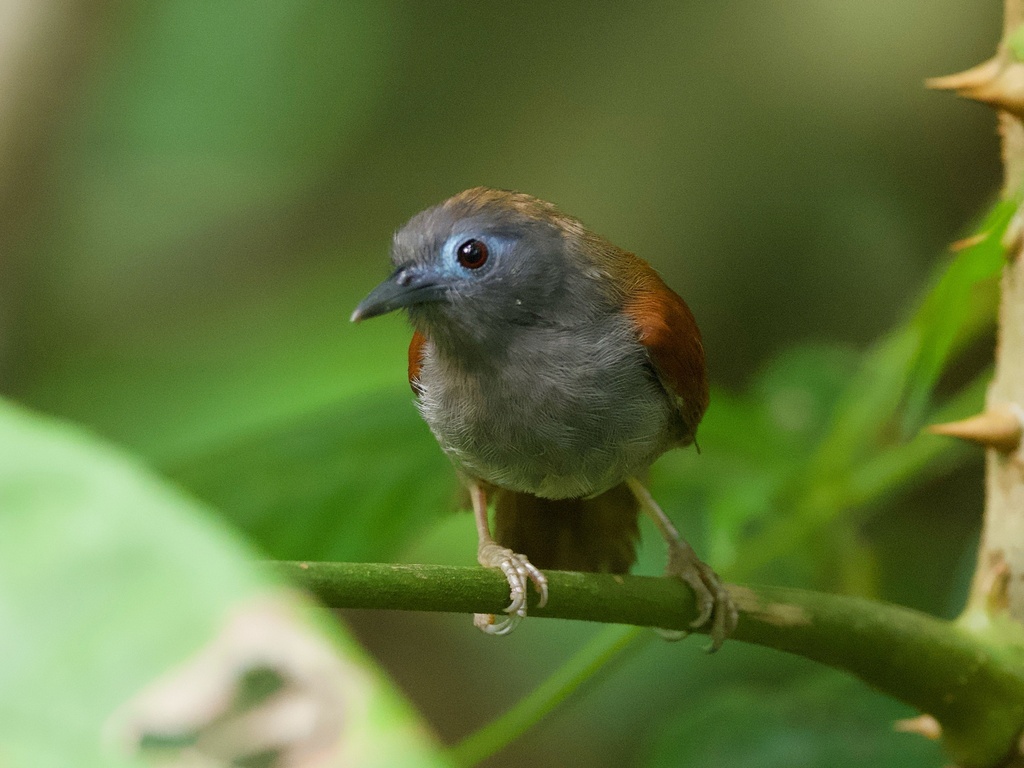
The chestnut-winged babbler is chestnut-brown with a greyish face and underparts, and is 12.5–13.5 cm (4.9–5.3 in) long. It feeds on small Coleoptera beetles, Phasmida insects, ants, and Hemiptera bugs. Its foraging strategy is gleaning. Timalia erythroptera was the scientific name proposed by Edward Blyth in 1842 for an olive-brown babbler from Nepal. It was later placed in the genus Stachyris, but since 2020 is recognised as a Cyanoderma species. The grey-hooded babbler (C. bicolor) of Borneo was formerly considered conspecific.
Range & habitat
The chestnut-winged babbler occurs in the Malay Peninsula from southern Thailand to Singapore, and in Sumatra. It inhabits forests and shrublands up to an elevation of 800 m (2,600 ft). It is listed as Least Concern on the IUCN Red List.
Wikipedia: “Distribution and habitat”
Listen
Looking for field recordings…
Where it lives
Recorded sightings
—
geo-referenced records in GBIF, from museums, herbaria and field observers.
Drag the globe to turn it. Dots are where records exist, not a range map; darker means more records.
In the stacks
Searching the stacks…
Every page naming Cyanoderma erythropterum in the Biodiversity Heritage Library →
This page is assembled live from iNaturalist, GBIF, Wikipedia, the Source Library and the Internet Archive. It is not yet part of the hand-edited codex. iNaturalist taxon 339781.