On eBird ↗
Green-backed Tailorbird
Live sightings near you, the range map, bar charts of when it is seen, and Macaulay Library photos and recordings.
Green-backed Tailorbird
Orthotomus chloronotus
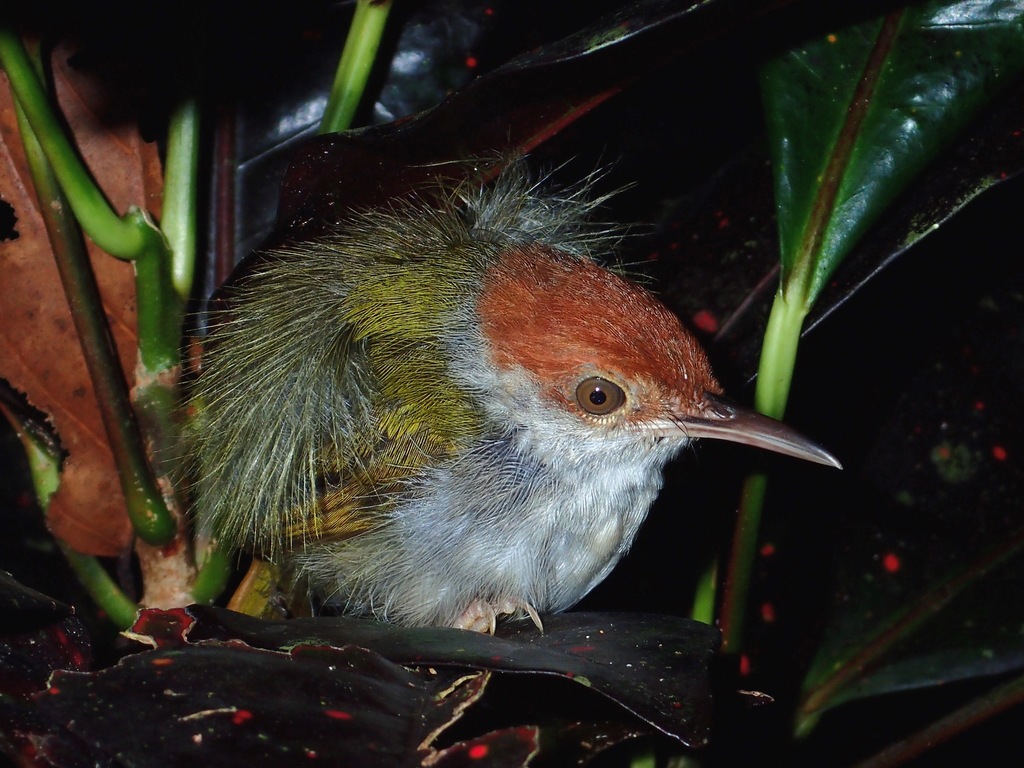
The green-backed tailorbird (Orthotomus chloronotus), also known as the trilling tailorbird, is a species of bird formerly placed in the "Old World warbler" assemblage, but now placed in the family Cisticolidae. The bird is endemic to the Philippines on the Northern side of the island of Luzon. Its natural habitats are tropical moist lowland forests, tropical mangrove forests and secondary growth.
From the article Green-backed tailorbird on Wikipedia (CC BY-SA), quoted section by section
Description
It was formerly conspecific with Philippine tailorbird but differentatied by its green back, darker underparts and stronger trilling call. This species is monotypic.
Range & habitat
It lives in lowland forest edge and clearings and also agricultural land and any secondary growth with tangled undergrowths up to 1,060 meters above sea level. IUCN Red List has assessed this as least-concern as it is tolerant, if not more suited to degraded habitat.
== References ==
Wikipedia: “Habitat and conservation status”
What it does
It is known to feed on small invertebrates. Usually seen foraging in dense undergrowth, typically in pairs. Breeding season believed to be at least in March to May. Nest is typically placed 2 to 10 meters above the ground on the tip of a branch or leaf of a fern. Like all tailorbirds, nest is complex and sown together to form a pouch. Lays 2 to 3 eggs which are white with reddish and brown spots.
Wikipedia: “Ecology and behavior”
Listen
Looking for field recordings…
Where it lives
Recorded sightings
—
geo-referenced records in GBIF, from museums, herbaria and field observers.
Drag the globe to turn it. Dots are where records exist, not a range map; darker means more records.
In the stacks
Searching the stacks…
Every page naming Orthotomus chloronotus in the Biodiversity Heritage Library →
This page is assembled live from iNaturalist, GBIF, Wikipedia, the Source Library and the Internet Archive. It is not yet part of the hand-edited codex. iNaturalist taxon 339744.