On eBird ↗
Black Sicklebill
Live sightings near you, the range map, bar charts of when it is seen, and Macaulay Library photos and recordings.
Black Sicklebill
Epimachus fastosus
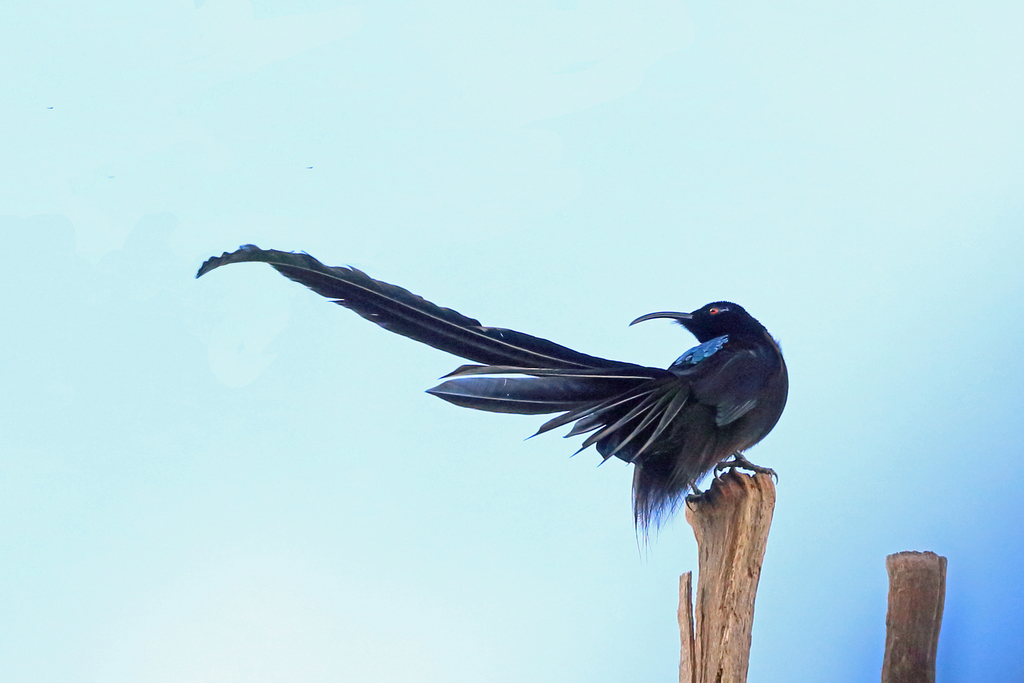
The black sicklebill (Epimachus fastosus) is a large member of the birds of paradise family, Paradisaeidae. This species is found throughout most of central New Guinea and the Vogelkop region to the northwest in montane forests at altitudes from 1,800 to 2,150 m (5,900 to 7,100 ft).
From the article Black sicklebill on Wikipedia (CC BY-SA), quoted section by section
Description
As the second-longest bird of paradise species (behind the ribbon-tailed astrapia), the black sicklebill measures about 110 cm (43 in) in length if the tail is included, and around 24 in (61 cm) without the tail. The female is around 21 in (53 cm) in length. The black sicklebill is a very bizarre species of bird of paradise. The male has a black head with a long, silver, slightly downcurved bill (not as downcurved as Drepanornis sicklebills), a bright yellow mouth, and scarlet-red eyes which are surrounded by iridescent scaly feathers of typically blue-greenish color that cover most of the front of the face. The rest of the head, including the neck, is jet black. The back is jet black, but is mostly covered with iridescent scale-like feathers with metallic blue color, but can be concluded as greenish-blue in some lights. His wings are black with a less conspicuous bluish iridescence. The greatly exaggerated tail is jet black with a more visible blue iridescence, more notable at the center. On its underside, he has very soft, almost silky brownish-black plumage that ends in relatively elongated flank plumes that extend slightly past the tail, but these plumes are more pronounced in the brown sicklebill. Typically hidden when perched, the males' most splendid ornaments are two glorious pectoral fans on each side of the breast. …
What it does
Black sicklebills, like many of their relatives, are primarily omnivorous, feeding on fruits, insects, and other animal prey. Unlike most mostly frugivorous cousins, it tends to feed on both items at an equal proportion. It typically feeds solitarily, but mixed foraging flocks are not abnormal.
Wikipedia: “Feeding”
In human culture
The species' scientific name is Epimachus fastosus. Epimachus, its generic name, means "equipped for battle", referring to this genus' machine gun-sounding calls. Its specific name, fastosus, means "proud". For its subspecies, atratus means "black", ultimus means "final" (probably referring to this subspecies as the last one discovered for this species), and stresemanni honors the German naturalist, Erwin Stresemann.
Wikipedia: “Etymology”
Listen
Looking for field recordings…
Where it lives
Recorded sightings
—
geo-referenced records in GBIF, from museums, herbaria and field observers.
Drag the globe to turn it. Dots are where records exist, not a range map; darker means more records.
In the old herbals & bestiaries


In the stacks
Searching the stacks…
Every page naming Epimachus fastosus in the Biodiversity Heritage Library →
This page is assembled live from iNaturalist, GBIF, Wikipedia, the Source Library and the Internet Archive. It is not yet part of the hand-edited codex. iNaturalist taxon 339687.