On eBird ↗
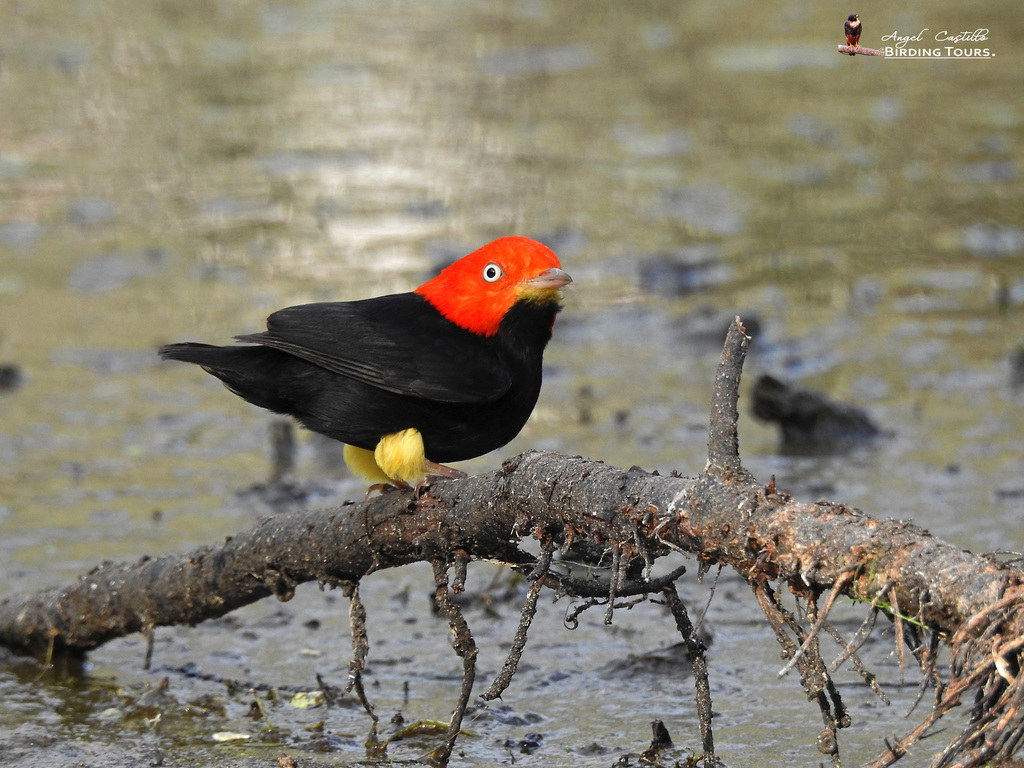
Red-capped Manakin
Live sightings near you, the range map, bar charts of when it is seen, and Macaulay Library photos and recordings.
Red-capped Manakin
Ceratopipra mentalis
The red-capped manakin (Ceratopipra mentalis) is a species of bird in the Pipridae family. It is found in Belize, Colombia, Costa Rica, Ecuador, Guatemala, Honduras, Mexico, Nicaragua, Peru and Panama. Its natural habitat is subtropical or tropical moist lowland forests.
From the article Red-capped manakin on Wikipedia (CC BY-SA), quoted section by section
Description
The red-capped manakin is a small passerine, measuring 4 in (10 cm) in length and weighing 16 g (0.56 oz). The male is velvety black apart from a bright red head and nape, bright yellow thighs, and a pale yellow chin and wing linings. The female is olive green above, with paler, more yellow-green underparts. Both sexes have dull brown legs. The male's irides are white, while those of the female and young are brown. While the adult male is distinctive, the female and youngsters can be confused with several similar species. The male golden-collared manakin is larger, and has orange (rather than brown) legs, while the female velvety manakin is a brighter green (rather than olive).
Range & habitat
Found primarily in humid forest and second growth woodland, the red-capped manakin typically occurs below 400–500 m (1,300–1,600 ft) above sea level, though it sometimes ranges as high as 900 m (3,000 ft). Most are resident, but some individuals are known to migrate to take advantage of changing food resources: the number of red-capped manakins caught in mist nets at La Selva Biological Reserve, in eastern Costa Rica, tripled in January and February, when a favored fruit ripened, for example, while the number caught at a nearby higher elevation site (where the fruits were not found) dropped to zero.
Wikipedia: “Habitat and range”
What it does
The red-capped manakin is a frugivore, feeding almost exclusively on fruits. These pass very quickly through the bird's digestive system, typically taking less than 18 minutes to process. The manakins ability to process large quantities of fruit have evolved to be fast due to experiencing certain seasons where there is not an abundant amount of fruits. Therefore, they had to consume large volumes of food to get the nutrients they need. Seeds from a variety of plants are consumed; one study in Costa Rica found evidence of 70 species, including those from the genera Clidemia, Hampea, Henriettea, Leandra, Miconia, Ossaea, Pinzona and Psychotria, in the fecal droppings of red-capped manakins.
Wikipedia: “Food and feeding”
Listen
Looking for field recordings…
Where it lives
Recorded sightings
—
geo-referenced records in GBIF, from museums, herbaria and field observers.
Drag the globe to turn it. Dots are where records exist, not a range map; darker means more records.
In the stacks
Searching the stacks…
Every page naming Ceratopipra mentalis in the Biodiversity Heritage Library →
This page is assembled live from iNaturalist, GBIF, Wikipedia, the Source Library and the Internet Archive. It is not yet part of the hand-edited codex. iNaturalist taxon 339673.