On eBird ↗
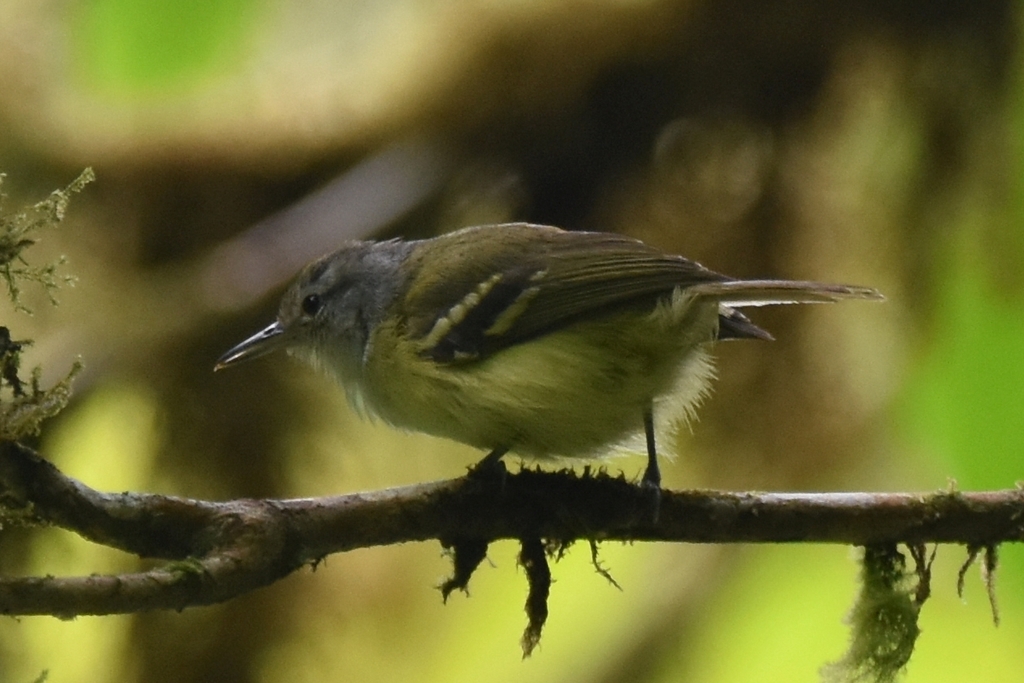
Rufous-rumped Antwren
Live sightings near you, the range map, bar charts of when it is seen, and Macaulay Library photos and recordings.
Rufous-rumped Antwren
Euchrepomis callinota
The rufous-rumped antwren (Euchrepomis callinota) is a species of bird in subfamily Euchrepomidinae of family Thamnophilidae, the "typical antbirds". It is found in Colombia, Costa Rica, Ecuador, French Guiana, Guyana, Panama, Peru, Suriname, and Venezuela.
From the article Rufous-rumped antwren on Wikipedia (CC BY-SA), quoted section by section
Description
The rufous-rumped antwren is 10 to 12 cm (3.9 to 4.7 in) long and weighs about 7 to 9.5 g (0.25 to 0.34 oz). It is small, slender, and long-tailed, and somewhat resembles a greenlet or New World warbler. The sexes have different plumage. Adult males of the nominate subspecies E. c. callinota have blackish lores and line through the eye on an otherwise pale gray face. Their crown and nape are black, their upper back olive, their lower back and rump bright rufous or orange brown, and their uppertail coverts olive. Their tail is dusky with olive edges on the feathers. Their wing coverts are slate gray with pale yellow tips that form two bars on the closed wing; their flight feathers are dusky with olive edges. Their throat and breast are pale gray and their belly and undertail coverts are pale yellow-green. Adult females have a brownish olive crown and grayish olive sides of their head. In both sexes, their iris is brown or dark brown, their maxilla black, their mandible shades of gray with a black tip, and their legs and feet bluish gray or gray. Subspecies E. c. peruviana is very similar to the nominate but their lower breast has a yellowish green tinge giving a gradual transition from the gray breast to the yellow-green belly. Subspecies E. c. venezuelana is known well only from the holotype, a female. …
Range & habitat
The rufous-rumped antwren has a highly disjunct distribution. The nominate subspecies is by far the most widespread and has several separate populations. The northernmost is found on the eastern slope of the Cordillera de Talamanca in Costa Rica and Panama. The others are found in the Serranía del Darién and Santander department, south on the west slope of the Andes into Ecuador as far as El Oro Province, and on the east slope of the Andes from Sucumbíos Province in Ecuador south into northern Peru's Cajamarca and Amazonas departments. Subspecies E. c. peruviana is found south of the Marañón River in central and southeastern Peru between the departments of San Martín and Cuzco. E. c. venezuelana is found in the Serranía del Perijá that straddles the Colombia-Venezuela border and in the Andes of the Venezuelan states of Mérida and Barinas. E. c. guianensis is found in southern Guyana, central Suriname, and central French Guiana. The rufous-rumped antwren inhabits the interior and edges of humid foothill and montane forest. In elevation it ranges between 700 and 1,200 m (2,300 and 3,900 ft) in Costa Rica, between 700 and 2,500 m (2,300 and 8,200 ft) in Colombia, and between 900 and 1,800 m (3,000 and 5,900 ft) in Ecuador. In most of Peru it ranges between 1,050 and 2,000 m (3,400 and 6,600 ft) but occurs between 750 and 1,000 m (2,500 and 3,300 ft) in Cuzco.
Wikipedia: “Distribution and habitat”
What it does
The rufous-rumped antwren feeds on arthropods, though details of its diet are lacking. It typically forages in pairs that usually join mixed-species feeding flocks. It forages almost entirely in the forest canopy, acrobatically gleaning prey from leaves and sticks.
Wikipedia: “Feeding”
Listen
Looking for field recordings…
Where it lives
Recorded sightings
—
geo-referenced records in GBIF, from museums, herbaria and field observers.
Drag the globe to turn it. Dots are where records exist, not a range map; darker means more records.
In the stacks
Searching the stacks…
Every page naming Euchrepomis callinota in the Biodiversity Heritage Library →
This page is assembled live from iNaturalist, GBIF, Wikipedia, the Source Library and the Internet Archive. It is not yet part of the hand-edited codex. iNaturalist taxon 339634.