On eBird ↗
Mindoro Boobook
Live sightings near you, the range map, bar charts of when it is seen, and Macaulay Library photos and recordings.
Mindoro Boobook
Ninox mindorensis
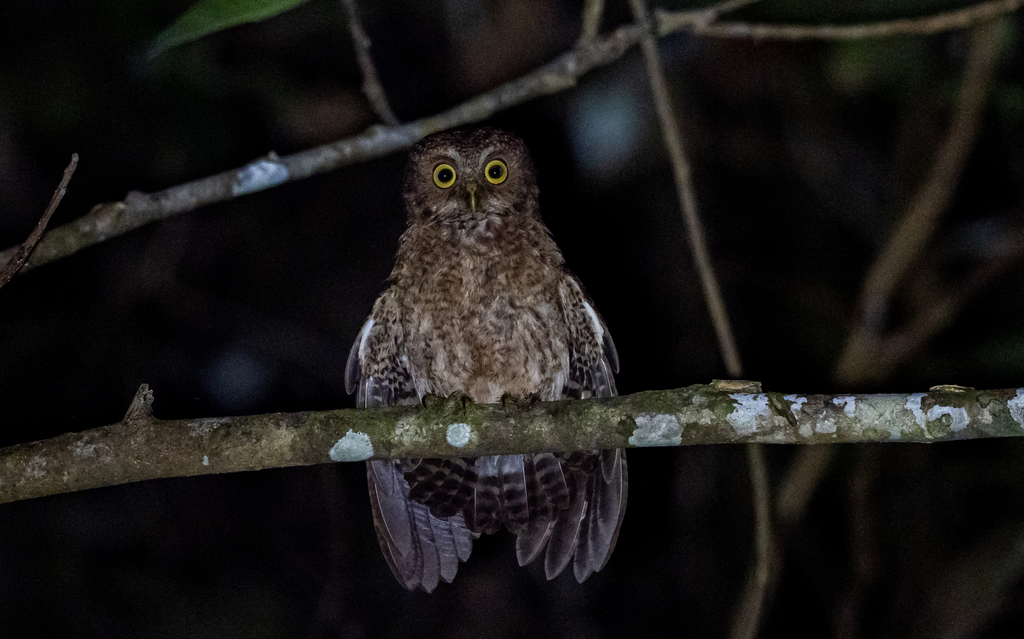
The Mindoro boobook or Mindoro hawk-owl (Ninox mindorensis) is a species of owl in the family Strigidae that is endemic to the Philippines found in the island of Mindoro. Its habitat is the tropical lowland rainforests. It is threatened and declining due to deforestation.
From the article Mindoro boobook on Wikipedia (CC BY-SA), quoted section by section
Description
The Romblon boobook is a medium sized owl found in the forests of Mindoro. It is predominantly dark brown on its head and cback and has a lighter reddish brown color on its chest and sometimes has white vertical streaking. Its wings are mottled brown with a white scapular. It has very fine barring on its mantle, chest and vent. It has dull olive-yellow eyes. The Mindoro boobook is an earless species. The males and females look much alike. Its call is described as a long series of mournful whistles that end in a screech. Along with the Camiguin boobook, Romblon boobook, Cebu boobook,Luzon boobook and Mindanao boobook, it was once part of the Philippine hawk-owl species complex but these species were split in 2012 due to physical and vocal differences. Among the complex, it is distinguished by the fine barring on its head and belly and its overall darker plumage. It is medium-sized at 20cm tall, along with the Sulu boobook, in the Philippine hawk-owl species complex. This is in between the larger Camiguin boobook, Romblon boobook and Cebu boobook at 25cm and the smaller Luzon boobook and Mindanao boobook which are 15 to 18cm tall.
Wikipedia: “Description and taxonomy”
Range & habitat
Its habitat is in tropical moist lowland primary and secondary forests up to 1250 meters above sea level. It is also occasionally seen on forest edges, clearings and plantations. The IUCN Red List classifies this bird as vulnerable with best estimates of population (as of 2024) as 2,500 to 9,999 mature individuals (range: 2,500 – 25,000). This species' main threat is habitat loss with wholesale clearance of forest habitats as a result of legal and illegal logging, mining, conversion into farmlands and urbanization. In 1988, just 120 km2 of forest remained on Mindoro, of which only 25% was closed-canopy. It occurs in a few protected areas in Mounts Iglit-Baco National Park (which is also the stronghold of the critically endangered Tamaraw) and Naujan Lake National Park. There is no species-specific conservation program at present, but conservation actions proposed include more species surveys to better understand habitat and population, initiating education and awareness campaigns to raise the species' profile and instill pride in locals, and lobbying for protection of the remaining forest.
Wikipedia: “Habitat and conservation status”
What it does
This species ecology has yet to be properly studied but it is pressumed to have a typical boobook diet of insects, small mammals, reptiles, amphibians and possibly even birds. Nothing is known about its breeding habits but is presumed to nest in tree cavities like other boobooks.
Wikipedia: “Ecology and behaviour”
Listen
Looking for field recordings…
Where it lives
Recorded sightings
—
geo-referenced records in GBIF, from museums, herbaria and field observers.
Drag the globe to turn it. Dots are where records exist, not a range map; darker means more records.
In the stacks
Searching the stacks…
Every page naming Ninox mindorensis in the Biodiversity Heritage Library →
This page is assembled live from iNaturalist, GBIF, Wikipedia, the Source Library and the Internet Archive. It is not yet part of the hand-edited codex. iNaturalist taxon 339611.