On eBird ↗
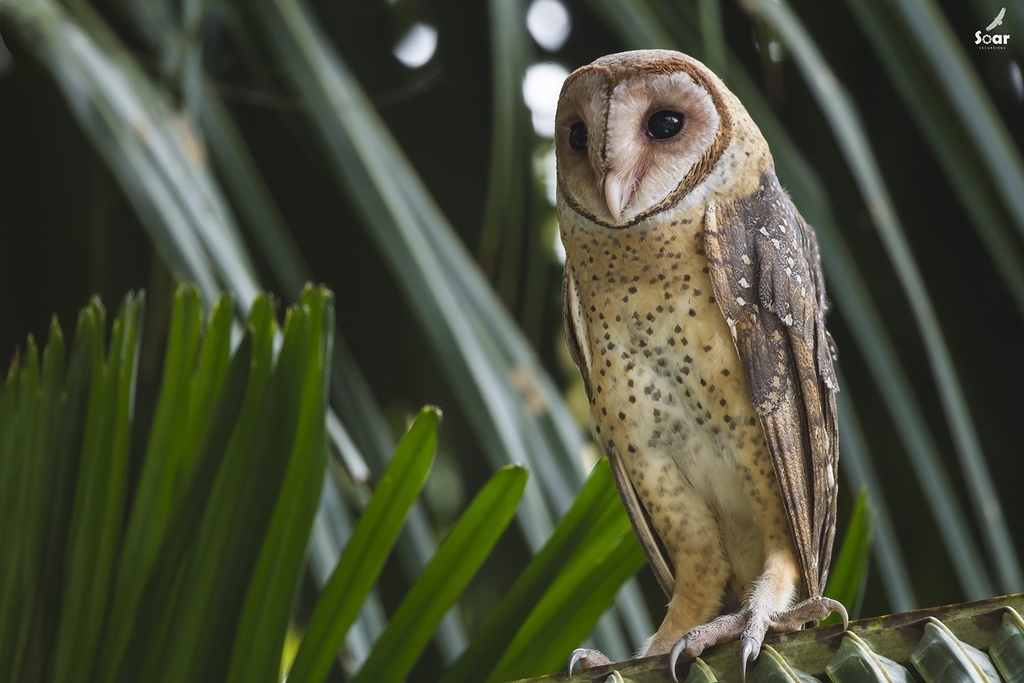
Andaman Masked-Owl
Live sightings near you, the range map, bar charts of when it is seen, and Macaulay Library photos and recordings.
Andaman Masked Owl
Tyto deroepstorffi
The Andaman masked owl (Tyto deroepstorffi) is a barn owl endemic to the southern Andaman Islands archipelago of India, in the Bay of Bengal, Indian Ocean. Regarded by some authors as a subspecies of the common barn owl (Tyto alba), it is recognized by others as a species in its own right.
From the article Andaman masked owl on Wikipedia (CC BY-SA), quoted section by section
Description
The Andaman masked owl has a length of between 30 and 36 cm (12 and 14 in) from head to tail, with the tail being 11 cm (4.3 in) from its base. The longest primary measures 25-26 cm. It is almost uniformly dark reddish-brown above, with some speckling of buffish-orange, and a more yellowish torso than the common barn owl. The facial disc is pale, reddish-buff with a distinctive orange-brown margin. The eyes are blackish and the beak is creamy-white. The breast is golden-brown with blackish spots, paling towards the belly, which is whitish. The legs are fully feathered to near the feet. The toes are greyish-pink and the claws purplish-grey. The voice has been described as a rather high-pitched, short, rasping, descending shriek which terminates abruptly and is repeated several times.
Range & habitat
The Andaman masked owl is known only from the southern Andaman Islands. It occurs on the coastal plain, in fields and gardens with trees, and in human settlements. It is not thought to be migratory.
Wikipedia: “Distribution and habitat”
What it does
Little is known of the habits of this owl but they are likely to be similar to those of other related species. It is nocturnal, roosting during the day and emerging at dusk. It feeds on small rodents, and the bones of mice and rats have been found in regurgitated pellets beneath roosting places. It probably nests in cavities but details of its breeding habits are not known.
== References ==
Wikipedia: “Ecology”
Listen
Looking for field recordings…
Where it lives
Recorded sightings
—
geo-referenced records in GBIF, from museums, herbaria and field observers.
Drag the globe to turn it. Dots are where records exist, not a range map; darker means more records.
In the stacks
Searching the stacks…
Every page naming Tyto deroepstorffi in the Biodiversity Heritage Library →
This page is assembled live from iNaturalist, GBIF, Wikipedia, the Source Library and the Internet Archive. It is not yet part of the hand-edited codex. iNaturalist taxon 339603.