- Plants
- ›Vascular Plants
- ›flowering plants
- ›Dicots
- ›Legumes, Milkworts, and Allies
- ›Legumes
- ›Faboideae
- ›Millettieae
- ›Millettia
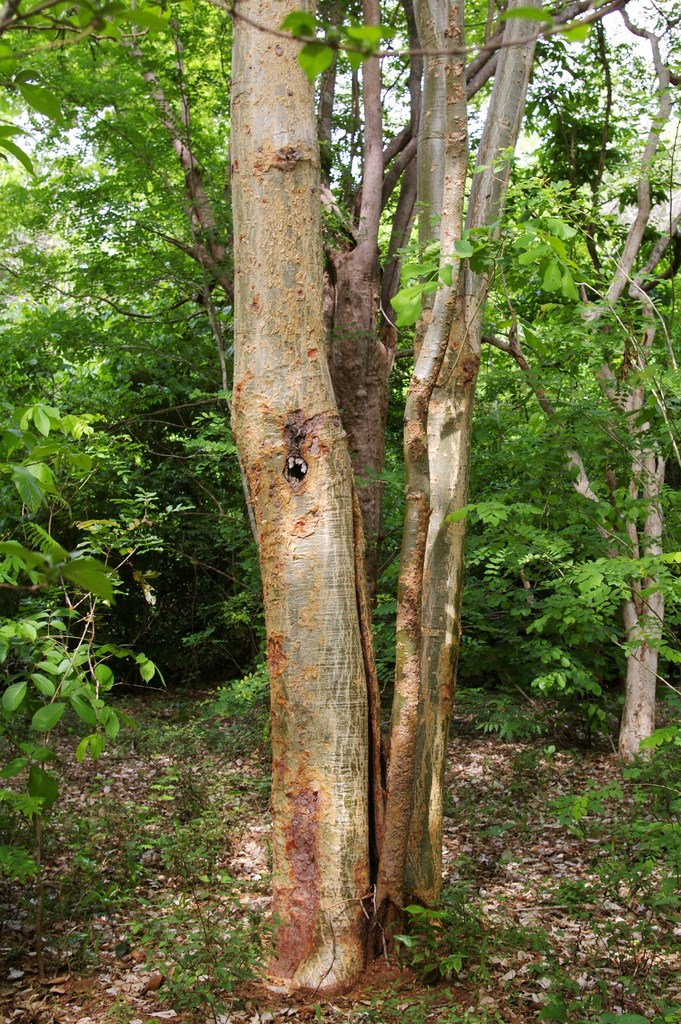
panga-panga
Millettia stuhlmannii
Millettia stuhlmannii, commonly known as panga panga, is a well-known species of timber tree that is native to the southeastern Afrotropics. The alternative name partridge wood refers to the light and dark patterns of its heartwood, which is said to form ‘partridge-breast’ figures. The wood of the tropical species M. laurentii has similar qualities and uses, but is slightly darker, and lacks the copious yellowish white resin of the heartwood vessels. Its foliage is similar to...
From the article Millettia stuhlmannii on Wikipedia (CC BY-SA), quoted section by section
Description
The large compound leaves are greenish above and bluish green below, with one terminal and 7 to 9 pairs of opposite leaflets. It is deciduous, with the foliage emerging before flowering time. The large, lilac flowers appear from November to January as seasonal rains commence, and are produced on long, pendulous racemes. The woody seed pods are flat and velvety, and release their seeds when they split open due to increasing torsion. The root nodules have a symbiotic relationship with rhizobial bacteria.
Range & habitat
It is found in southern Tanzania, eastern Zimbabwe, Mozambique and very locally in the Venda region of South Africa. Though locally common or even dominant, over-utilization may deplete many populations. Besides harvesting for timber, their numbers are also depleted by unsustainable harvesting of bark and roots, which are employed for medicinal and magical purposes.
Wikipedia: “Range and status”
Where it lives
Recorded sightings
—
geo-referenced records in GBIF, from museums, herbaria and field observers.
Drag the globe to turn it. Dots are where records exist, not a range map; darker means more records.
In the stacks
Searching the stacks…
Every page naming Millettia stuhlmannii in the Biodiversity Heritage Library →
This page is assembled live from iNaturalist, GBIF, Wikipedia, the Source Library and the Internet Archive. It is not yet part of the hand-edited codex. iNaturalist taxon 339372.