- Animals
- ›Arthropods
- ›Hexapods
- ›Insects
- ›Winged and Once-winged Insects
- ›Butterflies and Moths
- ›Bagworms, Clothes Moths, and Allies
- ›Fungus Moths, Clothes Moths, & Allies
- ›Nemapogoninae
- ›Nemapogon
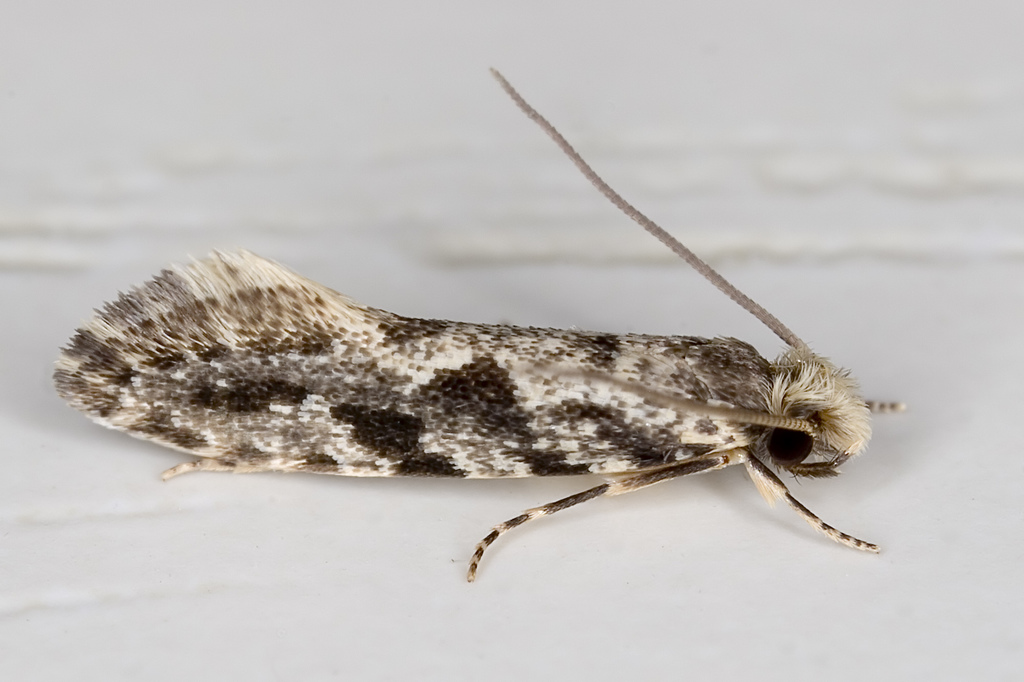
European grain moth
Nemapogon granella
Nemapogon granella (European grain worm or European grain moth) is a species of tineoid moth. It belongs to the fungus moth family (Tineidae), and therein to the subfamily Nemapogoninae. It is the type species of its genus Nemapogon, and via that also of the subfamily Nemapogoninae. It is also the type species of the proposed genera Brosis (as established by J. Hübner, a junior homonym and thus invalid) and Diaphthirusa, which are consequently junior objective synonyms of Nemapogon.
From the article Nemapogon granella on Wikipedia (CC BY-SA), quoted section by section
What it does
This moth ranges widely across the western Palearctic. However, even in its native range its distribution is somewhat patchy; in the UK for example, it is widespread, but may still be locally absent. It has not been recorded from France and Slovenia, but this may simply be due to its being overlooked or confused with similar species than being genuinely absent, as it is found in the neighboring countries. Its apparent absence from Iceland, on the other hand, is more likely genuine. But this synanthropic moth has been distributed essentially all over the globe, though many such introduced populations are not stable for long periods of time. Still, it is regularly found in Australia for example, about as far away from its native range as is possible on Earth. The adults are most often seen throughout the summer months, e.g. from March to September in the UK. Naturally, populations associated with humans can be encountered at any time of the year.
This small moth has a wingspan of 10–18 mm. The forewings are irregularly mottled black, white and grey, resembling close relatives such as the cork moth (N. cloacella). They have a row of large black spots on the leading edge, which merge with spots within the wing to form a rough band zigzagging along the length of the forewings. The hindwings are uniformly greyish-brown and surrounded by a fringe of long hairs. …
Wikipedia: “Ecology and description”
Listen
Looking for field recordings…
Where it lives
Recorded sightings
—
geo-referenced records in GBIF, from museums, herbaria and field observers.
Drag the globe to turn it. Dots are where records exist, not a range map; darker means more records.
In the stacks
Searching the stacks…
Every page naming Nemapogon granella in the Biodiversity Heritage Library →
This page is assembled live from iNaturalist, GBIF, Wikipedia, the Source Library and the Internet Archive. It is not yet part of the hand-edited codex. iNaturalist taxon 338579.