- Animals
- ›Arthropods
- ›Hexapods
- ›Insects
- ›Winged and Once-winged Insects
- ›Stick Insects
- ›Verophasmatodea
- ›Anareolatae
- ›Phasmatidae
- ›Phasmatinae
- ›Phasmatini
- ›Acrophylla
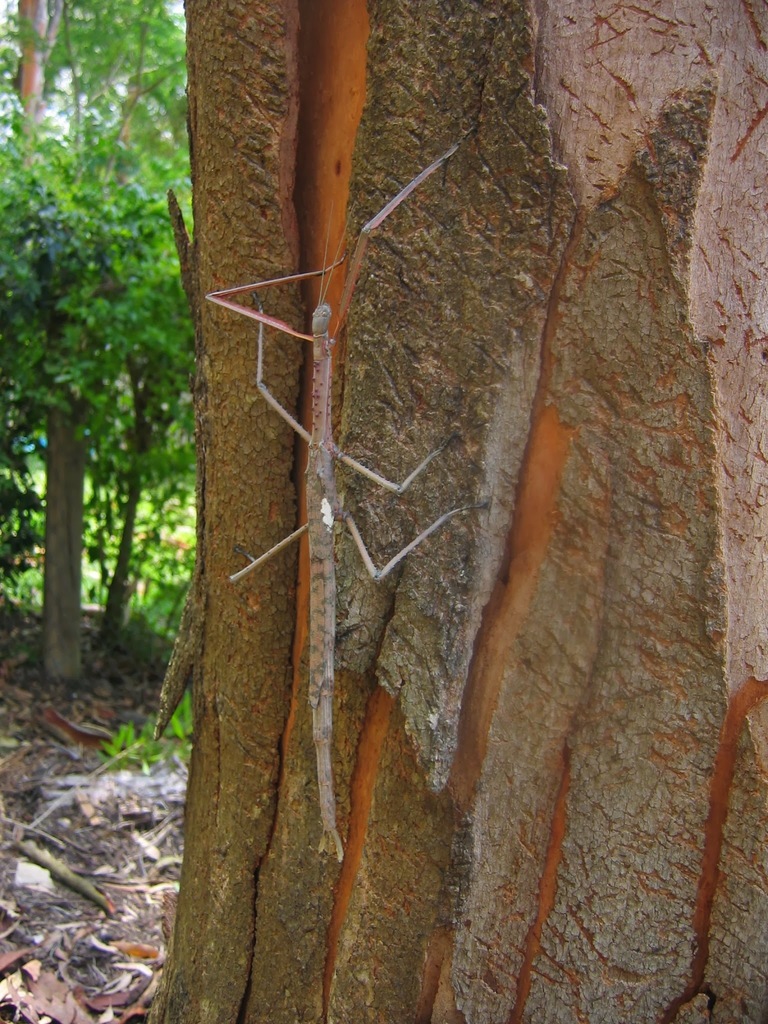
Titan Stick Insect
Acrophylla titan
Acrophylla titan, the titan stick insect, is the third-longest stick insect found in Australia. First described by William Sharp Macleay in 1826, it was considered to be the longest stick insect in the world until the discovery of Ctenomorpha gargantua.
It is native to south-east Queensland and New South Wales.
From the article Acrophylla titan on Wikipedia (CC BY-SA), quoted section by section
Description
Titan stick insects are pale brown-grey in color and can grow up to 26 centimetres (10 in) in body length. Their long, wavy cerci are a unique trait of the species. Males and females can be easily distinguished due to the females being larger and having sharp spines on the legs. Males are able to fly but females are flightless.
Breeding. A. titan breeds during winter/summer. During the mating process, the male connects his abdomen to the lower part of the female's egg compartment. Mating can take up to 40 minutes and is repeated several times. A single female will typically produce 200 to 1000 eggs in her lifetime. However, A. titan also holds the record for most eggs laid by a single phasmid due to one female laying over 2,050 eggs. The females then flick their eggs to the ground. The eggs look similar to those of the Children's stick insect (Tropidoderus childrenii) but they are black-grey with a small white growth. Ants pick them up and eat the growth, and leave the egg in the refinery where they hatch.
Listen
Looking for field recordings…
Where it lives
Recorded sightings
—
geo-referenced records in GBIF, from museums, herbaria and field observers.
Drag the globe to turn it. Dots are where records exist, not a range map; darker means more records.
In the stacks
Searching the stacks…
Every page naming Acrophylla titan in the Biodiversity Heritage Library →
This page is assembled live from iNaturalist, GBIF, Wikipedia, the Source Library and the Internet Archive. It is not yet part of the hand-edited codex. iNaturalist taxon 337432.