On eBird ↗
Eurasian Jackdaw
Live sightings near you, the range map, bar charts of when it is seen, and Macaulay Library photos and recordings.
Eurasian Jackdaw
Coloeus monedula
The western jackdaw (Coloeus monedula), also known as the Eurasian jackdaw, the European jackdaw, or simply the jackdaw, is a passerine bird in the crow family. It is found across Europe, western Asia and western North Africa; it is mostly resident, although northern and eastern populations migrate south in the winter. Four subspecies are recognised, which differ mainly in the darker or paler greyscale of the plumage on the head and nape. Linnaeus first described it formally, giving it the name Corvus monedula. The common name derives from the word jack, denoting "small", and daw, a less common synonym for "jackdaw", and the native English name for the bird.
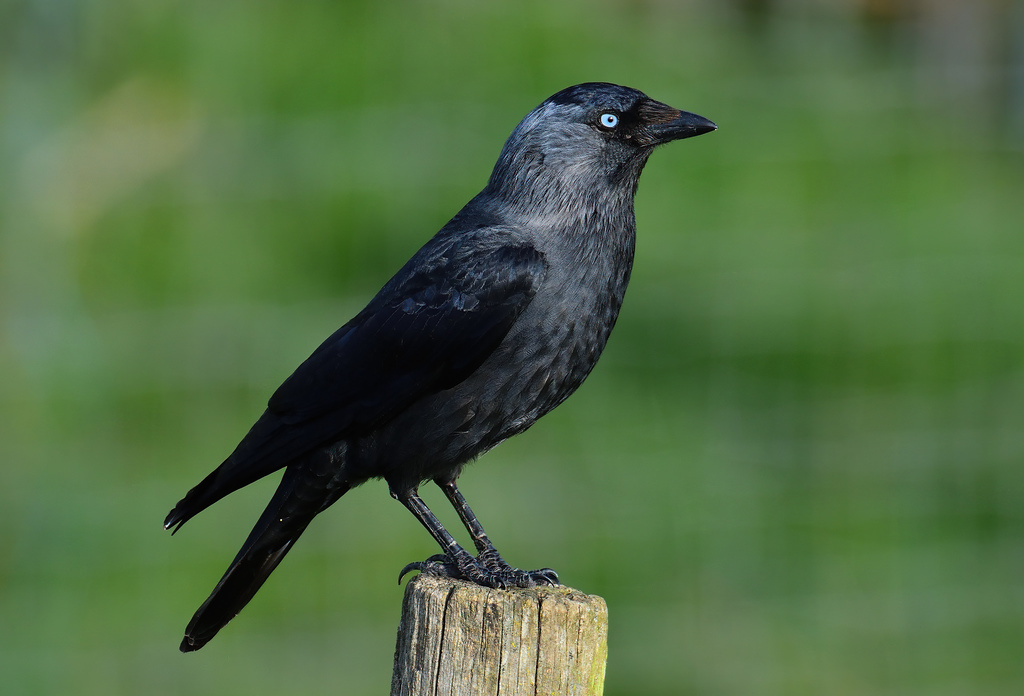
Measuring 34–39 centimetres (13–15 in) in length, the western jackdaw is a black-plumaged bird with a grey nape and distinctive pale iris. It is gregarious and vocal, living in small groups with a complex social structure in farmland, open woodland, on coastal cliffs, and in urban settings. Like its relatives, jackdaws are intelligent birds, and have been observed using tools. An omnivorous and opportunistic feeder, it eats a wide variety of plant material and invertebrates, as well as food waste from urban areas. Western jackdaws are monogamous and build simple nests of sticks in cavities in trees, cliffs, or buildings. About five pale blue or mint green eggs with brown to grey speckles are laid and incubated by the female. The young fledge in four to five weeks.
From the article Western jackdaw on Wikipedia (CC BY-SA), quoted section by section
Description
The western jackdaw measures 34–39 centimetres (13–15 in) in length and weighs around 240 grams (8.5 oz). Most of the plumage is a shiny black, with a purple (in subspecies monedula and spermologus) or blue (in subspecies cirtensis and soemmerringii) sheen on the crown, forehead, and secondaries, and a green-blue sheen on the throat, primaries, and tail. The cheeks, nape and neck are light grey to greyish-silver, and the underparts are slate-grey. The legs are black, as is the short stout bill, the length of which is about 75% of the length of the rest of the head. There are rictal bristles covering around 40% of the maxilla and 25% of the lower mandible. The irises of adults are greyish or silvery white while those of juveniles are light blue, becoming brownish before whitening at around one year of age. The sexes look alike, though the head and neck plumage of male birds fades more with age and wear, particularly just before moulting. Western jackdaws undergo a complete moult from June to September in the western parts of their range, and a month later in the east. The purplish sheen of the cap is most prominent just after moulting. Immature birds have duller and less demarcated plumage. The head is a sooty black, sometimes with a faint greenish sheen and brown feather bases visible; the back and side of the neck are dark grey and the underparts greyish or sooty black. …
Range & habitat
The western jackdaw is found from Northwest Africa through all of Europe, except for the subarctic north, and eastwards through central Asia to the eastern Himalayas and Lake Baikal. To the east, it occurs throughout Turkey, the Caucasus, Iran, Iraq, Afghanistan, Pakistan, and northwestern India. However, it is regionally extinct in Malta and Tunisia. The range is vast, with an estimated global extent between 1 and 10 million square kilometres (0.4–4 million square miles). It has a large global population, with an estimated 15.6 to 45 million individuals in Europe alone. Censuses of bird populations in marginal uplands in Great Britain show that western jackdaws greatly increased in numbers between the 1970s and 2010, although this increase may be related to recovery from previous periods when they were regarded as pests. The UK population was estimated at 2.5 million individuals in 1998, up from 780,000 in 1970.
Most populations are resident, but the northern and eastern populations are more migratory, relocating to wintering areas between September and November and returning between February and early May. Their range expands northwards into Russia to Siberia during summer and retracts in winter. They are vagrants to the Faroe Islands, particularly in the winter and spring, and occasionally to Iceland. …
Wikipedia: “Distribution and habitat”
What it does
Generally wary of people in the forest or countryside, western jackdaws are much tamer in urban areas. Highly gregarious, western jackdaws are generally seen in flocks of varying sizes, though males and females pair-bond for life and pairs stay together within flocks. Flocks increase in size in autumn and birds congregate at dusk for communal roosting, with up to several thousand individuals gathering at one site. At Uppsala, Sweden, 40,000 birds have been recorded at a single winter roost with mated pairs often settling together for the night. Western jackdaws frequently congregate with hooded crows or rooks, the latter particularly when migrating or roosting. They have been recorded foraging with the common starling (Sturnus vulgaris), Northern lapwing (Vanellus vanellus), and common gull (Larus canus) in northwestern England. Flocks are targets of coordinated hunting by pairs of lanner falcons (Falco biarmicus), although larger groups are more able to elude the predators. Western jackdaws sometimes mob and drive off larger birds such as European magpies, common ravens, or Egyptian vultures (Neophron percnopterus); one gives an alarm call which alerts its conspecifics to gather and attack as a group. …
Wikipedia: “Behaviour”
In human culture
The western jackdaw was one of the many species originally described by Carl Linnaeus in his 18th century work Systema Naturae. Owing to its supposed fondness for picking up coins, Linnaeus gave it the binomial name Corvus monedula, choosing the specific name mǒnēdŭla, which is derived from moneta, the Latin stem of the word "money". Jackdaws are now placed in the genus Coloeus, from the Ancient Greek κολοιός (koloios) for jackdaw, while most older works retained the two jackdaw species in Corvus. Old English had a wide range of words that could denote jackdaws, most of which were to some extent onomatopoeic, imitating the western jackdaw's call. Several, however, are first attested only in the names of places and people and might have denoted other corvids as well as or instead of jackdaws. The terms included cā (found, for example, in the place-names Cawood and Kaber, which in Scottish and north English dialects became ka or kae, and in more southerly accents co, coo, and coe) and cawe or cāwe. As many as three jackdaw-words seem to have derived from a proto-Indo-European root */gewH-/ meaning something like "call, cry out": ċēo and ċēawe (both no longer used), along with *ċēoh, which became modern English chough. …
Wikipedia: “Etymology”
Listen
Looking for field recordings…
Where it lives
Recorded sightings
—
geo-referenced records in GBIF, from museums, herbaria and field observers.
Drag the globe to turn it. Dots are where records exist, not a range map; darker means more records.
In the stacks
Searching the stacks…
Every page naming Coloeus monedula in the Biodiversity Heritage Library →
This page is assembled live from iNaturalist, GBIF, Wikipedia, the Source Library and the Internet Archive. It is not yet part of the hand-edited codex. iNaturalist taxon 336399.