- Plants
- ›Vascular Plants
- ›flowering plants
- ›Dicots
- ›Sunflowers, Bellflowers, Fanflowers, and Allies
- ›Sunflowers, Daisies, Asters, and Allies
- ›chicories, dandelions, and allies
- ›Lettuce, Chicory, Dandelion and Salsify Tribe
- ›Lettuce subtribe
- ›Cicerbita
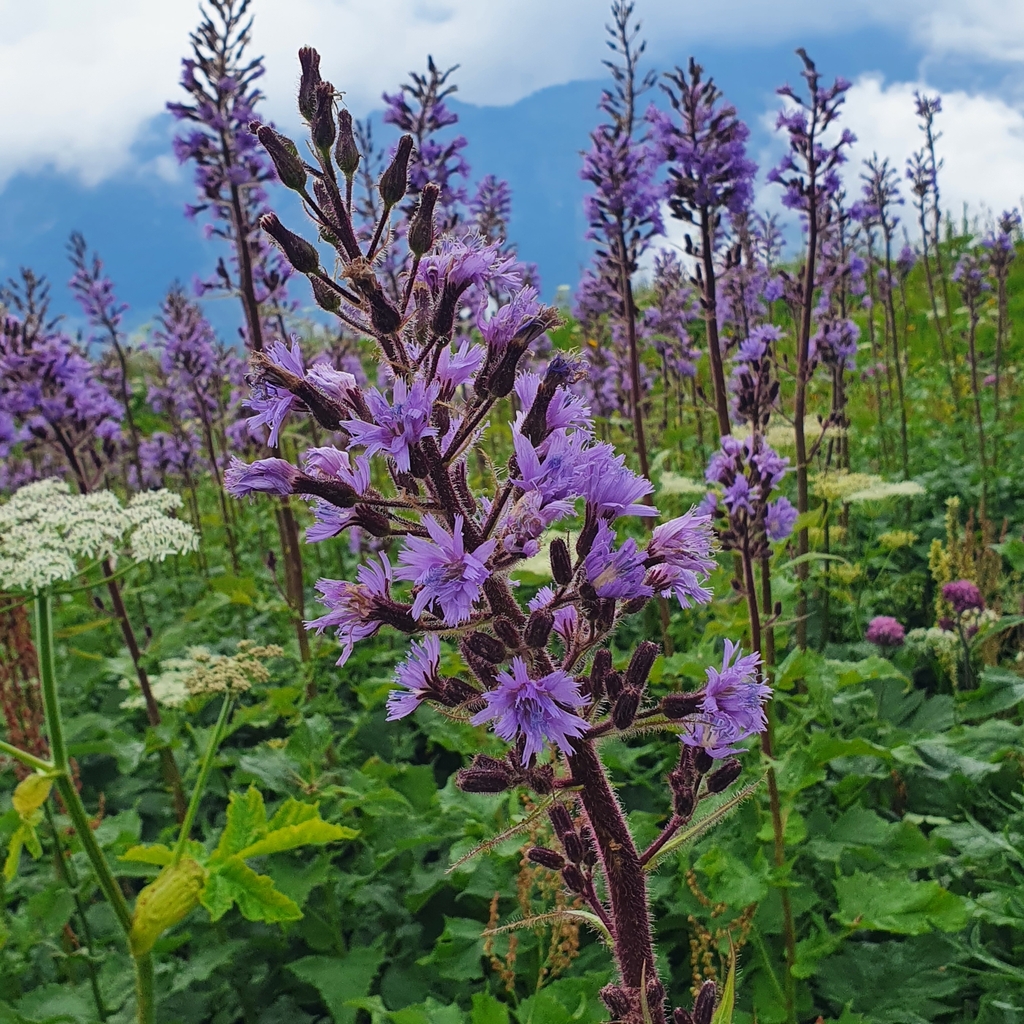
Alpine Blue-sow-thistle
Cicerbita alpina
Cicerbita alpina, commonly known as the alpine sow-thistle or alpine blue-sow-thistle is a perennial herbaceous species of plant sometimes placed in the genus Cicerbita of the Asteraceae family, and sometimes placed in the genus Lactuca as Lactuca alpina. It is native to upland and mountainous parts of Europe.
From the article Cicerbita alpina on Wikipedia (CC BY-SA), quoted section by section
Description
Cicerbita alpina on average reaches 80 centimetres (31 in) in height, with a minimum height of 50 cm (20 in) and a maximum height of 150 cm (59 in). The stem is erect and usually unbranched. It has glandular hairs and contains a white milky juice, a kind of latex. The alternate leaves are broad, triangular and clasping the stem, bluish-grey beneath, hairy along the veins and with toothed margins. The inflorescence is a panicle. Each composite flower is about 2.5 cm (1 in) wide and is set within a whorl of bracts. The individual blue-violet florets are tongue-like with a toothed, truncated tip, each having five stamens and a fused carpel. All the florets are ray florets; there are no disc florets. The seeds are clothed in unbranched hairs. The flowering period extends from June to September in the temperate northern hemisphere.
Range & habitat
Cicerbita alpina grows on many mountains of Europe (the Alps, the Pyrenees, the northern Apennines, the Scandinavian Peninsula, Scotland (where it is endangered and found in only four known locations), the Carpathians and the Urals. These plants can be found in alpine woods, besides streams, in rich-soil in hollows and in tall meadows, usually between 1,000 and 1,800 metres (3,280 and 5,910 ft) above sea level.
Conservation. It became a protected species in the UK in 1975 under the Conservation of Wild Creatures and Wild Plants Act.
Wikipedia: “Distribution and habitat”
What it does
In Finland, this plant is known as "bear-hay" because the Eurasian brown bear feeds on it, as do elk and reindeer. People also sometimes make use of it and eat it raw or cooked in reindeer milk.
Wikipedia: “Ecology”
Where it lives
Recorded sightings
—
geo-referenced records in GBIF, from museums, herbaria and field observers.
Drag the globe to turn it. Dots are where records exist, not a range map; darker means more records.
In the stacks
Searching the stacks…
Every page naming Cicerbita alpina in the Biodiversity Heritage Library →
This page is assembled live from iNaturalist, GBIF, Wikipedia, the Source Library and the Internet Archive. It is not yet part of the hand-edited codex. iNaturalist taxon 336295.