- Animals
- ›Arthropods
- ›Hexapods
- ›Insects
- ›Winged and Once-winged Insects
- ›Butterflies and Moths
- ›Geometrid and Swallowtail Moths
- ›Geometer Moths
- ›Ennominae
- ›Boarmiini
- ›Erannis
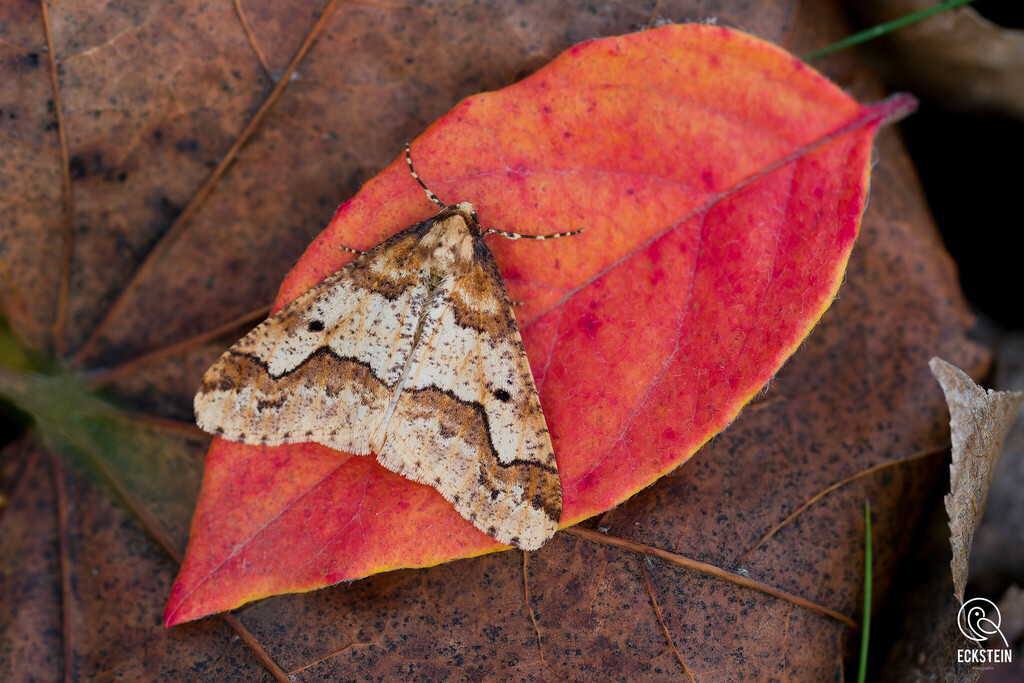
Mottled Umber
Erannis defoliaria
The mottled umber (Erannis defoliaria) is a moth of the family Geometridae. It is common throughout much of the Palearctic region. The species was first described by Carl Alexander Clerck in 1759.
From the article Mottled umber on Wikipedia (CC BY-SA), quoted section by section
Description
Only males of the species have wings, the female is completely wingless. Patterns on wings vary by specimen, the wingspan is 30-40mm. The adults fly from October to December in temperate climates.
Technical description and variation. The female of this species is wingless and rather spider-like and can be found on the trunks and stems of its larval food plants. She is white or yellow-and-black patched. The male is fully winged and very variable. The ground colour of the forewing is pale yellow or light yellow ochre and suffused dark grey. The basal and distal fasciae are dark brown. The basal fascia is bordered on the inner side by a brown cloud; the distal fascia has a brown cloud on the outer edge. There is also a brown cloud along the costa. There are two dark brown oblong spots in the upper half of the terminal area. The hindwing is grey white with grey suffusion. There is a grey-black discal spot on both wings. There are numerous and significant deviations from this colour pattern and some specimens are very dark. Truly melanic forms are also frequent. As with the peppered moth, the darker forms tend to be prevalent in industrial areas.
Range & habitat
The species can be found in western Europe from northern Scandinavia to the Mediterranean, then east to the Caucasus, northern Iran, Russia, Russian Far East, and Ussuri.
Wikipedia: “Distribution”
Listen
Looking for field recordings…
Where it lives
Recorded sightings
—
geo-referenced records in GBIF, from museums, herbaria and field observers.
Drag the globe to turn it. Dots are where records exist, not a range map; darker means more records.
In the stacks
Searching the stacks…
Every page naming Erannis defoliaria in the Biodiversity Heritage Library →
This page is assembled live from iNaturalist, GBIF, Wikipedia, the Source Library and the Internet Archive. It is not yet part of the hand-edited codex. iNaturalist taxon 335848.