On eBird ↗
Yellow-footed Green-Pigeon
Live sightings near you, the range map, bar charts of when it is seen, and Macaulay Library photos and recordings.
Yellow-footed Green Pigeon
Treron phoenicopterus
The yellow-footed green pigeon (Treron phoenicoptera), also known as yellow-legged green pigeon, is a common species of green pigeon found in the Indian subcontinent. It is the state bird of Maharashtra. In Marathi it is called Hariyal. The species feeds on fruit, including many species of Ficus. They forage in flocks. In the early morning they are often seen sunning on the tops of emergent trees in dense forest areas. They especially are found sitting in...
From the article Yellow-footed green pigeon on Wikipedia (CC BY-SA), quoted section by section
Description
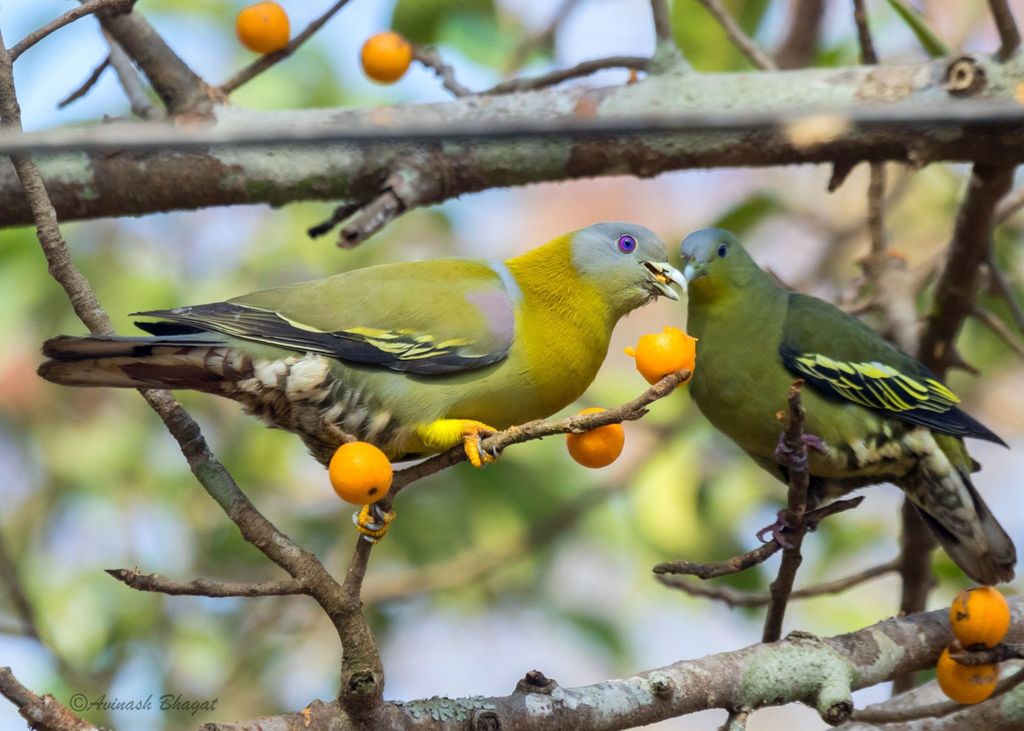
The yellow-footed green pigeon measures about 33 cm (13 in) long as an adult. Its plumage combines green, yellow, grey, and purple, creating a distinctive appearance. Its most noticeable feature is its bright yellow or yellow-orange legs and feet. Adults have a bluish-grey or greyish crown and nape, a yellowish-green forehead and throat, and a broad yellow or olive-yellow collar around the neck. Their upperparts appear pale greyish-green, while a noticeable mauve or purple patch covers the shoulder. The wings are dark with yellow edges, and the base of the tail has a yellow-green colour. Grey feathers form the end of the tail, while the undertail feathers range from purple to cinnamon-rufous.
Geographic Variation. The species also shows some geographic variation. Northern birds usually have greyish underparts, while southern birds tend to have more yellow-green underparts.
Sexual Dimorphism. The species is slightly sexually dimorphic as the male usually has brighter plumage than the female. Northern males have a strongly contrasting yellow-green forehead and throat, a grey cap and lower breast, olive-green upperparts, and a noticeable mauve shoulder patch. Their breast can also show stronger yellow-orange or golden colouring. …
Range & habitat
This species is extant in Pakistan, India, Nepal, Sri Lanka, Bangladesh, Bhutan, Myanmar, China, Thailand, Vietnam, Laos and Cambodia. The species occurs from the lowlands and up into foothill environments. The species has adapted surprisingly well to human-modified landscapes. The nominate subspecies, T. p. phoenicopterus, lives across northern South Asia. Its range extends from eastern Pakistan and northern India through the Himalayan foothills, the Gangetic Plain, Bangladesh, and Assam. A second subspecies, T. p. chlorigaster, lives across much of peninsular India, while a third subspaces, T. p. phillipsi, occurs in Sri Lanka. Other subspecies live in Myanmar, southwestern China, Thailand, Laos, and Vietnam.
Wikipedia: “Distribution and habitat”
What it does
The yellow-footed green pigeon is principally an arboreal frugivore. It prefers wooded areas with fruiting trees, especially fig trees (Ficus). They forage in flocks. They are habitat generalists: in the early morning, they are often seen sunning on the tops of emergent trees in dense forest areas, especially Banyan trees. It lives in tropical and subtropical forests, deciduous and semi-evergreen forests, and along forest edges. It also uses wooded farmland, orchards, village groves, gardens, and urban parks. Across much of South Asia, it has become a familiar bird around villages and cities where suitable trees remain. Historical accounts describe the same behavior. Dr. John Latham, drawing partly on observations from Dr. Francis Buchanan, wrote that the "Hurrial" lived in large fig trees and fed mainly on their fruit. He also noted that the birds stayed in the trees and rarely came to the ground.
Wikipedia: “Behavior and ecology”
At the table
Like many birds that Western scientists described during the colonial era, the yellow-footed green pigeon had local names and was familiar to people throughout its range long before European naturalists formally described it. In Assam, a historical ornithologist named E. C. Stuart Baker noted in his 1913 book Indian Pigeons and Doves that local names for it often overlapped with names used for the Wedge-tailed green pigeon and Pin-tailed green pigeon. According to Baker, people may have called the wedge-tailed green pigeon any of the following names: "Sang-pong" in Lepcha, "Daorep-galou" in Kachari, "Lumba-dum Kohhlu" in Hindi, "Bor Haitha" in Assamese, "Harial" in the language spoken in the Terai region at the time, and "Ngu" in Burmese. In Marathi, it is called "Haroli" or "Hariyal", and it is known as "Haitha" in Upper Assam and "Haitol" in Lower Assam.
Wikipedia: “Indigenous Names and Traditional Uses”
In human culture
The species name phoenicopterus comes from Greek words associated with crimson or red and wing, giving it the general meaning "red-winged" or "crimson-winged". This name refers to the bird's reddish-purple shoulder and wing feathers. The name Treron comes from the Greek word trērōn, a [timid] pigeon or dove.
Wikipedia: “Etymology”
Listen
Looking for field recordings…
Where it lives
Recorded sightings
—
geo-referenced records in GBIF, from museums, herbaria and field observers.
Drag the globe to turn it. Dots are where records exist, not a range map; darker means more records.
In the stacks
Searching the stacks…
Every page naming Treron phoenicopterus in the Biodiversity Heritage Library →
This page is assembled live from iNaturalist, GBIF, Wikipedia, the Source Library and the Internet Archive. It is not yet part of the hand-edited codex. iNaturalist taxon 3352.