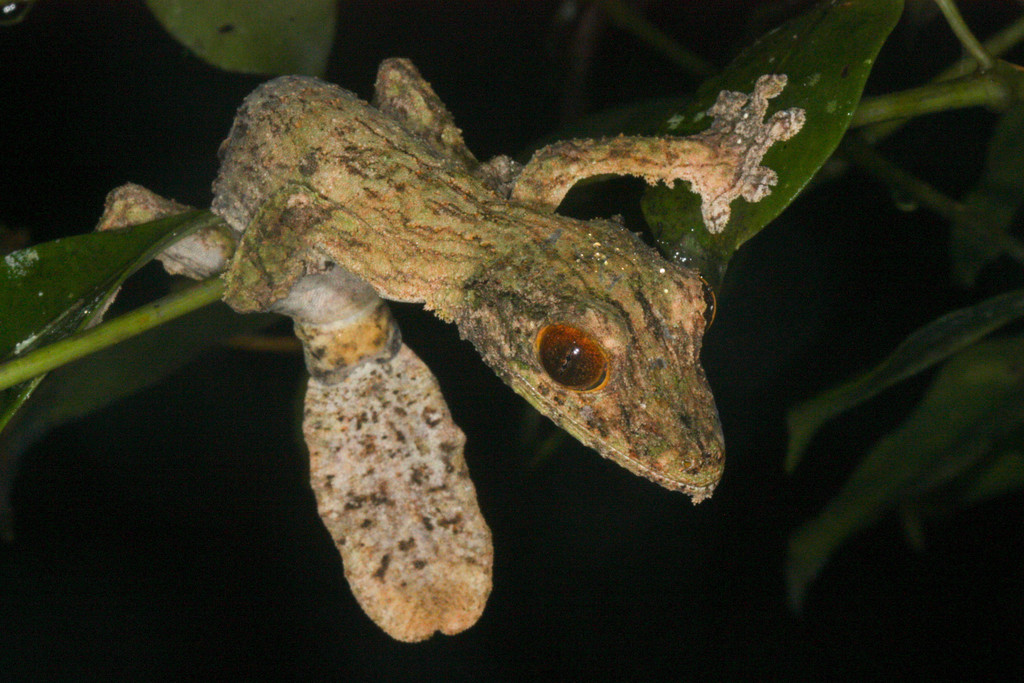
Mossy Leaf-tailed Gecko
Uroplatus sikorae
Uroplatus sikorae is a species of gecko commonly referred to as the mossy leaf-tailed gecko. This species, endemic to Madagascar, is found in primary and secondary forests on the island. It has the ability to change its skin color to match its surroundings and possesses dermal flaps which break up its outline when at rest.
From the article Uroplatus sikorae on Wikipedia (CC BY-SA), quoted section by section
Description
The mossy leaf-tailed gecko ranges in size from 15 to 20 centimetres (6 to 8 in) when measured from nose to base of the tail. Their eyes are large and lidless, and have yellow sclera with elliptical pupils, suited for the gecko's nocturnal habits. As with all Uroplatus geckos, the tail is dorso-ventrally flattened. U. sikorae has coloration developed as camouflage, most being grayish brown to black or greenish brown with various markings meant to resemble tree bark, down to the lichens and moss found on the bark. U. sikorae has flaps of skin, running the length of its body, head and limbs, known as the dermal flap, which it can lay against the tree during the day, scattering shadows, and making its outline practically invisible. Additionally, the gecko has a limited ability to alter its skin color to match its surroundings.
Range & habitat
Uroplatus sikorae is endemic to Madagascar. These geckos can be found in primary and secondary forests of the Eastern and central tropical forests of Madagascar.
Wikipedia: “Distribution and habitat”
What it does
Mossy leaf-tailed geckos are nocturnal and arboreal. These geckos rely on their natural camouflage as they dwell among the trees. They spend most of the daylight hours hanging vertically on tree trunks, head down, resting. During the night, they will venture from their daylight resting spots, and go off in search of prey. It has the ability to change its skin color to match its surroundings and possesses dermal flaps which break up its outline when at rest. Mossy leaf-tailed geckos are insectivores eating insects, arthropods, and gastropods.
Wikipedia: “Biology and behavior”
In human culture
The specific name, sikorae, is a Latinization of the surname of Franz Sikora, an Austrian fossil-hunter and explorer of Madagascar.
Wikipedia: “Etymology”
Where it lives
Recorded sightings
—
geo-referenced records in GBIF, from museums, herbaria and field observers.
Drag the globe to turn it. Dots are where records exist, not a range map; darker means more records.
In the stacks
Searching the stacks…
Every page naming Uroplatus sikorae in the Biodiversity Heritage Library →
This page is assembled live from iNaturalist, GBIF, Wikipedia, the Source Library and the Internet Archive. It is not yet part of the hand-edited codex. iNaturalist taxon 33517.