- Animals
- ›Arthropods
- ›Hexapods
- ›Insects
- ›Winged and Once-winged Insects
- ›Butterflies and Moths
- ›Pyralid and Crambid Snout Moths
- ›Crambid Snout Moths
- ›Pearl Moths
- ›Udeini
- ›Udea
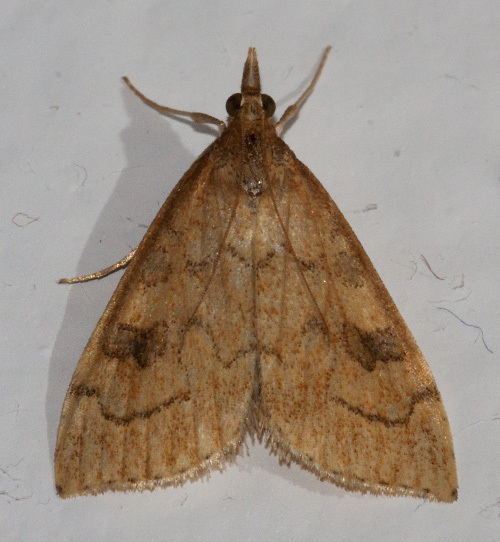
False Celery Leaftier
Udea profundalis
Udea profundalis is a moth in the family Crambidae. It was described by Packard in 1873. It is found in North America, where it has been recorded from British Columbia, through Washington, Oregon and Nevada to California and Texas. Records east of the Rocky Mountains, refer to Udea rubigalis.
The length of the forewings is 8.5–12 mm. Adults are deep ochreous-brown, the inner line on the forewings angulated outwards broadly on the median vein and inwards on the submedian. There is a large, round discal dot and a bell-shaped, reniform spot. The outer line is dark. The hindwings are primarily white
Listen
Looking for field recordings…
Where it lives
Recorded sightings
—
geo-referenced records in GBIF, from museums, herbaria and field observers.
Drag the globe to turn it. Dots are where records exist, not a range map; darker means more records.
In the stacks
Searching the stacks…
Every page naming Udea profundalis in the Biodiversity Heritage Library →
This page is assembled live from iNaturalist, GBIF, Wikipedia, the Source Library and the Internet Archive. It is not yet part of the hand-edited codex. iNaturalist taxon 335030.