- Animals
- ›Chordates
- ›Vertebrates
- ›Reptiles
- ›Snakes and Lizards
- ›Lizards
- ›Geckos
- ›Typical Geckos
- ›Calodactylodes
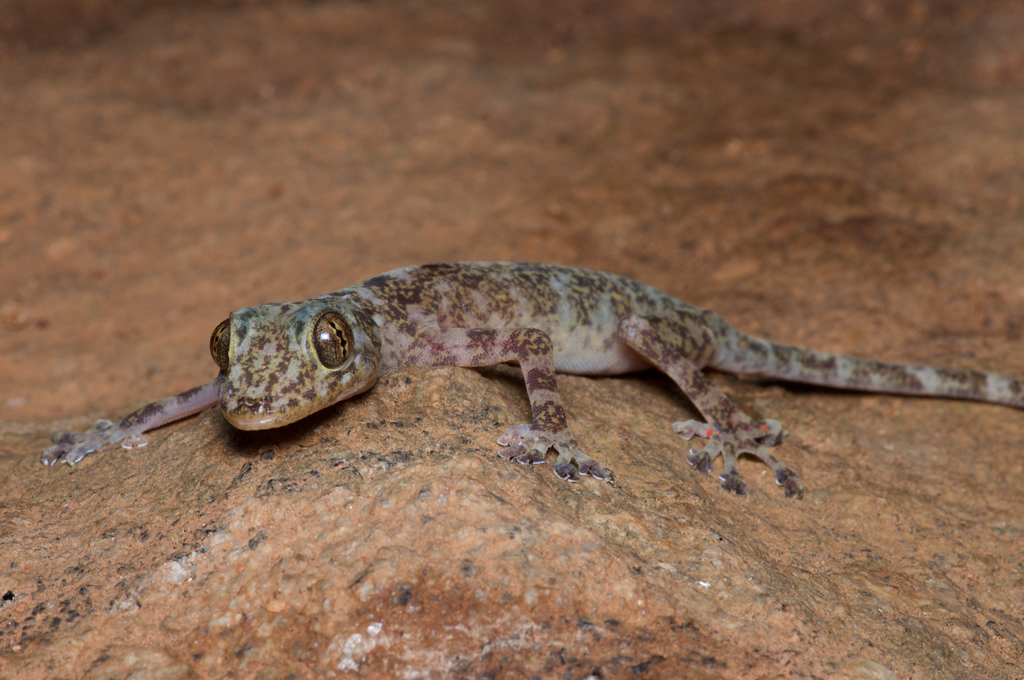
Sri Lankan Golden Gecko
Calodactylodes illingworthorum
Calodactylodes illingworthorum is a species of gecko, a lizard in the family Gekkonidae. The species is known only from the island of Sri Lanka. Common names for C. illingworthorum include the golden gecko, Illingworths' gecko, Illingworths' golden gecko, and the Sri Lankan golden gecko.
From the article Calodactylodes illingworthorum on Wikipedia (CC BY-SA), quoted section by section
Description
The head of C. illingworthorum is wider than the body. The pupil of the eye is vertical. There are two pairs of enlarged, nearly rectangular lamellae under each finger and toe. The tail has 27 segments. The dorsum is a yellow-ochre color with dark brown spots. The throat is either bright yellow or orange. The chest and venter are pale gray or yellow. There are 4 pre-anal pores and 4 to 10 femoral pores.
Range & habitat
A large, rock-dwelling gecko from the dry zone of Sri Lanka, C. illingworthorum is distributed in the monsoon forests of the eastern parts of the country, such as Namadagala, Monaragala, Nilgala, Gal Oya National Park, Buttala, and Ampara.
Wikipedia: “Habitat and geographic range”
What it does
C. illingworthorum inhabits rocky biotopes, such as granitic caves within savannah and monsoon forests. A single cave may house up to 50 individuals. Its diet comprises large insects, such as dipterans, coleopterans, their larvae, glow-worms, and other arthropods. Its call uttered throughout the day, and more commonly at dusk, is a harsh, chuckling note. It leaves its rock habitat by dusk to the adjoining vegetation for foraging and returns in the morning.
Wikipedia: “Ecology and diet”
In human culture
The specific name, illingworthorum, which is genitive plural, is in honor of Margaret and Percy Illingworth.
Wikipedia: “Etymology”
Where it lives
Recorded sightings
—
geo-referenced records in GBIF, from museums, herbaria and field observers.
Drag the globe to turn it. Dots are where records exist, not a range map; darker means more records.
In the stacks
This page is assembled live from iNaturalist, GBIF, Wikipedia, the Source Library and the Internet Archive. It is not yet part of the hand-edited codex. iNaturalist taxon 33492.