- Animals
- ›Arthropods
- ›Hexapods
- ›Insects
- ›Winged and Once-winged Insects
- ›Butterflies and Moths
- ›Hawk, Sphinx, Silk, Emperor, and Allied Moths
- ›Emperor and Giant Silk Moths
- ›Emperor Moths
- ›Saturniini
- ›Actias
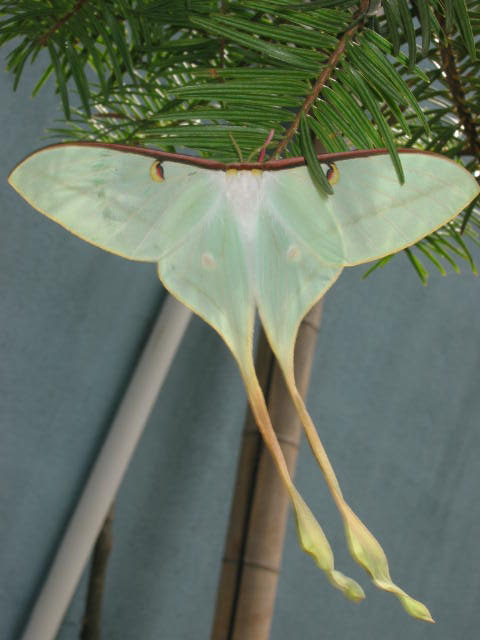
Chinese Moon Moth
Actias dubernardi
Actias dubernardi, the Chinese moon moth, is a moth of the family Saturniidae. The species was first described by Charles Oberthür in 1897.
From the article Actias dubernardi on Wikipedia (CC BY-SA), quoted section by section
Range & habitat
This moth can be found in the Mountainous Forests of Southeast Asia, including large parts of China, Vietnam, Laos, Thailand, and potentially Taiwan. Their habitats are very humid, and can get quite cold at night, or winter. The Cloud Forests they inhabit are located from 1000 m to 2500 m above sea level.
Wikipedia: “Range”
What it does
It takes 70–85 days to progress from an egg to the adult, depending on the temperature and humidity. The female releases pheromones that attracts the male so they can mate.
Egg. The female lays up to 120 eggs, and may place their eggs anywhere. The egg is oval-shaped, 1.5 by 1 millimetre (0.059 in × 0.039 in); whitish gray, and firmly stuck to branches or sides of the cage that the female had been kept in. Caterpillars, 4–5 millimetres (0.16–0.20 in) long, hatch after 10–14 days, the warmer and the higher the humidity, the quicker it happens.
Larva. The newly hatched larva is black with hairs. It sheds its skin four times in its larval stage. In the first instar, it is initially black but becomes a deep red-brown as it grows. In the second instar, it continues to lighten to an orange-brown. In the third instar, it changes into a beautiful green with white stripes and silver/gold metallic reflective markings on the sides of the tubercles. Above the thoracic segments there is a stripe of white, black and red which can be opened and closed to show or hide the aposematic colouration. It is hairy in all its stages, and it feeds on pine trees. The fully grown caterpillar is 60–75 millimetres (2.4–3.0 in) long. It spins its brownish silk cocoon on the ground among moss or among pine needles. They are easy to rear as long as they eat in their first instar, and disease is avoided. …
Wikipedia: “Life cycle”
Listen
Looking for field recordings…
Where it lives
Recorded sightings
—
geo-referenced records in GBIF, from museums, herbaria and field observers.
Drag the globe to turn it. Dots are where records exist, not a range map; darker means more records.
In the stacks
Searching the stacks…
Every page naming Actias dubernardi in the Biodiversity Heritage Library →
This page is assembled live from iNaturalist, GBIF, Wikipedia, the Source Library and the Internet Archive. It is not yet part of the hand-edited codex. iNaturalist taxon 334917.