- Animals
- ›Arthropods
- ›Hexapods
- ›Insects
- ›Winged and Once-winged Insects
- ›Butterflies and Moths
- ›Tortricid Leafroller Moths and Allies
- ›Tortricid Leafroller Moths
- ›Olethreutine Leafroller Moths
- ›Olethreutini
- ›Paralobesia
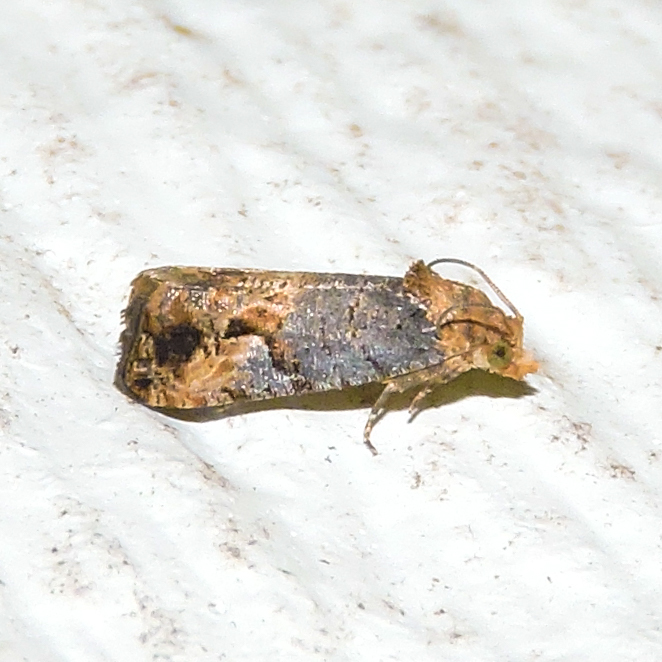
Grape Berry Moth
Paralobesia viteana
Paralobesia viteana, the grape berry moth, is a moth of the family Tortricidae, found in Eastern North America and western Colorado, where it is an important agricultural pest in vineyards. The synonym Endopiza viteana is frequently used in literature, but was replaced by Paralobesia viteana per J.W. Brown (2006).
From the article Paralobesia viteana on Wikipedia (CC BY-SA), quoted section by section
Range & habitat
Paralobesia viteana is native to Eastern North America, with wild grape as ancestral host plant. In recent times, it has also been observed in western Colorado. The primary host plant in both areas is grape (Vitis spp.), both wild and cultivated variations, though documentation of P. viteana on other host plants, including sassafras and blackberry, exists. Because of the damage done by the larvae when feeding from the grape berries and blossoms, P. viteana is considered to be one of the worst insect pests on grape berries in the Eastern North American bioregion.
Wikipedia: “Range and host plants”
What it does
Depending on weather and location, P. viteana occurs in two to four generations per year, with generations above a second being more common in the southern areas of its range but occasionally happening in the northern areas as well. The last generation overwinters in the pupal stage. Adults of the various generations of P. viteana are on wing from roughly March to August, depending on the weather and location. The adults of the first flight emerge, after overwintering, during spring around the time of grapevine bloom. The females lay the eggs of the first generation separately on flowers or small berries. After about four to eight days the eggs hatch. The first generation larvae feed on flowers, growing fruit clusters and tender stems from the outside, webbing the developing cluster together. As the caterpillars reach maturity, they leave the cluster to pupate by cutting part of a leaf and wrapping it around themselves to create a cocoon. Occasionally, they pupate within a webbed cluster. The later generations of larvae do not feed externally, but tunnel into the berries, feeding from within. This causes red spots on the grape berries at the point of entry. Grapes affected in such a way are known as "stung" berries. A single caterpillar may go through two to six berries before pupating. …
Wikipedia: “Behaviour”
Listen
Looking for field recordings…
Where it lives
Recorded sightings
—
geo-referenced records in GBIF, from museums, herbaria and field observers.
Drag the globe to turn it. Dots are where records exist, not a range map; darker means more records.
In the stacks
Searching the stacks…
Every page naming Paralobesia viteana in the Biodiversity Heritage Library →
This page is assembled live from iNaturalist, GBIF, Wikipedia, the Source Library and the Internet Archive. It is not yet part of the hand-edited codex. iNaturalist taxon 334338.