- Animals
- ›Arthropods
- ›Hexapods
- ›Insects
- ›Winged and Once-winged Insects
- ›Beetles
- ›Water, Rove, Scarab, Long-horned, Leaf, and Snout Beetles
- ›Cucujiform Beetles
- ›Snout and Bark Beetles
- ›True Weevils
- ›Broad-nosed Weevils
- ›Naupactini
- ›Naupactus
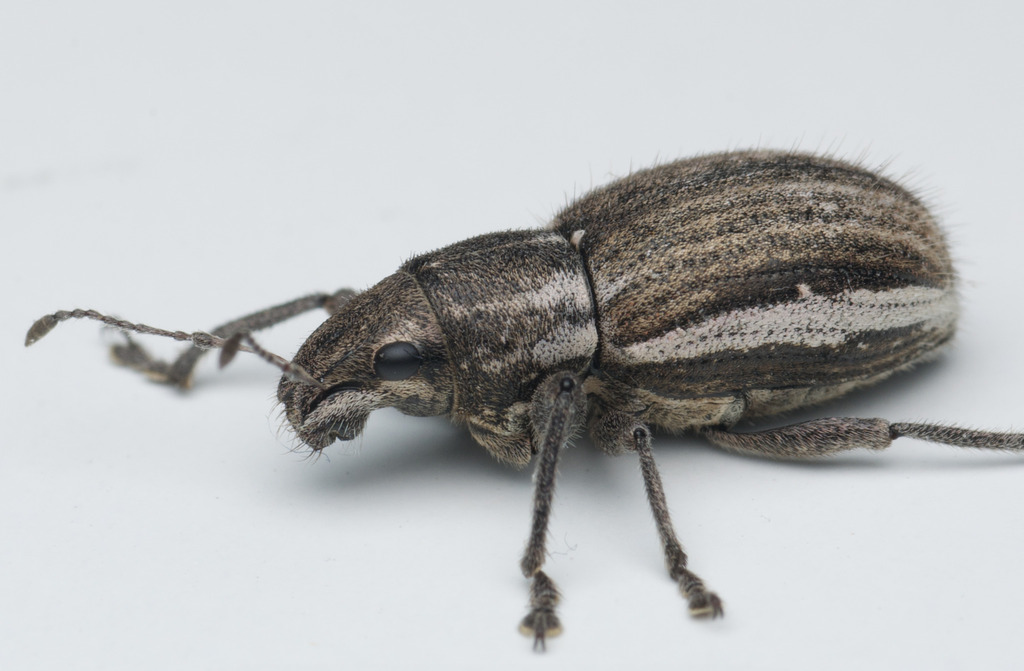
White-fringed weevil
Naupactus leucoloma
Naupactus leucoloma is a species of broad-nosed weevil in the family of beetles known as Curculionidae.
From the article Naupactus leucoloma on Wikipedia (CC BY-SA), quoted section by section
Description
The adult of Naupactus leucoloma is dark grey in colour with two lighter-coloured bands running longitudinally down its thorax and head. They are between 8-12mm long, and 4mm wide at the abdomen. The body of N. leucoloma is covered with hairs that are longer on the forewing. Wings of N. leucoloma vary greatly in size between individual specimens, but the forewings are fused, thus making the adults unable to fly. Males are not known to exist with N. leucoloma outside of their native range, and all individuals are females in the naturalised range. Reproduction is through parthenogenesis. Males of N. leucoloma are rare and only occur in the native range of South America, but also may be extinct. The larvae of N. leucoloma are about 12mm long, and occur in the soil. They have no legs similar to other species of weevils, their heads are partially retracted into the thorax, and they are yellowish white in colour, with black mandibles protruding from the head.
Range & habitat
Naupactus leucoloma is native to much of Argentina, from the Jujay and Salta provinces northwest, right down to the southeast in the Chubut province. It is also native to Uruguay and southern Brazil. Outside the native range, N. leucoloma has also been introduced through anthropological means to the United States, South Africa, Chile, Peru, Australia and New Zealand where it is well established
Wikipedia: “Distribution”
What it does
The larval stage of Naupactus leucoloma has the most potential for significant damage to crops with young plants quite often being killed as a result of the damage, and adult plants surviving but often with a large yield loss. This is a result of the larvae feeding on and causing significant damage to the root systems. N. leucoloma larvae are great generalists and have been observed feeding on 385 different plant species. Some of these species include alfalfa, beans, brassicas, carrots, clover, onions and potatoes. Adults of this species feed on the leaves of a large diversity of plants; this herbivory, however, causes less damage and is not usually of as much significance as the larval stage, but can still cause significant damage if the numbers are high enough.
Wikipedia: “Diet”
Listen
Looking for field recordings…
Where it lives
Recorded sightings
—
geo-referenced records in GBIF, from museums, herbaria and field observers.
Drag the globe to turn it. Dots are where records exist, not a range map; darker means more records.
In the stacks
Searching the stacks…
Every page naming Naupactus leucoloma in the Biodiversity Heritage Library →
This page is assembled live from iNaturalist, GBIF, Wikipedia, the Source Library and the Internet Archive. It is not yet part of the hand-edited codex. iNaturalist taxon 333624.