On eBird ↗
Common Bronzewing
Live sightings near you, the range map, bar charts of when it is seen, and Macaulay Library photos and recordings.
Common Bronzewing
Phaps chalcoptera
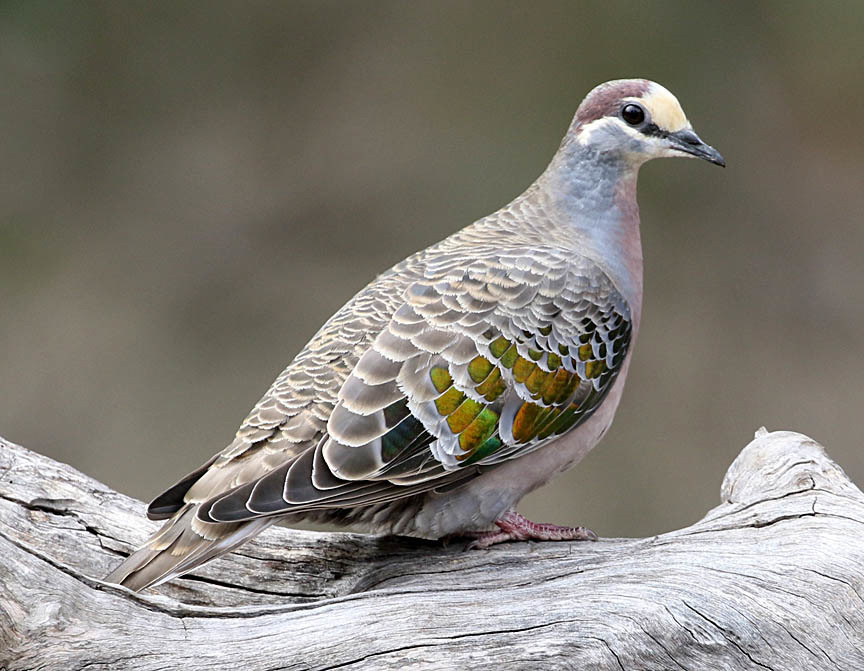
The common bronzewing (Phaps chalcoptera) is a species of medium-sized, heavily built pigeon. Native to Australia and one of the country's most common pigeons, the common bronzewing is able to live in almost any habitat, with the possible exception of very barren areas and dense rainforests. Its advertising call is an extraordinary mournful whooo repeated at metronomic intervals.
From the article Common bronzewing on Wikipedia (CC BY-SA), quoted section by section
Description
Males of the species have pale-yellow to yellow-white foreheads, and pink breasts. Both males and females have an easily discernible white line around and proximate to their eyes. Common bronzewings also have patches of red, blue and green on their wings, a feature which is characteristic of all bronzewing pigeons. Young birds are usually duller in colour and browner than the mature common bronzewing. Rarely found far from a source of water, common bronzewings either travel alone or in pairs or in flocks, and are usually cautious, making approach by humans or other animals difficult. Common bronzewings are, on average, between 30 and 36 centimetres (12–14 in) in length.
What it does
The common bronzewing's diet primarily consists of seeds and all varieties of vegetables. It searches for food in small groups. The search can sometimes last for days, and, since the pigeon must drink frequently, it utilizes watering holes or any other available source of water.
Wikipedia: “Feeding”
Listen
Looking for field recordings…
Where it lives
Recorded sightings
—
geo-referenced records in GBIF, from museums, herbaria and field observers.
Drag the globe to turn it. Dots are where records exist, not a range map; darker means more records.
In the stacks
Searching the stacks…
Every page naming Phaps chalcoptera in the Biodiversity Heritage Library →
This page is assembled live from iNaturalist, GBIF, Wikipedia, the Source Library and the Internet Archive. It is not yet part of the hand-edited codex. iNaturalist taxon 3335.