- Animals
- ›Arthropods
- ›Hexapods
- ›Insects
- ›Winged and Once-winged Insects
- ›Grasshoppers, Crickets, and Katydids
- ›Katydids, Crickets, and Allies
- ›Crickets
- ›True Crickets and Allies
- ›Tree Crickets and Bush Crickets
- ›Tree Crickets
- ›Oecanthidi
- ›Oecanthini
- ›Oecanthus
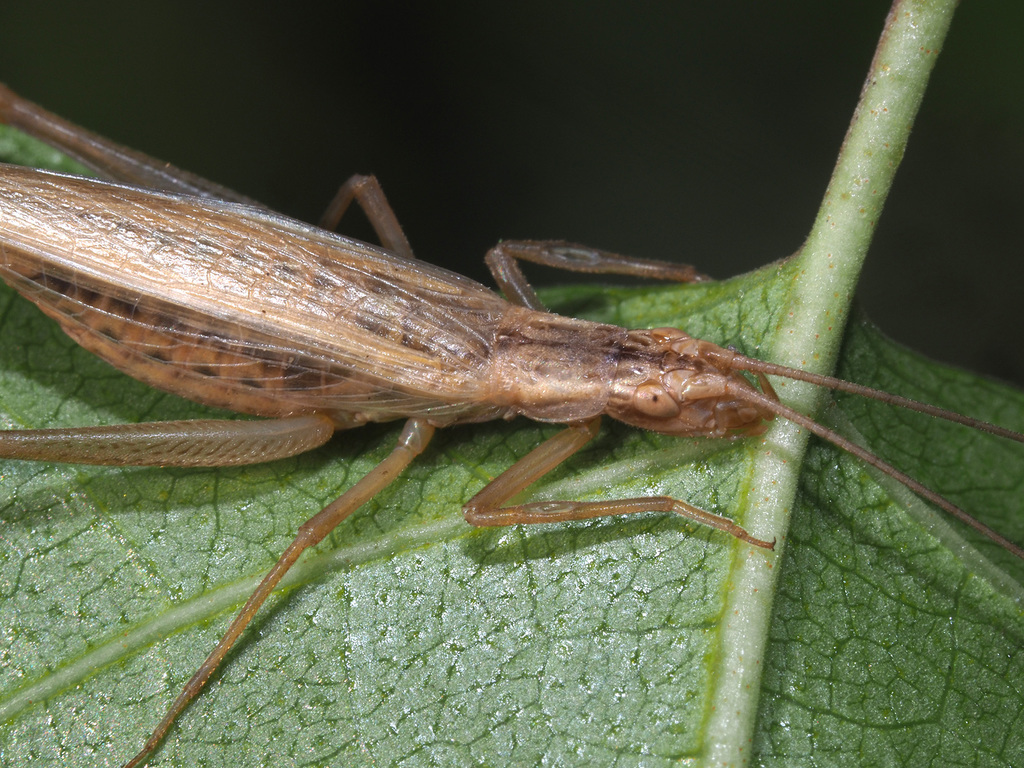
Italian Tree Cricket
Oecanthus pellucens
Oecanthus pellucens, common name European tree cricket, is a species of tree crickets belonging to the family Oecanthidae, subfamily Oecanthinae.
From the article Oecanthus pellucens on Wikipedia (CC BY-SA), quoted section by section
Description
The adult males grow up to 10–13 millimetres (0.39–0.51 in) long, the female is slightly larger than the male, about 11–14 millimetres (0.43–0.55 in) long. The colouration of Oecanthus pellucens is yellowish-brown, straw-colored. The body is very elongated and slender. The wings usually protrude out slightly above the abdomen, but can be shorter or longer. The wings of the males are larger than those of females. The antennae are longer than the body. The ovipositor of the female is long and slightly curved. The females are recognizable by the club-shaped end of the ovipositor.
Range & habitat
This species is present in most of Europe, especially in the countries around the Mediterranean with a focus on Southern Europe. The northern boundary runs through northern France, Belgium, southern Germany, the Czech Republic and southern Poland. The first, apparently viable, British colony was discovered near Dungeness in Kent in 2015. In southern Europe there is also the closely related and very similar species Oecanthus dulcisonans. It is also present in the eastern Palearctic realm, in the Near East, and in North Africa.
Wikipedia: “Distribution”
Listen
Looking for field recordings…
Where it lives
Recorded sightings
—
geo-referenced records in GBIF, from museums, herbaria and field observers.
Drag the globe to turn it. Dots are where records exist, not a range map; darker means more records.
In the stacks
Searching the stacks…
Every page naming Oecanthus pellucens in the Biodiversity Heritage Library →
This page is assembled live from iNaturalist, GBIF, Wikipedia, the Source Library and the Internet Archive. It is not yet part of the hand-edited codex. iNaturalist taxon 332307.