- Animals
- ›Chordates
- ›Vertebrates
- ›Reptiles
- ›Snakes and Lizards
- ›Lizards
- ›Iguanas and Allies
- ›Iguanas, Anoles, and Allies
- ›Helmeted Lizards
- ›Basiliscus
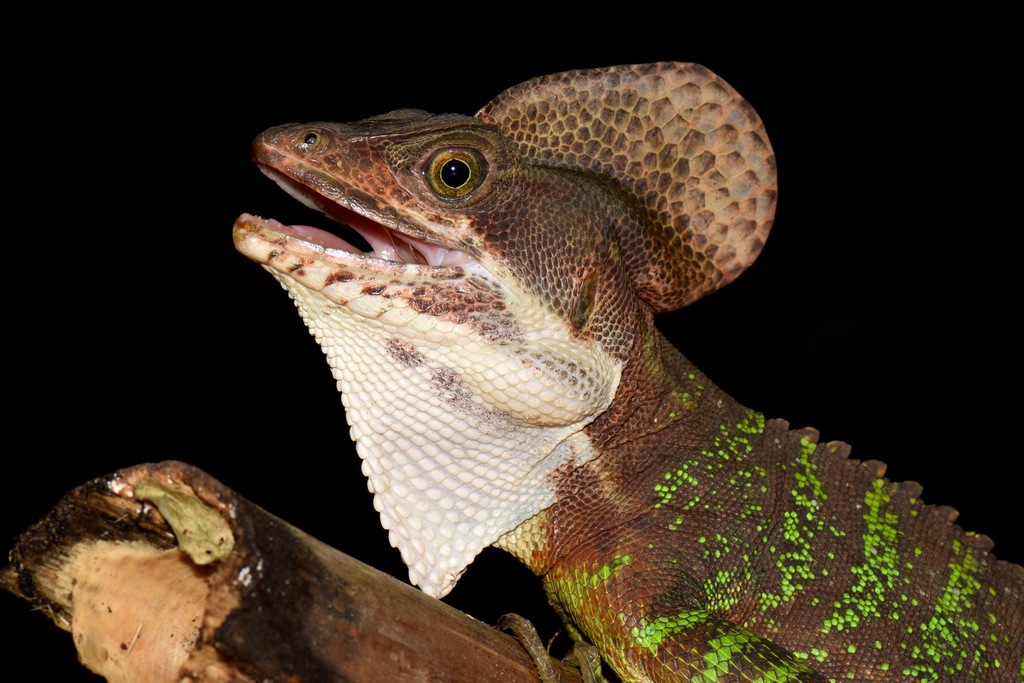
Western Basilisk
Basiliscus galeritus
The western basilisk (Basiliscus galeritus), also known as the red-headed basilisk, is a large species of lizard in the family Corytophanidae. The species is endemic to northwestern South America.
From the article Western basilisk on Wikipedia (CC BY-SA), quoted section by section
Description
Males of B. galeritus reach a total length (including tail) up to about 77.5 cm (30.5 in), while females reach about 63.5 cm (25.0 in). Its body color is olive-green with a reddish-brown underbelly. The throat is white to yellow. On the back it has a small crest similar to that of young individuals of the common basilisk. It may have a narrow white stripe or a row of white dots on each side. It has no back flap. The adult males bear a round head flap/crest.
Range & habitat
B. galeritus inhabits forests at altitudes of 0–1,600 m (0–5,249 ft) in western Colombia and western Ecuador in South America. Earlier reports of its occurrence in Central America are mistaken and actually refer to young of the closely related common basilisk.
Wikipedia: “Habitat and geographic range”
In human culture
The specific name, galeritus, which is Latin, means "wearing a hood", referring to the head crest.
Wikipedia: “Etymology”
Where it lives
Recorded sightings
—
geo-referenced records in GBIF, from museums, herbaria and field observers.
Drag the globe to turn it. Dots are where records exist, not a range map; darker means more records.
In the stacks
Searching the stacks…
Every page naming Basiliscus galeritus in the Biodiversity Heritage Library →
This page is assembled live from iNaturalist, GBIF, Wikipedia, the Source Library and the Internet Archive. It is not yet part of the hand-edited codex. iNaturalist taxon 33120.