- Animals
- ›Arthropods
- ›Hexapods
- ›Insects
- ›Winged and Once-winged Insects
- ›Ants, Bees, Wasps, and Sawflies
- ›Narrow-waisted Wasps, Ants, and Bees
- ›Ants, Bees, and Stinging Wasps
- ›Vespoid Wasps
- ›Hornets, Paper Wasps, Potter Wasps, and Allies
- ›Paper Wasps
- ›Polistini
- ›Polistes
- ›Aphanilopterus
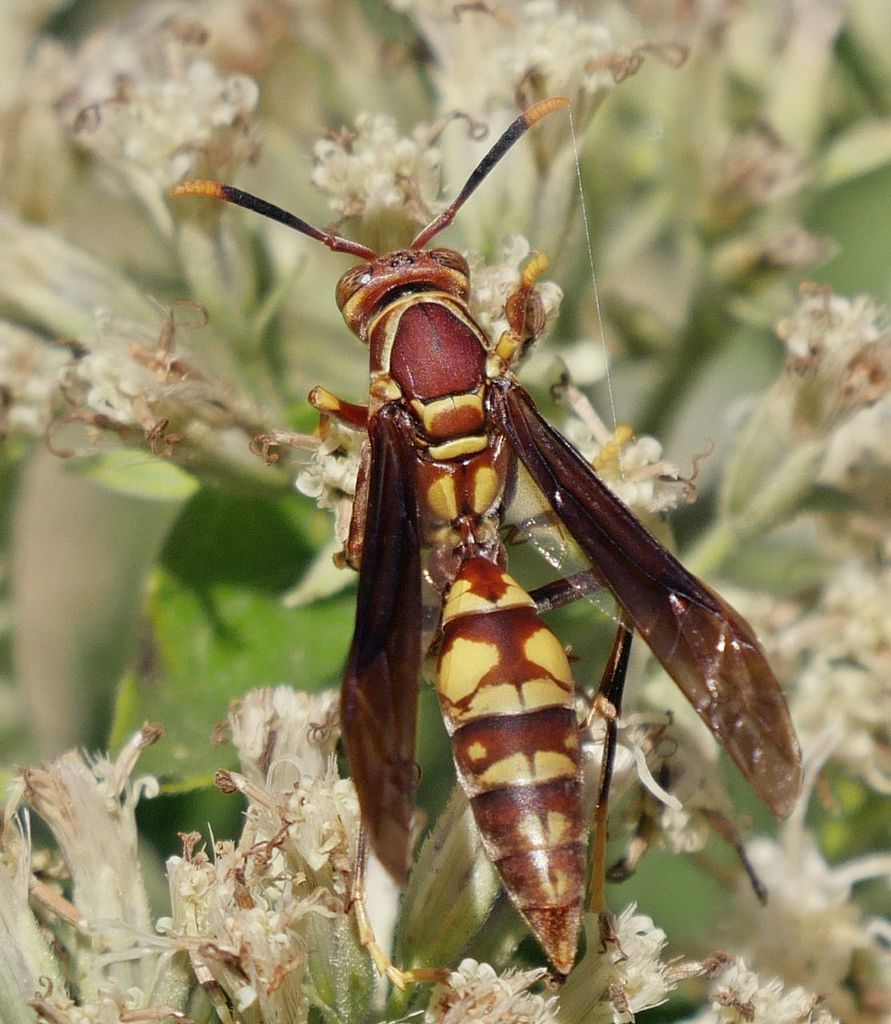
Variegated Paper Wasp
Polistes versicolor
Polistes versicolor, also known as the variegated paper wasp or yellow paper wasp, is a subtropical social wasp within Polistes, the most common genus of paper wasp. It is the most widely distributed of South American wasp species and is particularly common in the Southeastern Brazilian states. The P. versicolor nest, made of chewed vegetable fiber, is typically a single, uncovered comb attached to the substrate by a single petiole. The yellow wasp is frequently found in urban areas. New nests and colonies are usually founded by an association of females, sometimes in human buildings.
The P. versicolor colony cycle broadly ranges from 3 to 10 months, although there appears to be no relationship between the colony's development and the season of the year. While P. versicolor do have clear annual colony cycles, many young queens have the opportunity to hibernate during the winter, forming optional winter aggregations. Dominance hierarchies within these aggregations are characterized by physical aggression of the dominant female(s) towards the associated females, who tend to be sisters. Wagging movements are also often used as a form of communication within the colony. P. versicolor is generally predatory, capturing a wide range of insects, although it often feeds on pollen and nectar as well. Therefore, P. versicolor can be useful as a pollinator or as effective pest control.
From the article Polistes versicolor on Wikipedia (CC BY-SA), quoted section by section
Description
Both male and female P. versicolor have yellow transparent wings and a black body featuring the characteristic yellow bands on the thorax and abdomen. The differences between females are exclusively size-related. Within an aggregation of P. versicolor, the queens are the indisputably largest females and newly emerged females are the smallest. Aggregated females are larger than all other females. The female body sizes within a colony often depend on the environmental conditions: an increase in body size is often seen with the approach of an unfavorable season.
Wikipedia: “Description and identification”
Range & habitat
Widely distributed throughout South America, P. versicolor ranges from Costa Rica to Argentina. High densities of P. versicolor have been observed on the high mountains of the Turimiquire massif in Anzoategui State, Venezuela, most likely caused by migration due to the seasonal periodicity associated with the dry season. P. versicolor nests can frequently be found in natural environments with substrata consisting of leaves, branches, roots, stones, and even the abandoned nests of other social wasp species. In some cases, the wasp actually takes over empty Mischocyttarus drewseni nests to lay their eggs instead of creating their own nests. Often, however, its nests are found in human constructions; P. versicolor is facultatively synanthropic. P. versicolor even appear to nest preferably in human constructions in areas with little human activity; nests in natural vegetation are increasingly rare. This has been linked to the fact that the fragility of plants often does not offer appropriate support for the nest and exposes the nest to the stress of weather. In contrast, nests on manmade gypsum plaster are typically found in high places in buildings, where these nests are highly protected from not only human interference, but also weather and direct solar irradiation.
Wikipedia: “Distribution and habitat”
What it does
The worker P. versicolor tend to complete the bulk of colony feeding. The secretion of the workers’ hypopharyngeal glands is the main constituent of the royal jelly produced by the workers to feed the brood. The development of these glands can be clearly linked to the behaviors carried out by the workers in the nest; queens and males do not possess developed hypopharyngeal glands. After emergence, workers from the 3rd to the 18th day feed almost exclusively on pollen, which provides the protein needed to produce the royal jelly in their hypopharyngeal glands that feeds the rest of the brood. After the 18th day, the workers become foragers, constantly flying to and from the nest to collect food; they switch from feeding on pollen to feeding on nectar, which can better provide for their energetic needs. With the switch to nectar consumption comes a large reduction of their hypopharyngeal glands. However, these structures remain active throughout the lives of these wasps. P. versicolor is generally a predatory wasp, capturing a wide range of insects. While they don't typically have a prey preference, P. versicolor usually feed on insects from the orders Lepidoptera (95.4%) and Coleoptera (1.1%). Chlosyne lacinia saundersii (Lepidoptera: Nymphalidae) is the most collected prey (13.5%).
Wikipedia: “Diet”
How it is grown
Each colony of P. versicolor is estimated to capture 4,015 insect preys per year. Thus, P. versicolor colonies can prove to be a powerful strategy for pest management of herbivorous insects, especially defoliating caterpillars. By transferring P. versicolor to artificial shelters, these colonies can be managed and used to restore the balance between the species in agricultural ecosystems with relatively minimal costs. In addition to agricultural pest management, P. versicolor can also be a useful pollinator. These social wasps mainly feed on honeydew, fruit juices, and nectar. While foraging for these food supplies, especially nectar, P. versicolor are able to simultaneously pollinate many flowering plants. They are most attracted to species of the plant family Asteraceae, which not only have a large nectar resource concealed at a depth of only a few millimeters, but also include species flowering in May and June, allowing pollen to be collected in addition to nectar.
Wikipedia: “Agriculture”
Listen
Looking for field recordings…
Where it lives
Recorded sightings
—
geo-referenced records in GBIF, from museums, herbaria and field observers.
Drag the globe to turn it. Dots are where records exist, not a range map; darker means more records.
In the stacks
Searching the stacks…
Every page naming Polistes versicolor in the Biodiversity Heritage Library →
This page is assembled live from iNaturalist, GBIF, Wikipedia, the Source Library and the Internet Archive. It is not yet part of the hand-edited codex. iNaturalist taxon 330292.