- Animals
- ›Chordates
- ›Vertebrates
- ›Reptiles
- ›Snakes and Lizards
- ›Lizards
- ›Iguanas and Allies
- ›Dragons and Chameleons
- ›Chameleons
- ›Furcifer
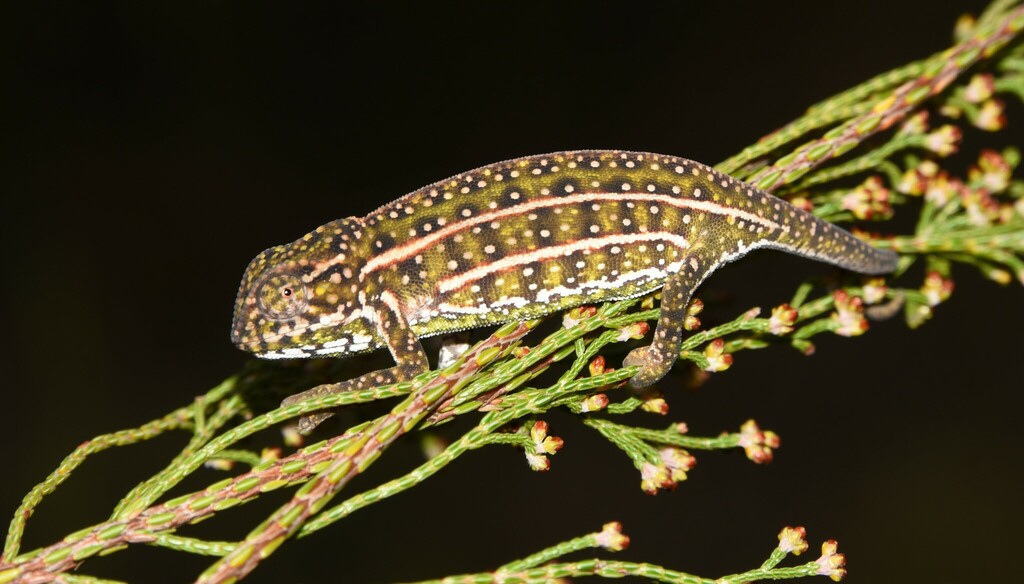
Jeweled Chameleon
Furcifer campani
The jewelled chameleon (Furcifer campani), also commonly known as Campan's chameleon or the Madagascar forest chameleon, is a species of lizard in the family Chamaeleonidae. The species is endemic to the central highlands of Madagascar, where it is threatened by bush fires and habitat loss.
From the article Jewelled chameleon on Wikipedia (CC BY-SA), quoted section by section
Description
F. campani grows to a total length (including tail) of about 14 centimetres (5.5 in). The background colour varies from pale green through dark green to brown. There are three pale brown, lateral stripes running along each side of the body and numerous small bright-coloured spots between them. The head is often decorated with small red spots. This chameleon has a crest running along its back composed of small projecting granules.
Range & habitat
F. campani is endemic to the central mountainous region of Madagascar where it lives at altitudes of 1,850 to 2,300 metres (6,070 to 7,550 ft). Its range extends from Ankaratra, an extinct volcano, to the Andringitra National Park, an area of 14,500 square kilometres (5,600 sq mi). However, only part of this is suitable habitat, and its population is fragmented. It is a terrestrial species and its habitat is mountain grass and heathland with shrubs and isolated trees.
Wikipedia: “Distribution and habitat”
What it does
Chameleons are ambush predators, standing still and waiting for suitable prey to come within reach. The diet of a chameleon consists largely of insects which it catches by shooting out its long tongue which has a sticky tip.
Wikipedia: “Behaviour and diet”
In human culture
The specific name, campani, is in honour of Dominique Campan, a French resident of Madagascar.
Wikipedia: “Etymology”
Where it lives
Recorded sightings
—
geo-referenced records in GBIF, from museums, herbaria and field observers.
Drag the globe to turn it. Dots are where records exist, not a range map; darker means more records.
In the stacks
Searching the stacks…
Every page naming Furcifer campani in the Biodiversity Heritage Library →
This page is assembled live from iNaturalist, GBIF, Wikipedia, the Source Library and the Internet Archive. It is not yet part of the hand-edited codex. iNaturalist taxon 33013.