- Animals
- ›Chordates
- ›Vertebrates
- ›Reptiles
- ›Snakes and Lizards
- ›Lizards
- ›Iguanas and Allies
- ›Dragons and Chameleons
- ›Chameleons
- ›Chamaeleo
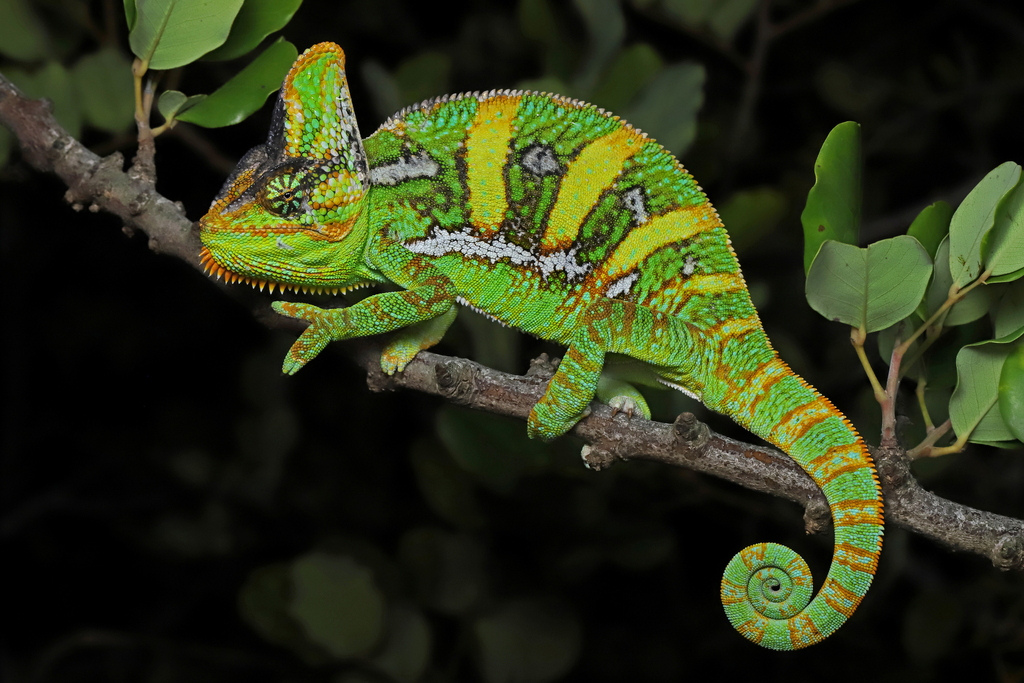
Veiled Chameleon
Chamaeleo calyptratus
The veiled chameleon (Chamaeleo calyptratus) is a species of chameleon (family Chamaeleonidae) native to the Arabian Peninsula in Yemen and Saudi Arabia. Other common names include cone-head chameleon, Yemen chameleon, and Yemeni chameleon. They are born pastel green and without their distinctive casques on their head. When newly hatched veiled chameleons are surprised, they may drop to the ground and turn a bright red color due to stress.
As they mature, their casque develops along with more vibrant coloring, as well as a dramatic gular fold that will protrude from their throat and chin. They are known for their variable color changes due to a variety of factors, including to show aggression, social status, reproduction, and stress. Female lifespan is around five years while male lifespan is around eight, and they breed a few times a year.
From the article Veiled chameleon on Wikipedia (CC BY-SA), quoted section by section
Description
The male is 43 to 61 cm (17 to 24 in) long from the snout to the tip of the tail. The female is shorter, no more than about 35 cm (14 in), but it has a thicker body. Both sexes have a casque on the head which grows larger as the chameleon matures, reaching about 5 cm (2.0 in) in the largest adults. Newly hatched offspring are born pastel green in color and develop stripes and different colors as they mature. Adult females are green with white, orange, yellow, or tan mottling. Adult males are brighter with more defined bands of yellow or blue and some mottling. Coloration can be affected by several factors, including social status. In experimental conditions, young veiled chameleons reared in isolation developed to be darker and duller in color compared to those raised with other individuals. Females change color over the course of their reproductive cycles. Chameleons also tend to change to a much darker color when stressed.
Range & habitat
The veiled chameleon (Chamaeleo calyptratus) is an arboreal species. It is native to the south-western Arabian Peninsula where the climate is semi-arid and tropical. It is highly susceptible to stress which makes it a species difficult to treat in captivity. This chameleon lives in a number of habitat types in its native range, including plateaus, mountains, and valleys. Like most other chameleons, it is arboreal, living in trees and other large plants. It prefers warmer temperature, generally between 24 and 35 °C (75 and 95 °F).
Wikipedia: “Habitat and distribution”
What it does
The veiled chameleon is primarily insectivorous. Like other chameleons, the veiled chameleon has the ability to capture large prey but their diets mainly consist of small prey. Green insects seem to be a favorite. However, it is one of several chameleon species also known to consume plants, such as vegetables and fruits. This is believed to perhaps be used as a source of water during the dry season.
Wikipedia: “Diet”
How it is grown
Veiled chameleons require specific care and husbandry in order to ensure their health. Captive veiled chameleons should never be released in the wild because they are an invasive species that can cause significant harm to a local ecosystem. It is important to be responsible when owning a veiled chameleon as a pet and never to release them in the wild. There are many local reptile rescue organizations around the world that will be able to take the veiled chameleon if the owner does not want it anymore. It is important that veiled chameleons have a tall and spacious enclosure that provides plenty of climbing opportunities. Since veiled chameleons are arboreal, an adult veiled chameleon should have at least 2 feet by 2 feet by 4 feet in size with lots of vines to climb on [1]. Veiled chameleon also require a basking spot with a temperature of 90–95 degrees Fahrenheit, with a cooler area of 70–80 degrees Fahrenheit. Veiled chameleons also need a full-spectrum UVB lighting. The UVB light helps metabolize calcium properly. Veiled chameleons are insectivores and require a diet of live insects such as crickets, roaches, and mealworms. Insects should be dusted with calcium. Veiled chameleons require regular access to water for drinking and humidity. …
Wikipedia: “Husbandry”
In human culture
The term 'veiled chameleon' refers to the species Chamaeleo calyptratus. 'Veiled' describes their distinctive casque on the head, resembling a veil. This term highlights the species' unique feature. The generic term 'chameleon' is derived from the Greek 'χαμαιλέων' ('khamailéōn'), a compound of 'χαμαί' ('khamaí'), meaning 'low to the ground' and 'λέων' ('léōn'), meaning 'lion', emphasizing the specie's nature as akin to a miniature lion, highlighting its dignified and perhaps majestic demeanor, much like a lion in miniature form, staying close to the ground. The species name 'calyptratus' comes from the Greek 'καλύπτρα' (kalýptra), meaning 'veil' or 'cover', referring to the distinctive casque or veil-like structure on their head. This casque not only serves as a significant physical characteristic but also plays a practical role in channeling dew and rainwater towards the mouth for hydration.
Wikipedia: “Etymology”
Where it lives
Recorded sightings
—
geo-referenced records in GBIF, from museums, herbaria and field observers.
Drag the globe to turn it. Dots are where records exist, not a range map; darker means more records.
In the stacks
Searching the stacks…
Every page naming Chamaeleo calyptratus in the Biodiversity Heritage Library →
This page is assembled live from iNaturalist, GBIF, Wikipedia, the Source Library and the Internet Archive. It is not yet part of the hand-edited codex. iNaturalist taxon 32873.