- Animals
- ›Chordates
- ›Vertebrates
- ›Reptiles
- ›Snakes and Lizards
- ›Lizards
- ›Iguanas and Allies
- ›Dragons and Chameleons
- ›Chameleons
- ›Trioceros
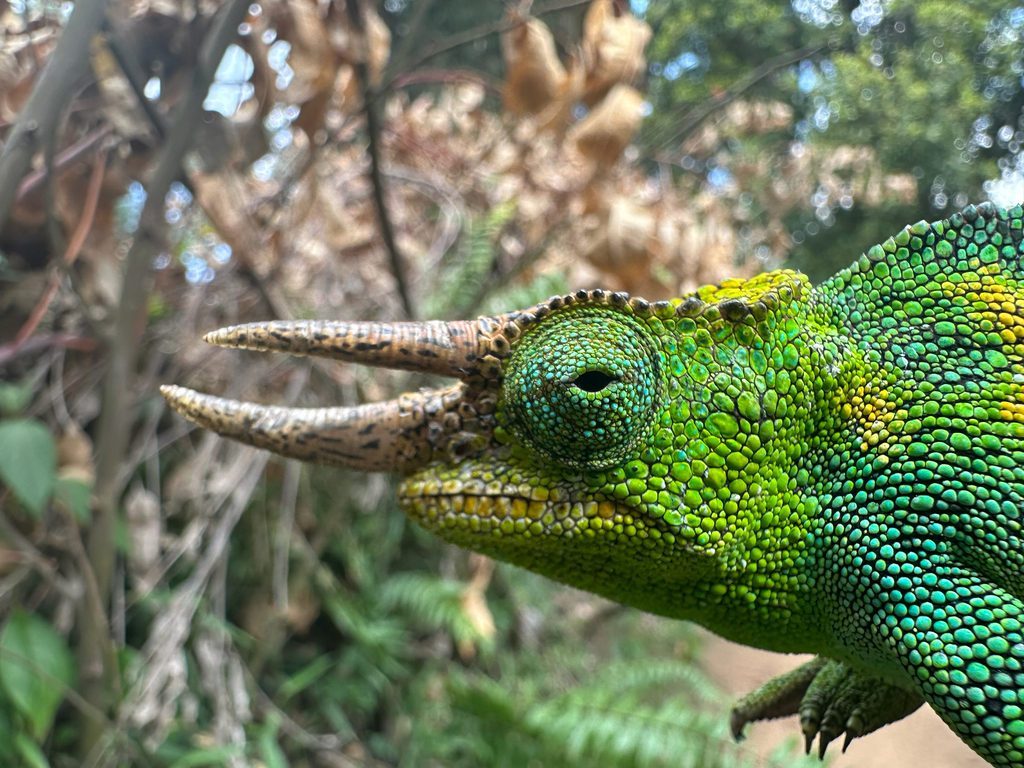
Johnston's Chameleon
Trioceros johnstoni
Trioceros johnstoni, known commonly as Johnston's chameleon, Johnston's three-horned chameleon, and the Ruwenzori three-horned chameleon, is a species of chameleon, a lizard in the family Chamaeleonidae. The species is endemic to highlands in the Albertine Rift in central Africa. It reaches up to 30 cm (12 in) in total length (including tail). Only the adult male has three horns. The female is hornless.
From the article Trioceros johnstoni on Wikipedia (CC BY-SA), quoted section by section
Range & habitat
T. johnstoni is found in forests at altitudes between 1,000 and 2,500 m (3,300–8,200 ft) in the Albertine Rift of eastern Democratic Republic of the Congo, western Burundi, western Rwanda, and southwestern Uganda, but also tolerates semi-urbanized environments as long as some trees and bushes remain.
Wikipedia: “Distribution and habitat”
What it does
Males of T. johnstoni are fiercely territorial and readily will fight other males, using their horns and biting.
Wikipedia: “Behaviour”
In human culture
The three long annulated horns in the male T. johnstoni makes it superficially similar to T. jacksonii and T. werneri, and to an extent also to the short-horned T. fuelleborni and the smooth-horned T. oweni, but they are not close relatives. Its nearest relative is the hornless T. ituriensis. The specific name johnstoni was given in honour of the British explorer Harry Johnston.
Wikipedia: “Taxonomy and etymology”
Where it lives
Recorded sightings
—
geo-referenced records in GBIF, from museums, herbaria and field observers.
Drag the globe to turn it. Dots are where records exist, not a range map; darker means more records.
In the stacks
Searching the stacks…
Every page naming Trioceros johnstoni in the Biodiversity Heritage Library →
This page is assembled live from iNaturalist, GBIF, Wikipedia, the Source Library and the Internet Archive. It is not yet part of the hand-edited codex. iNaturalist taxon 32837.