- Plants
- ›Vascular Plants
- ›flowering plants
- ›Dicots
- ›Sunflowers, Bellflowers, Fanflowers, and Allies
- ›Sunflowers, Daisies, Asters, and Allies
- ›Asteroideae
- ›Millerieae
- ›Milleriinae
- ›Smallanthus
Yacon
Smallanthus sonchifolius
The yacón (Smallanthus sonchifolius) is a species of perennial daisy traditionally grown in the northern and central Andes from Colombia to northern Argentina for its crisp, sweet-tasting, tuberous roots. Their texture and flavour are very similar to jicama, mainly differing in that yacón has some slightly sweet, resinous, and floral (similar to violet) undertones to its flavour, probably due to the presence of inulin, which produces the sweet taste of the roots of elecampane, as well....
From the article Yacón on Wikipedia (CC BY-SA), quoted section by section
Description
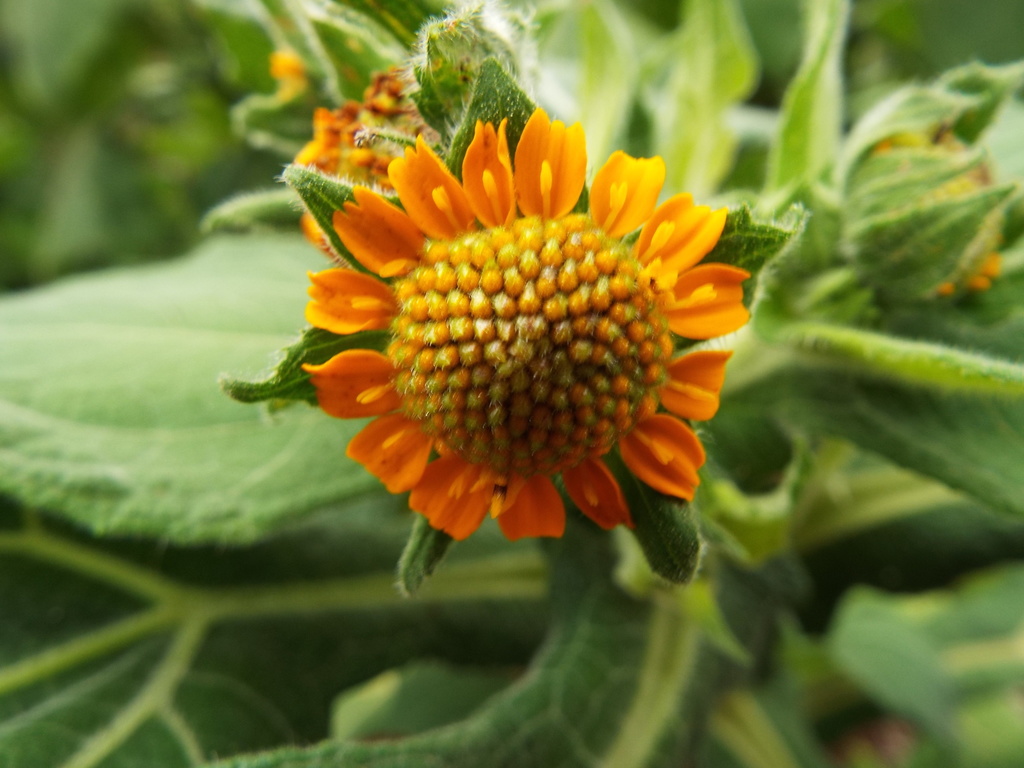
Yacón is a perennial herb that grows up to 2.5 metres (8 feet) tall. The stem is cylindrical to angular and hollow when the plant is mature. Leaves are opposite and deltoid. Their upper surface is hairy. Underground tubers consist of branching rhizomes and up to 20 tuberous storage roots. The rhizomes continually produce leafy shoots, while the storage roots are the principal economic product of the plant. The storage roots are up to 25 centimetres (10 inches) long, 10 cm (4 in) wide, achieving a weight of 0.2–2 kilograms (0.44–4.4 pounds), and have varying skin colours. The colour depends on the variety, and ranges from white to pink to brown. Yacón plants produce small, inconspicuous flowers at the end of the growing season. The timing of flowering strongly depends on the environmental conditions. If environmental conditions are favourable, flowering begins 6–7 months after planting and peaks about two months later. The yellow to orange coloured flower head is a pseudanthium (i.e. one apparent flower head is in reality composed of several florets). Each flower head is bisexual, uniting female and male florets in one pseudanthium. The yellow or orange ray florets are female and up to 12 mm long, while the yellow-brown disc florets are male and about 7 mm long. The seeds are stored inside dark brown achenes averaging 2.2–3.7 mm in length. …
At the table
Generally, yacón is cultivated in different countries for food and medicinal use. Since 1960, cultivation has spread from South America to countries such as New Zealand and Japan.
Food and storage. The tubers can be eaten raw, boiled, dehydrated, roasted or processed into beverages, jams, syrup, vinegar, flour, chips and juice. If they are eaten fresh, they are sweet and crunchy. While usable-sized edible tubers develop fairly early in the season, they taste much sweeter after they have matured and have been exposed to some frost. After harvest, tubers left in the sun to harden taste much better than those eaten immediately. The harvested tubers can be stored over several months, however the fructooligosaccharide content decreases over time. If the storage temperature keeps at 1 degree, the turnover from fructooligosaccharides to glucose, fructose and sucrose will also slow down.
Medicinal use. Yacón is believed to have health promoting effects. The tubers contain phytoalexines, phenolic compounds and high concentrations of fructanes, which are considered as bioactive compounds that are beneficial for human health. The leaves have been shown to be radical scavenging, cytoprotective and anti-hyperglycemic active. There has been considerable research into yacón products for medicinal purposes because of its antidiabetic and hypoglycaemic effect. …
Wikipedia: “Uses”
How it is grown
Freezing temperatures cause the above-ground parts to die back; the plant will re-sprout from the rhizome under favourable temperature and moisture conditions. The optimal growing temperature range is 18–25 °C. Yacón can easily be grown in gardens in climates with only light freezes. It grows well in Kathmandu, Nepal, southern Australia (including Tasmania) and in New Zealand, where the climate is mild and the growing season long. The plant was introduced to Japan in the 1980s, and from there its cultivation spread to other Asian countries, notably South Korea, China, and the Philippines, and is now widely available in markets in those countries. Traditionally, yacón roots are grown by farmers at mid-elevations on the eastern slopes of the Andes descending toward the Amazon. It is grown occasionally along field borders where the juicy tubers provide a welcome source of refreshment during field work. Until as recently as the early 2000s, yacón was hardly known outside of its limited native range, and was not available from urban markets. However, press reports of its use in Japan for its purported antihyperglycemic properties made the crop more widely known in Lima and other Peruvian cities. Yacón is also grown on the Atherton tablelands in Queensland. The plant can be grown using either stem cuttings or the purple rhizomes at the base of the stalks. …
Wikipedia: “Cultivation”
Where it lives
Recorded sightings
—
geo-referenced records in GBIF, from museums, herbaria and field observers.
Drag the globe to turn it. Dots are where records exist, not a range map; darker means more records.
In the old herbals & bestiaries

In the stacks
Searching the stacks…
Every page naming Smallanthus sonchifolius in the Biodiversity Heritage Library →
This page is assembled live from iNaturalist, GBIF, Wikipedia, the Source Library and the Internet Archive. It is not yet part of the hand-edited codex. iNaturalist taxon 327644.