- Animals
- ›Arthropods
- ›Hexapods
- ›Insects
- ›Winged and Once-winged Insects
- ›Grasshoppers, Crickets, and Katydids
- ›Grasshoppers, Locusts, and Allies
- ›Grasshoppers
- ›Short-horned Grasshoppers and Locusts
- ›Short-horned Grasshoppers
- ›Bandwing Grasshoppers
- ›Oedipodini
- ›Oedipoda
- ›Oedipoda caerulescens
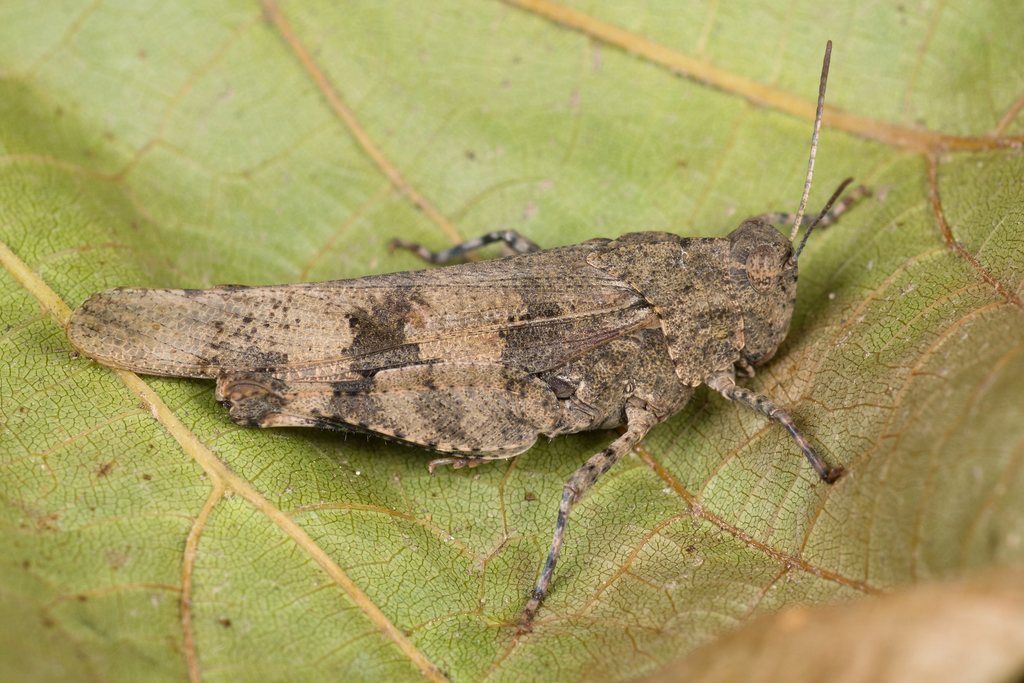
Blue-winged Grasshopper
Oedipoda caerulescens
The blue-winged grasshopper, Oedipoda caerulescens, is a grasshopper in the genus Oedipoda.
From the article Oedipoda caerulescens on Wikipedia (CC BY-SA), quoted section by section
Range & habitat
This species occurs in Europe, North Africa and Asia. It was recently rediscovered in the Maltese islands.
Wikipedia: “Distribution”
What it does
Oedipoda caerulescens frequents dry areas with low and open vegetation: dunes, heathlands, grasslands on sand and sunlit limestone rocks. Many stations correspond to land recently used for human activities, such as coal spoil heaps, quarries and pits, the ballast of railway tracks, etc. It is exclusively a terrestrial insect, and its cryptic coloration often matches its substrate. It presses itself to the ground and remains motionless, and jumps only at the very close approach of danger. A remarkable behavior is the "hook" landing which serves to confuse potential attackers. Thus, the grasshopper lands and swings round to face the direction it has come from. The sudden disappearance of the blue hind wings of the adult makes it difficult for predators to shift quickly enough to a different kind of search to relocate the prey. The female lays her eggs in bare, dry soil. In this species, acoustic emissions are virtually nonexistent. The diet consists mainly of grasses.
Wikipedia: “Ecology”
Listen
Looking for field recordings…
Where it lives
Recorded sightings
—
geo-referenced records in GBIF, from museums, herbaria and field observers.
Drag the globe to turn it. Dots are where records exist, not a range map; darker means more records.
In the stacks
Searching the stacks…
Every page naming Oedipoda caerulescens in the Biodiversity Heritage Library →
This page is assembled live from iNaturalist, GBIF, Wikipedia, the Source Library and the Internet Archive. It is not yet part of the hand-edited codex. iNaturalist taxon 326052.