- Animals
- ›Arthropods
- ›Hexapods
- ›Insects
- ›Winged and Once-winged Insects
- ›Butterflies and Moths
- ›Curved-horn Moths
- ›Twirler Moths
- ›Anomologinae
- ›Ptocheuusa
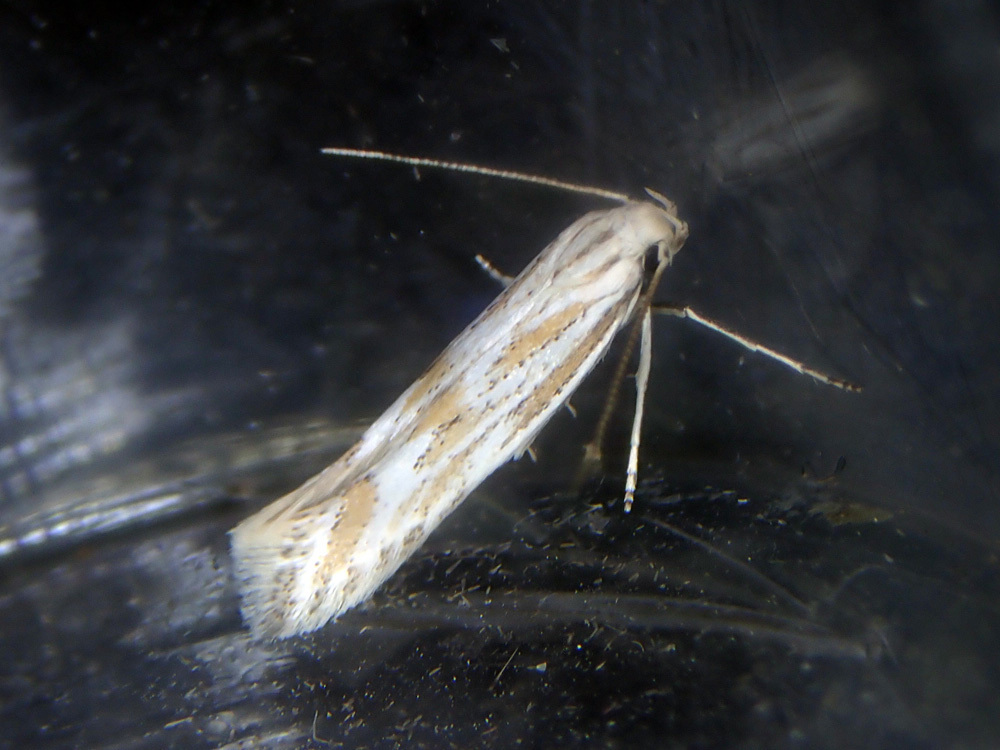
light fleabane neb
Ptocheuusa paupella
Ptocheuusa paupella, the light fleabane neb, is a moth of the family Gelechiidae, first described by the German entomologist, Philipp Christoph Zeller in 1847, from a specimen found in Syracuse, Sicily. It is found in Asia, Europe and North Africa.
From the article Ptocheuusa paupella on Wikipedia (CC BY-SA), quoted section by section
Range & habitat
It is found from western and southern Europe to the Ural Mountains, North Africa, Asia Minor and India.
== References ==
Wikipedia: “Distribution”
What it does
Imago The wingspan is 10–12 mm. The ground colour is buff, streaked with whitish and with darker speckling. The forewings are light ochreous-yellow, with some black scales mostly arranged in longitudinal rows; margins, a median longitudinal streak from base to middle, an indistinct inwardly oblique slender fascia before middle and another at 3/4, and sometimes two or three faint longitudinal lines in disc posteriorly white. Hindwings are pale grey. The larva is pale yellowish; head and two spots on 2 dark fuscous, head pale brown. Adults are on wing in June and again from August to September.
Ovum Eggs are laid on common fleabane (Pulicaria dysenterica), black knapweed (Centaurea nigra), mints (Mentha species) and golden samphire (Inula crithmoides).
Larva Larvae feed on the achenes in the flower heads of the food plant, with a raised section of florets showing the presence a larva. In Britain and Ireland the larvae are found from June to August, again in September and October and overwinter fully fed until May when they form a pupa.
Pupa In Great Britain and Ireland, larvae can be found in May and June and again in August and September. …
Wikipedia: “Life cycle”
Listen
Looking for field recordings…
Where it lives
Recorded sightings
—
geo-referenced records in GBIF, from museums, herbaria and field observers.
Drag the globe to turn it. Dots are where records exist, not a range map; darker means more records.
In the stacks
Searching the stacks…
Every page naming Ptocheuusa paupella in the Biodiversity Heritage Library →
This page is assembled live from iNaturalist, GBIF, Wikipedia, the Source Library and the Internet Archive. It is not yet part of the hand-edited codex. iNaturalist taxon 325631.