- Animals
- ›Arthropods
- ›Hexapods
- ›Insects
- ›Winged and Once-winged Insects
- ›Butterflies and Moths
- ›Owlet Moths and Allies
- ›Cutworm Moths and Allies
- ›Cutworms and Dart Moths
- ›Tholerini
- ›Cerapteryx
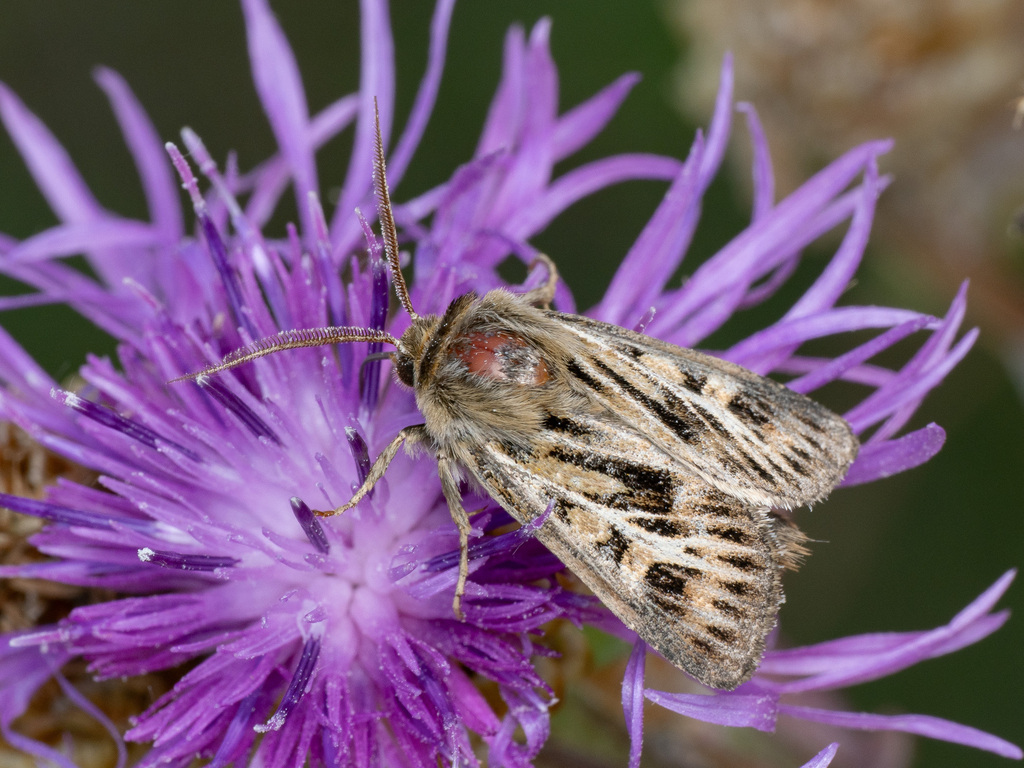
Antler Moth
Cerapteryx graminis
Cerapteryx graminis, the antler moth, is a moth of the family Noctuidae. It is a common species throughout most of Europe but is lacking in the very dry southern regions. The northernmost occurrence is Iceland, and above the Arctic circle. It also occurs in Siberia and in North Mongolia. The species has been introduced to North America. In the Alps it rises to an altitude of 2100 meters.
From the article Cerapteryx graminis on Wikipedia (CC BY-SA), quoted section by section
Description
This species is unusual for a noctuid in that there is marked sexual dimorphism. The male has a wingspan of 27–32 mm but the female is larger with a wingspan of 35–39 mm. The forewings are brown, speckled with black and marked with a bold white branched basal streak which gives the species its common name. The hindwings are dark brown with a white fringe. Larvae feed on a variety of grasses.
What it does
Young larvae are greenish and change their colour with age to grey-brown to brown. They then appear clumsy and have a roller shape. They also show pale lines as well as black spiracles. The underside and legs are light brown. The head is shiny brownish. The feed on various grasses including Deschampsia, Festuca and Nardus. It is sometimes so common that it damages pastures. The species overwinters as an egg.
Wikipedia: “Life cycle”
Listen
Looking for field recordings…
Where it lives
Recorded sightings
—
geo-referenced records in GBIF, from museums, herbaria and field observers.
Drag the globe to turn it. Dots are where records exist, not a range map; darker means more records.
In the stacks
Searching the stacks…
Every page naming Cerapteryx graminis in the Biodiversity Heritage Library →
This page is assembled live from iNaturalist, GBIF, Wikipedia, the Source Library and the Internet Archive. It is not yet part of the hand-edited codex. iNaturalist taxon 324217.