- Plants
- ›Vascular Plants
- ›flowering plants
- ›Dicots
- ›Sunflowers, Bellflowers, Fanflowers, and Allies
- ›Sunflowers, Daisies, Asters, and Allies
- ›Asteroideae
- ›asters and allies
- ›Brachyscominae
- ›Brachyscome
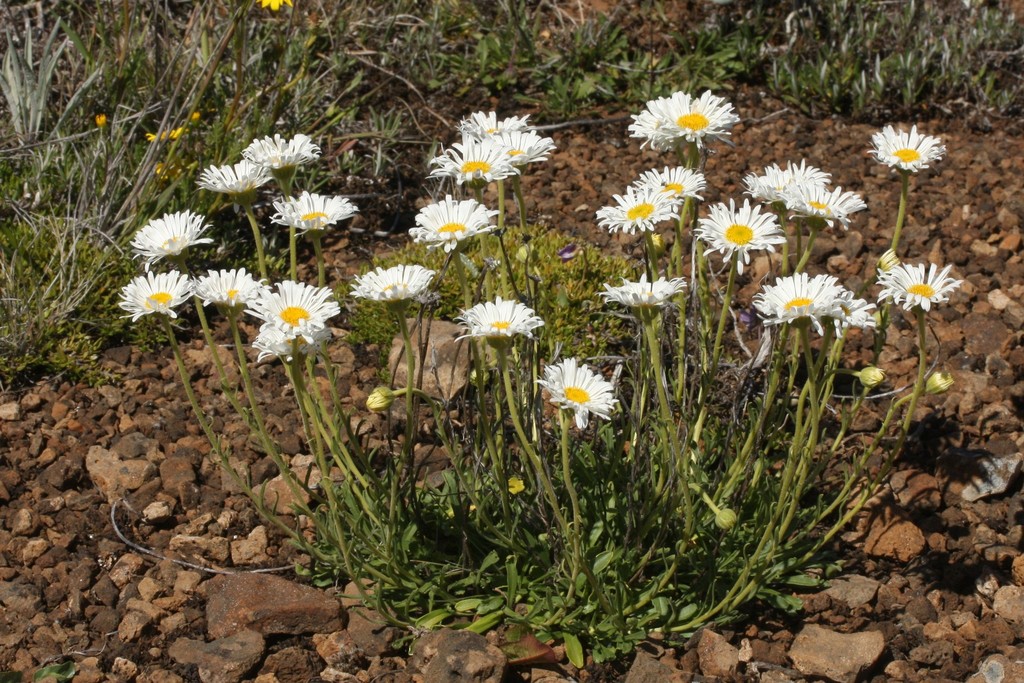
Brachyscome tenuiscapa
Brachyscome tenuiscapa, commonly known as mountain daisy, is a perennial herb in the family Asteraceae and is endemic to Tasmania. It commonly occurs in alpine environments, and was previously conglomerated with B. foliosa before being reclassified in 2014. It has white or mauve flowers with a yellow centre.
From the article Brachyscome tenuiscapa on Wikipedia (CC BY-SA), quoted section by section
Description
Brachyscome tenuiscapa is a perennial herb with a long, slender stem holding a singular white or mauve flower-head. The length of the stem ranges from 8–22 cm (3.1–8.7 in), and are unbranched, with small, leafy bracts and glandular hairs. Leaves are spoon-shaped, arranged in a small basal rosette and are distinctively toothed, 5–10 mm (0.20–0.39 in) wide and 2–3 cm (0.79–1.18 in) long. Flower-heads are 2–3 cm (0.79–1.18 in) across, and involucral bract tips are acute to subacute. Disc florets are a bright yellow with five lobes. The fruit is a dark brown to purplish-brown achene, wedge-shaped and slightly thickened at the margins. The pappus of B. tenuiscapa is white and very short, as is characteristic of the genus. B. tenuiscapa can be confused with Brachyscome scapigeraa, as they are both alpine plants with similar fruits and flowers, but B. scapigera has hairless leaves without toothing, and the basal cluster of leaves is more upright. B. tenuiscapa can be distinguished from the mainland Australian species Brachyscome foliosa (which which it was classified with for many years) as B. foliosa has black achenes, more leaves on the scape, and is more lobed than B. tenuiscapa.
Range & habitat
B. tenuiscapa mainly occurs in damp alpine or subalpine grasslands, heathlands, and herb fields, colonising bare patches via basal shoots. In Tasmania, its distribution is more concentrated in the Central Highlands, around Great Lake, although it has also been found at the northern edge of Mt Field National Park, as well as in the Southern Ranges. It is commonly associated with Poa species, particularly Poa gunnii, as well as heaths such as Epacris gunnii and Richea scoparia, peas such as Bossiaea riparia, other Asteraceaes such as Olearia algida, and even amongst cushion plant species Donatia novae-zelandiae.
Wikipedia: “Distribution and habitat”
Where it lives
Recorded sightings
—
geo-referenced records in GBIF, from museums, herbaria and field observers.
Drag the globe to turn it. Dots are where records exist, not a range map; darker means more records.
In the stacks
Searching the stacks…
Every page naming Brachyscome tenuiscapa in the Biodiversity Heritage Library →
This page is assembled live from iNaturalist, GBIF, Wikipedia, the Source Library and the Internet Archive. It is not yet part of the hand-edited codex. iNaturalist taxon 323106.