- Animals
- ›Arthropods
- ›Hexapods
- ›Insects
- ›Winged and Once-winged Insects
- ›Butterflies and Moths
- ›Geometrid and Swallowtail Moths
- ›Geometer Moths
- ›Waves and Mochas
- ›Sterrhini
- ›Idaea
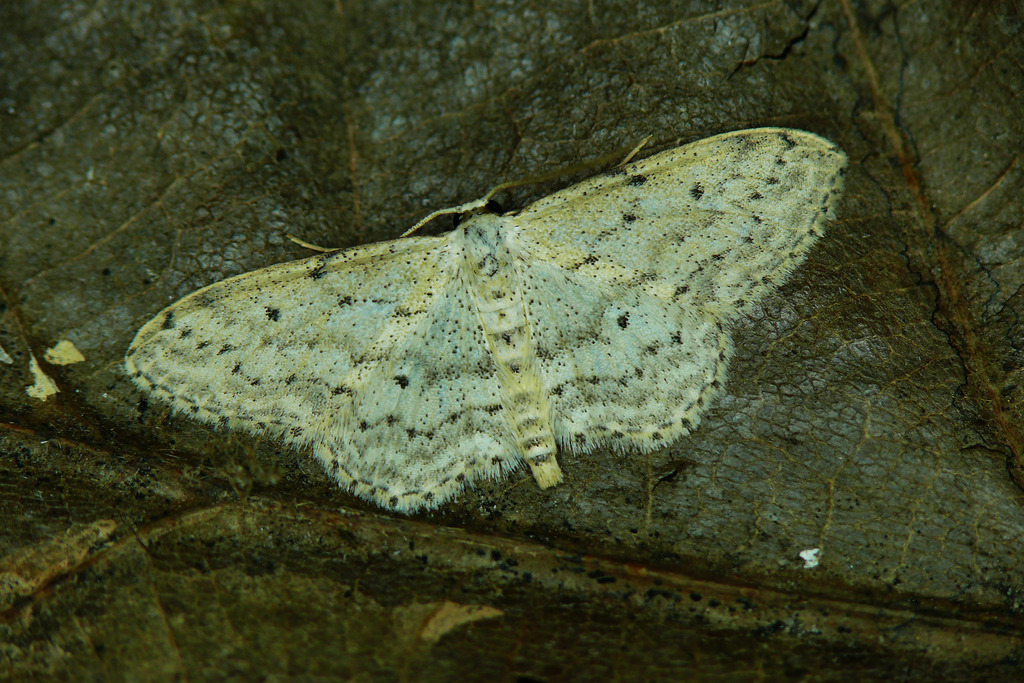
Small Dusty Wave
Idaea seriata
The small dusty wave (Idaea seriata) is a moth of the family Geometridae first described by Franz von Paula Schrank in 1802. It is found throughout Western, Central and Northern Europe. In the north, its range extends as far as Denmark and southern Scandinavia. In the east its range extends as far as Russia (Moscow or Veliky Novgorod). Idaea seriata is replaced by the subspecies Idaea seriata canteneraria, from the north-east of Spain and the central and eastern Mediterranean (including the islands, except Crete) to the Crimean peninsula, while the western Mediterranean and the Balearic Islands are inhabited by the sister species Idaea minuscularia. Outside Europe it is found in eastern Algeria, Tunisia, Turkey, Cyprus, the Caucasus and the northwest of Transcaucasia. In Morocco and western Algeria, it is replaced by the sister species Idaea minuscularia. In the British Isles it is common in England and Wales but is only found in the eastern half of Scotland and it is rare in Ireland.
The species is very small (wingspan 19–21 mm) and is probably one of the least striking members of the whole family, being basically grey with all markings indistinct apart from the black discal spot typical of the genus.
From the article Small dusty wave on Wikipedia (CC BY-SA), quoted section by section
Description
An extremely variable species, ranging from almost pure white forms without markings or with well expressed lines to unicolorous black-grey forms. The vertex of the head remains whitish in all the forms, the collar dark. The lines, when present, do not arise from enlarged costal spots, though not infrequently the costal extremity of the lines is a little blacker than the rest. The first line of the forewing is angled on the subcostal vein or at least strongly bent; it is thickened with dark marks on the veins. The median shade is thicker, not rarely rather strongly developed, often, on the contrary, quite obsolete even in forms in which the lines are sharply marked; it usually touches the cell-spot on the forewing and is always proximal to it on the hindwing. The postmedian is fine and grey, not itself conspicuous but marked with strong, coarse black spots on the veins; it stands rather near the distal margin and is incurved between the radials, then outcurved; the form of this line is best shown on the right forewing in our figure and may be compared to that which occurs in a higher degree of development in calunetaria. …
Wikipedia: “Description in Seitz”
Listen
Looking for field recordings…
Where it lives
Recorded sightings
—
geo-referenced records in GBIF, from museums, herbaria and field observers.
Drag the globe to turn it. Dots are where records exist, not a range map; darker means more records.
In the stacks
Searching the stacks…
Every page naming Idaea seriata in the Biodiversity Heritage Library →
This page is assembled live from iNaturalist, GBIF, Wikipedia, the Source Library and the Internet Archive. It is not yet part of the hand-edited codex. iNaturalist taxon 322983.