- Animals
- ›Arthropods
- ›Hexapods
- ›Insects
- ›Winged and Once-winged Insects
- ›Butterflies and Moths
- ›Geometrid and Swallowtail Moths
- ›Swallowtail Moths
- ›Uraniinae
- ›Chrysiridia
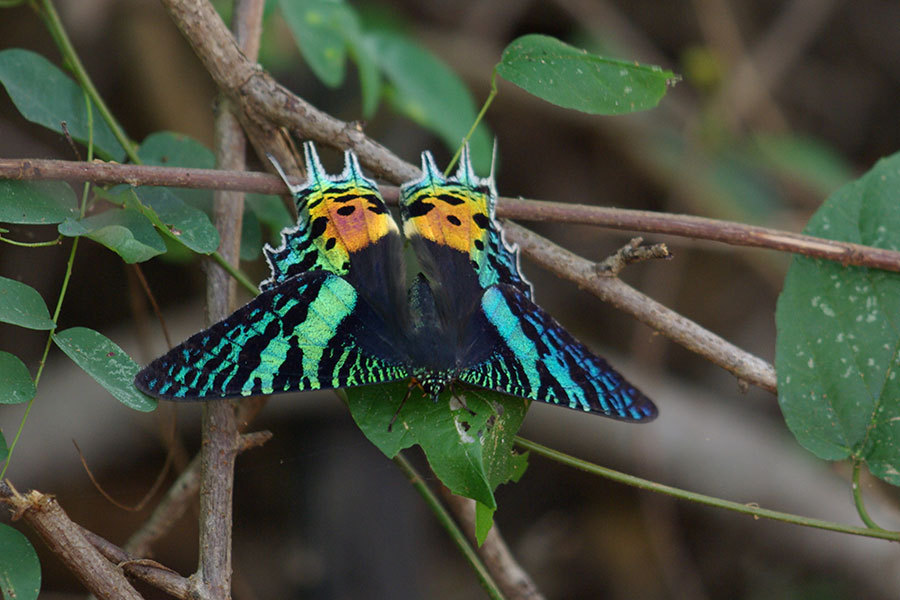
Madagascan Sunset Moth
Chrysiridia rhipheus
Chrysiridia rhipheus, the Madagascan sunset moth, is a species of day-flying moth of the family Uraniidae. It is considered one of the most impressive and appealing-looking lepidopterans. Famous worldwide, it is featured in most coffee table books on Lepidoptera and is much sought after by collectors, though many older sources misspell the species name as "ripheus". The colours originate from optical interference in the iridescent parts of the wings, while the black parts are pigmented. Adults have a wingspan of 7–9 cm (2.8–3.5 in).
Dru Drury, who described the moth in 1773, placed it in the genus Papilio, considering it a butterfly. Jacob Hübner placed it in the moth genus Chrysiridia in 1823. Later redescriptions led to junior synonyms such as Chrysiridia madagascariensis (Lesson, 1831).
From the article Chrysiridia rhipheus on Wikipedia (CC BY-SA), quoted section by section
Description
Chrysiridia rhipheus has a wingspan of 7–9 centimetres (2.8–3.5 in), and sometimes up to 11 centimetres (4.3 in). Moths from the highlands, 900–1,080 metres (2,950–3,540 ft), have a median wingspan of 7 cm (2.8 in); moths from lower altitudes, 600 m (2,000 ft), have a median wingspan of 9 cm (3.5 in). Like many other uraniine moths, the sunset moth has an uncanny resemblance to swallowtail butterflies, especially in its tails and colourful wings, and can easily be mistaken for a butterfly. The sunset moth is black with iridescent red, blue and green markings. There is a fringe of white scales on the wing edges, wider on the hindwings. The moth has six tails, very often lost or damaged during its life. Pattern variations are common, and the moth is often partly asymmetrical; one of the factors causing this is temperature shock during the pupal stage.
Wing microstructure. Unlike in many other moths, the colour of C. rhipheus's wings does not come from pigments. The colour originates from coherent scattering and interference of light by the microstructure of the ribbon-like scales covering the moth's wings. …
Range & habitat
Drury's specimen was given to him by Captain May of Hammersmith and believed to have come from China. Cramer believed the specimen came from Chandernagore in Bengal, however, giving rise to the French name "page de Chadernagor". It is now known that Chrysiridia rhipheus is endemic to Madagascar. Thousands of adult moths seasonally migrate between geographically isolated populations of their host plant Omphalea spp. They can be found almost everywhere on the island, except in the south-west and the extreme subdesertic south of the Androy where their host plant is absent. They migrate from the three species in the dry deciduous forest in the west (O. ankaranensis, O. occidentalis and O. palmata) to the eastern rainforest species (O. oppositifolia). The western species are largely in protected areas. The eastern species, on the other hand, is mostly unprotected and dispersed in widely scattered populations threatened by deforestation. Being the only evergreen species, O. oppositifolia is probably crucial for the moth's survival. The Jamaican moth Urania sloanus, from the same subfamily (Uraniinae), most likely became extinct after the loss of one of its host plant species. The moths migrate in response to changes in the host plants. …
Wikipedia: “Distribution and habitat”
What it does
Unlike most moths, the sunset moth is day flying and the bright aposematic colours warn predators of its toxicity, a strategy seen in many diurnal moths. Another habit the moth has in common with many butterflies is the night resting posture—the wings are held vertically over the back. During their migrations they roost in a group for the night. The moth flies over the crown of trees and in clearings. Sometimes because of high winds it is carried about 100 m (300 ft), it then falls, inert and wings closed, to the ground.
Life cycle. Continuous generations of the moth are present all year. The highest populations are found from March to August (fall and winter), while the lowest are from October to December (spring). The females lay their eggs late in the afternoon or at nightfall, and locate potential oviposition sites visually. Like the eggs of other Uraniidae, the sunset moth's eggs are domed with projecting ribs. A single egg weighs about 1 milligram (3.5×10⁻⁵ oz) and usually has 17 ribs, but sometimes 18 or less often 16. The eggs are usually laid on the lower surface of Omphalea leaves, but occasionally on the upper surface. Eggs are laid in groups of 60 to 110, usually about 80. After they hatch, the small caterpillars only eat the tissue (parenchyma) between the veins of the leaves. …
Wikipedia: “Behaviour”
In human culture
This spectacular moth is considered one of the most impressive and beautiful Lepidoptera, rivalling almost any of the butterflies in brilliance of colouring and form. It is featured in most coffee table books on the Lepidoptera, and is much sought after by collectors. It is collected in the wild, and raised commercially for the international butterfly trade; its wings were used to make jewellery in the Victorian era. Only one of the four species of host plants, Omphalea oppositifolia, is used to raise the moth commercially, mainly using plants collected in the wild, but also some cultivated for the purpose. The Madagascan sunset moth made its philatelic debut on a 100 CFA franc stamp released by Madagascar on March 25, 1960. Since then, the moth has been featured on more than ten standard-issue stamps and over twenty commemorative stamps. In Malagasy, lolo is polysemous for "butterfly" or "moth" and "soul". There is little doubt that this is because a pupa resembles a covered corpse and that the adult emerges from it—like the soul from the body of the dead. The Malagasy people believe the soul of the dead or of ancestors appears in the form of a lepidopteran, and thus to attack it is to attack the ancestors.
Wikipedia: “In culture”
Listen
Looking for field recordings…
Where it lives
Recorded sightings
—
geo-referenced records in GBIF, from museums, herbaria and field observers.
Drag the globe to turn it. Dots are where records exist, not a range map; darker means more records.
In the stacks
Searching the stacks…
Every page naming Chrysiridia rhipheus in the Biodiversity Heritage Library →
This page is assembled live from iNaturalist, GBIF, Wikipedia, the Source Library and the Internet Archive. It is not yet part of the hand-edited codex. iNaturalist taxon 322801.