- Animals
- ›Arthropods
- ›Hexapods
- ›Insects
- ›Winged and Once-winged Insects
- ›Butterflies and Moths
- ›Choreutoidea
- ›Metalmark Moths
- ›Choreutinae
- ›Anthophila
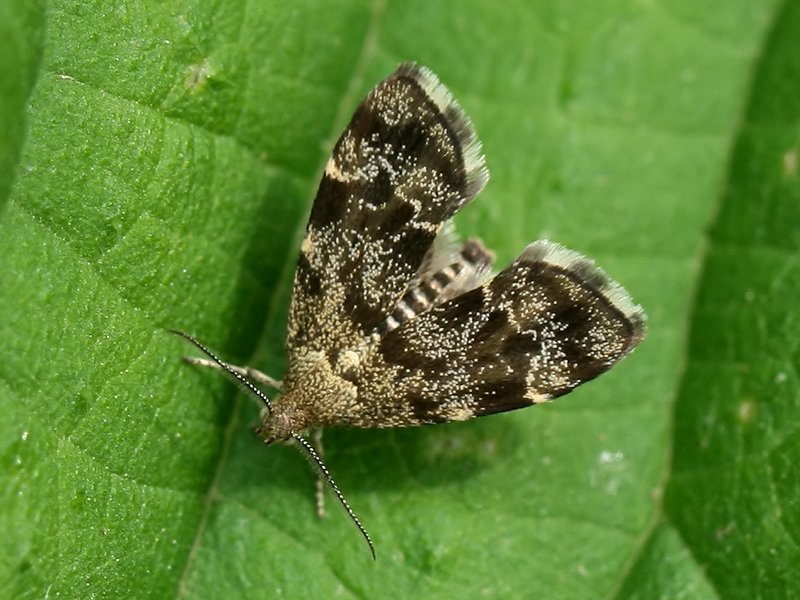
Common Nettle-tap
Anthophila fabriciana
Anthophila fabriciana, also known as the common nettle-tap, is a moth of the family Choreutidae first described in 1767 by Carl Linnaeus. The moth can be found flying around stinging nettles during the day.
From the article Anthophila fabriciana on Wikipedia (CC BY-SA), quoted section by section
Range & habitat
This species can be found in most of Europe and it occurs throughout Britain. It is also widespread from China (Taiwan, Xinjiang), the Himalaya, Mongolia, Russia, Korea, Japan (Hokkaido, Honshu, Shikoku), Afghanistan, Kazakhstan, the Canary Islands, Madeira, Asia Minor, Zakavkazye and the Oriental region. In 2013 it was reported to be present in Canada (Manitoba).
Wikipedia: “Distribution”
What it does
The moth flies in two generation per year from May to October depending on the location and are active during the day. Some adults may overwinter. They can occur wherever stinging nettles occur. Anthophila fabriciana has a wingspan of 10–15 millimetres (0.39–0.59 in). The forewings are a patchwork of dark brownish fuscous marbled with pale grey, with yellowish white costal spot and post-median fascia. The abdomen shows large pale bands. This species is rather similar to Choreutis pariana, which has whitish markings only along costa.
Ova. Eggs are laid on the stem, or on either surface of a leaf of the foodplant. The main food plant is stinging nettle (Urtica dioica), and can also be laid on eastern pellitory-of-the-wall (Parietaria officinalis) and tuberous comfrey (Symphytum tuberosum).
Larva. Larvae are up to 12 mm long, pale creamy-green or greenish-white with dark spots on each segment. They live in an individual, conspicuous web on the leaf of the host plant, usually on the upper surface, with the edges of the leaf drawn together.
Pupa. The pupa is spun in or near the larval web, and is covered in a white, dense, spindle-shaped cocoon, which is circa 8–9 mm long.
Wikipedia: “Life cycle”
Listen
Looking for field recordings…
Where it lives
Recorded sightings
—
geo-referenced records in GBIF, from museums, herbaria and field observers.
Drag the globe to turn it. Dots are where records exist, not a range map; darker means more records.
In the stacks
Searching the stacks…
Every page naming Anthophila fabriciana in the Biodiversity Heritage Library →
This page is assembled live from iNaturalist, GBIF, Wikipedia, the Source Library and the Internet Archive. It is not yet part of the hand-edited codex. iNaturalist taxon 321979.