- Animals
- ›Arthropods
- ›Hexapods
- ›Insects
- ›Winged and Once-winged Insects
- ›Butterflies and Moths
- ›Gracillarioidea
- ›Leaf Blotch Miner Moths
- ›Gracillariinae
- ›Caloptilia
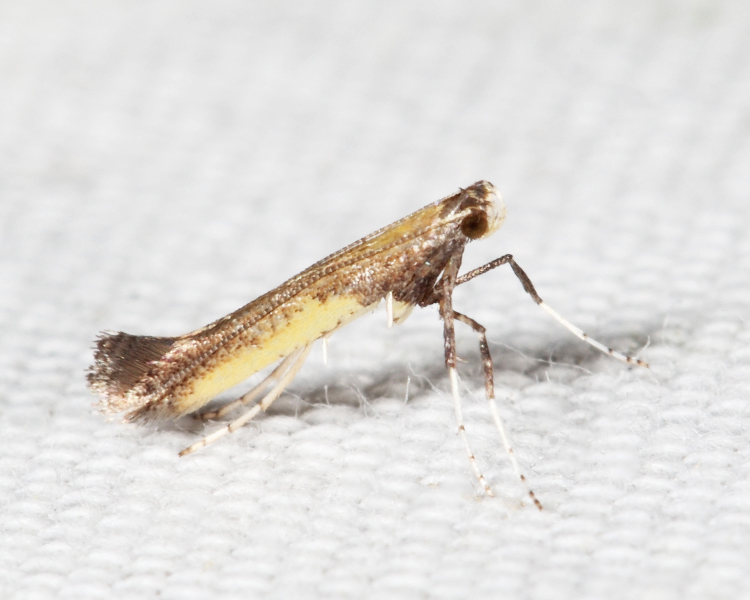
Azalea Leafminer Moth
Caloptilia azaleella
The azalea leaf miner (Caloptilia azaleella) is a moth of the Gracillariidae family. It is endemic to Japan, but has been introduced worldwide, wherever there are Azaleas.
From the article Caloptilia azaleella on Wikipedia (CC BY-SA), quoted section by section
Description
The type locality is Boskoop, Netherlands, and was described in 1913, from moths reared on Azalea indica, a cultivar of Rhododendron indicum, that was imported from Japan. The moths forewings are mainly dark brown with a yellow band along the costal margin. The wingspan is 10–11 millimetres (0.39–0.43 in) and it flies from May to October depending on the location and in Britain is double-brooded and sometimes there is a partial third brood.
Range & habitat
Initially described in the Netherlands from plants imported from Japan, it is found throughout Europe and has also been introduced in New Zealand and eastern Australia. In the southern part of Britain it occurs in sheltered gardens including Buckingham Palace, the Royal Botanic Gardens, Kew and the Royal Horticultural Society Gardens, Wisley. It has been widely reported in greenhouses. In the United States the species can be found from Florida to Texas, and as far north as Long Island, West Virginia, and the Ohio Valley. On the west Coast it is found in California, Washington and British Columbia, Canada.
Wikipedia: “Distribution”
What it does
Caloptilia azaleella deposits its eggs on azalea (Rhododendron spp) plants, under leaves near the midrib. These are the only hosts so far recorded. The larva initially forms a mine and later rolls the leaf downwards from the tip, forming a cone. When mature a pale-brown pupa is formed in a white, membranous silken cocoon spun beneath a leaf and the moths can mate a week later.
Wikipedia: “Ecology”
Listen
Looking for field recordings…
Where it lives
Recorded sightings
—
geo-referenced records in GBIF, from museums, herbaria and field observers.
Drag the globe to turn it. Dots are where records exist, not a range map; darker means more records.
In the stacks
Searching the stacks…
Every page naming Caloptilia azaleella in the Biodiversity Heritage Library →
This page is assembled live from iNaturalist, GBIF, Wikipedia, the Source Library and the Internet Archive. It is not yet part of the hand-edited codex. iNaturalist taxon 320764.