On eBird ↗
Cory's Shearwater
Live sightings near you, the range map, bar charts of when it is seen, and Macaulay Library photos and recordings.
Cory's Shearwater
Calonectris borealis
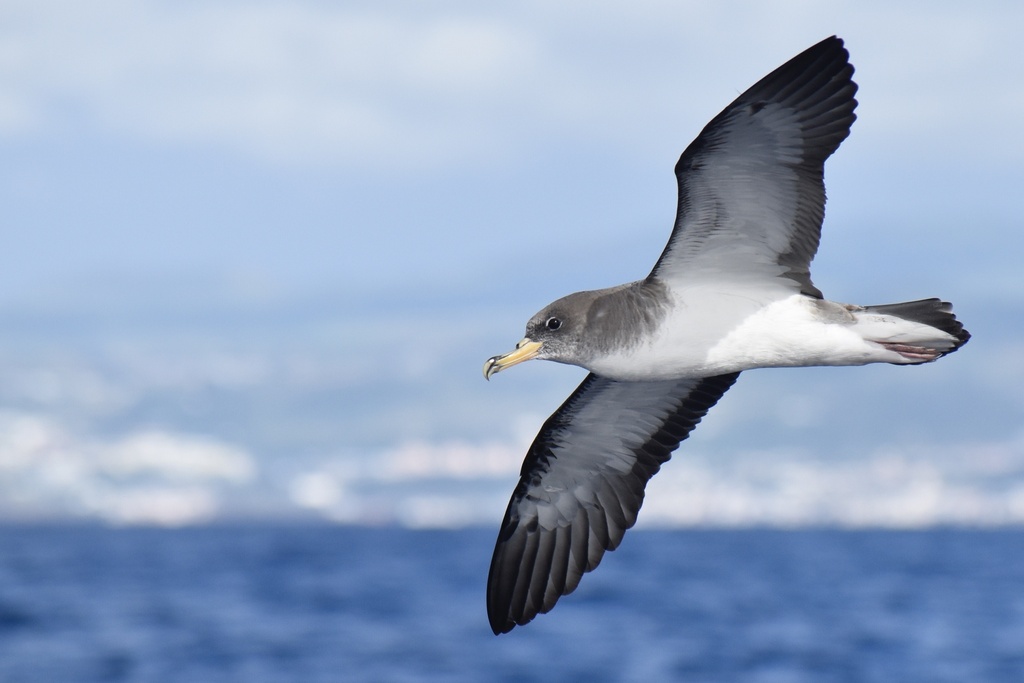
Cory's shearwater (Calonectris borealis) is a large shearwater in the seabird family Procellariidae. It breeds colonially on the archipelago of the Azores in the eastern Atlantic. Outside the breeding season it ranges widely in the Atlantic. It was formerly considered to be conspecific with Scopoli's shearwater.
From the article Cory's shearwater on Wikipedia (CC BY-SA), quoted section by section
Description
This shearwater is identifiable by its size, at 45–56 cm (18–22 in) in length and with a 112–126 cm (44–50 in) wingspan. It has brownish-grey upperparts, white underparts and a yellowish bill. It lacks the brown belly patch, dark shoulder markings and black cap of the great shearwater.
Range & habitat
This species breeds on Madeira, the Azores and the Berlengas Archipelago in Portugal and the Canary Islands in Spain.
Wikipedia: “Distribution and habitat”
What it does
This bird flies with long glides, and always with wings bowed and angled slightly back, unlike the stiff, straight-winged flight of the similarly sized great shearwater.
Breeding. They nest on open ground or among rocks or less often in a burrow where one white egg is laid. The burrow is visited at night to minimise predation from large gulls. In late summer and autumn, most birds migrate into the Atlantic as far north as the south-western coasts of Great Britain and Ireland. They return to the Mediterranean in February. The biggest colony is located in Savage Islands, Madeira.
Food and feeding. Cory's shearwater feeds on fish, molluscs and offal, and can dive deep (15 m (49 ft) or more) in search of prey. It readily follows fishing boats, where it indulges in noisy squabbles. This is a gregarious species, which can be seen in large numbers from ships or appropriate headlands. The Bay of Biscay ferries are particularly good for this species. It is silent at sea, but at night the breeding colonies are alive with raucous cackling calls.
Wikipedia: “Behaviour and ecology”
Listen
Looking for field recordings…
Where it lives
Recorded sightings
—
geo-referenced records in GBIF, from museums, herbaria and field observers.
Drag the globe to turn it. Dots are where records exist, not a range map; darker means more records.
In the stacks
Searching the stacks…
Every page naming Calonectris borealis in the Biodiversity Heritage Library →
This page is assembled live from iNaturalist, GBIF, Wikipedia, the Source Library and the Internet Archive. It is not yet part of the hand-edited codex. iNaturalist taxon 320711.