- Animals
- ›Arthropods
- ›Hexapods
- ›Insects
- ›Winged and Once-winged Insects
- ›Butterflies and Moths
- ›Geometrid and Swallowtail Moths
- ›Geometer Moths
- ›Ennominae
- ›Diptychini
- ›Petrophora
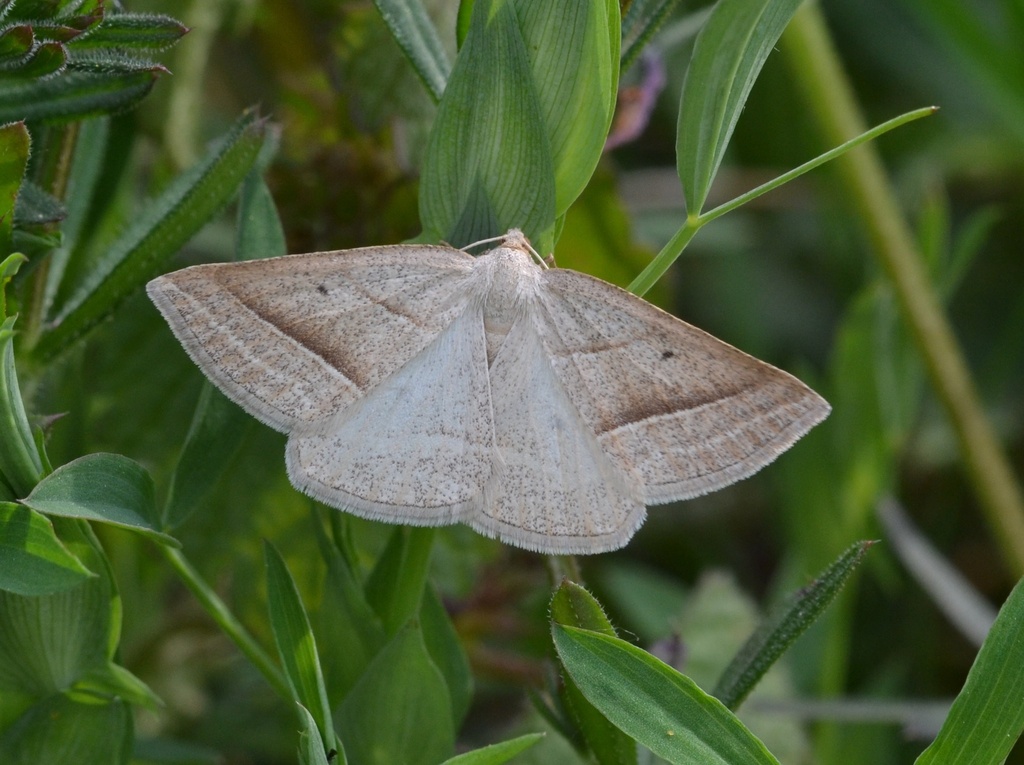
Brown Silver-line
Petrophora chlorosata
Petrophora chlorosata, the brown silver-line, is a moth of the family Geometridae found in Asia and Europe. The larvae feed on bracken. It was first described by the Italian physician and naturalist, Giovanni Antonio Scopoli in his 1763 Entomologia Carniolica.
From the article Petrophora chlorosata on Wikipedia (CC BY-SA), quoted section by section
Description
The wingspan is 31–37 mm. The length of the forewings is 15–18 mm. Quite distinct from all other Palearctic species, the forewing light brown, the lines finely whitish, proximally dark shaded, subterminal line rather straight, sometimes indistinct. The moth flies from the end of April to the end of June and are readily flushed from the foodpant or surrounding vegetation.[1] They are also attracted to light.
Ova The egg has an elliptical shape and is initially light yellow, later orange. It is covered with 24 to 25 longitudinal ribs. The microphyll rosette is nine to ten-leaf.
Larva The caterpillars have a brownish or greenish colour, show fine dark longitudinal lines and a wide whitish or yellowish side stripe. They feed on bracken (Pteridium aquilinum) from about mid-June to early September, although most have pupated in the soil by late July.
Pupa Overwinters as a pupa.
Range & habitat
It is found in the Palearctic extending from Ireland and Britain to Asia Minor, northern Iran, the Altai Mountains, Amdo, south-eastern Siberia, and Japan.
Wikipedia: “Distribution”
Listen
Looking for field recordings…
Where it lives
Recorded sightings
—
geo-referenced records in GBIF, from museums, herbaria and field observers.
Drag the globe to turn it. Dots are where records exist, not a range map; darker means more records.
In the stacks
Searching the stacks…
Every page naming Petrophora chlorosata in the Biodiversity Heritage Library →
This page is assembled live from iNaturalist, GBIF, Wikipedia, the Source Library and the Internet Archive. It is not yet part of the hand-edited codex. iNaturalist taxon 320699.