- Animals
- ›Chordates
- ›Vertebrates
- ›Reptiles
- ›Snakes and Lizards
- ›Lizards
- ›Glass, alligator, monitor lizards and allies
- ›Glass and Alligator Lizards
- ›Alligator Lizards
- ›Abronia
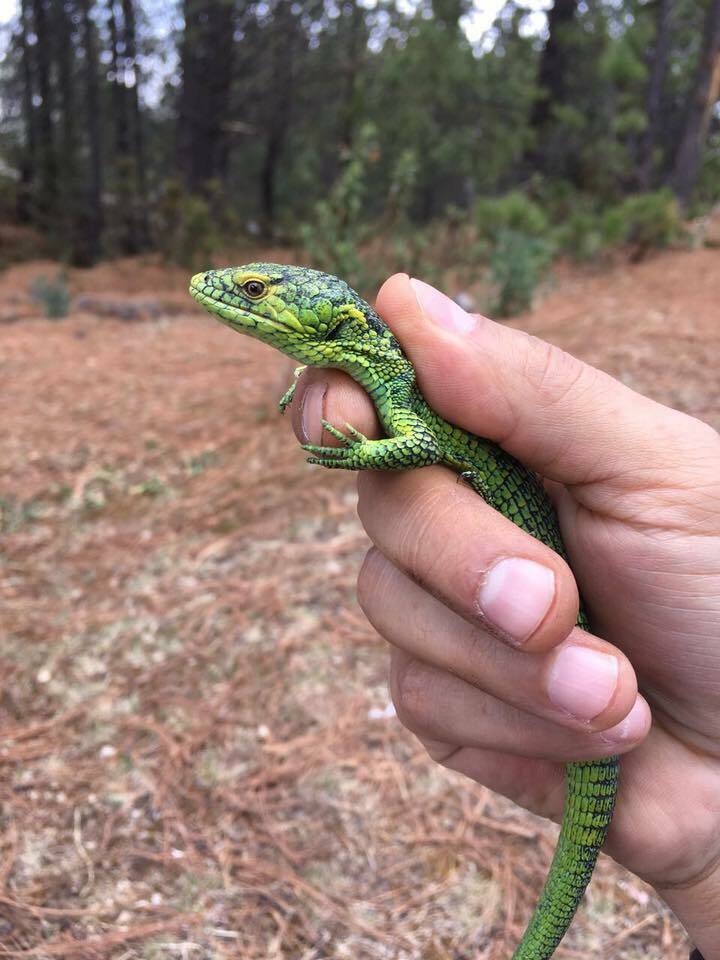
Matuda's Arboreal Alligator Lizard
Abronia matudai
Abronia matudai, also known commonly as Matuda's arboreal alligator lizard and escorpión arborícola de Matuda in New World Spanish, is a species of endangered arboreal alligator lizard in the family Anguidae. The species, which was originally described in 1946 by Norman Hartweg and Joseph Tihen, is native to Middle America.
From the article Abronia matudai on Wikipedia (CC BY-SA), quoted section by section
Description
Dorsally, Abronia matudai is green in life (fading to blue gray in alcohol), with about 11 dark crossbars on the head and body, and a corresponding number on the tail. The holotype has a snout-to-vent length (SVL) of 77 mm (3.0 in), and the tail is approximately the same length.
Range & habitat
Abronia matudai is found in southwestern Guatemala and southeastern Chiapas, Mexico.
Wikipedia: “Geographic distribution”
In human culture
The specific name, matudai, is in honor of Eizi Matuda, a Japanese-born Mexican botanist.
Wikipedia: “Etymology”
Where it lives
Recorded sightings
—
geo-referenced records in GBIF, from museums, herbaria and field observers.
Drag the globe to turn it. Dots are where records exist, not a range map; darker means more records.
In the stacks
Searching the stacks…
Every page naming Abronia matudai in the Biodiversity Heritage Library →
This page is assembled live from iNaturalist, GBIF, Wikipedia, the Source Library and the Internet Archive. It is not yet part of the hand-edited codex. iNaturalist taxon 32009.