- Animals
- ›Arthropods
- ›Hexapods
- ›Insects
- ›Winged and Once-winged Insects
- ›Ants, Bees, Wasps, and Sawflies
- ›Narrow-waisted Wasps, Ants, and Bees
- ›Ants, Bees, and Stinging Wasps
- ›Formicoidea
- ›Ants
- ›Odorous Ants
- ›Leptomyrmecini
- ›Dorymyrmex
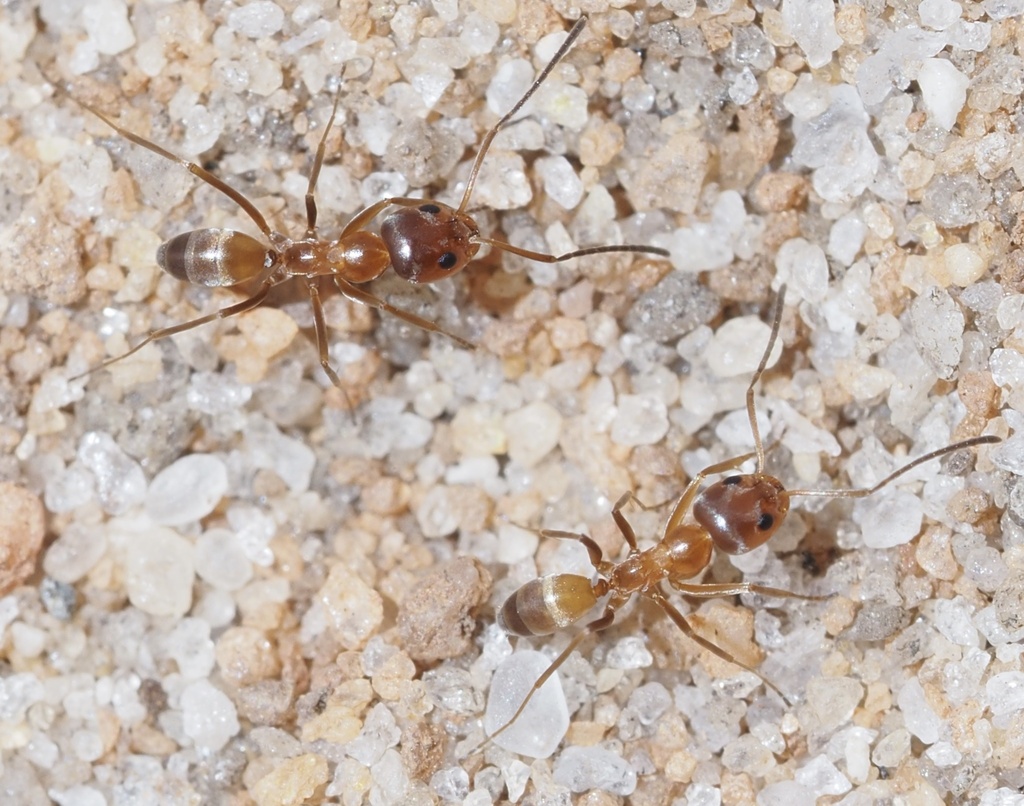
Buren's Pyramid Ant
Dorymyrmex bureni
Dorymyrmex bureni, also known as Buren's pyramid ant, is a species of ant in the genus Dorymyrmex. Described by Trager in 1988, the species is endemic to the United States. Pyramid ants are medium-sized ants, ranging from 2–4 mm. They are light orange in color and fast moving. Unlike other ant species in the area like the red imported fire ant (Solenopsis invicta), this species is relatively harmless to humans and unable to sting. The workers have a foul smelling coconut odor when crushed. Dorymyrmex bureni hunt living insects, even other winged ants. They also search for sap-sucking insects from which they collect honeydew. On the head of these ants are curved hairs, used for transporting beads of damp sand. Colonies are small. Nests usually have a single entrance with a mound of sand shaped like a crater. Dorymyrmex bureni prefer sandy soil. This species of ant is not an indoor pest, and the use of pesticides to control them is not necessary. They are found throughout the southeastern United States.
From the article Dorymyrmex bureni on Wikipedia (CC BY-SA), quoted section by section
Range & habitat
This species is almost entirely restricted to the Atlantic Coastal Plain, with populations extending to just outside the coastal plain in Alabama and Georgia. The latitudinal range is continuous from the Florida Keys along the American east coast to coastal New Jersey. There are disagreements in literature as to the westernmost extend of D. bureni populations, with some sources claiming Mississippi and others claiming eastern Texas. Modern verifiable records seem to stop around the Mississippi River. The disagreement on the westernmost extent of its range is likely due to the presence of the similar species Dorymyrmex flavus having a distribution that either borders or overlaps directly to the west of the range of D. bureni. Dorymyrmex bureni is also introduced to the manmade island of Ocean Cay in the Bahamas.
Wikipedia: “Distribution”
Listen
Looking for field recordings…
Where it lives
Recorded sightings
—
geo-referenced records in GBIF, from museums, herbaria and field observers.
Drag the globe to turn it. Dots are where records exist, not a range map; darker means more records.
In the stacks
Searching the stacks…
Every page naming Dorymyrmex bureni in the Biodiversity Heritage Library →
This page is assembled live from iNaturalist, GBIF, Wikipedia, the Source Library and the Internet Archive. It is not yet part of the hand-edited codex. iNaturalist taxon 319444.