- Plants
- ›Vascular Plants
- ›flowering plants
- ›Dicots
- ›Soapberries, Cashews, Mahoganies, and Allies
- ›soapberry family
- ›Diploglottis
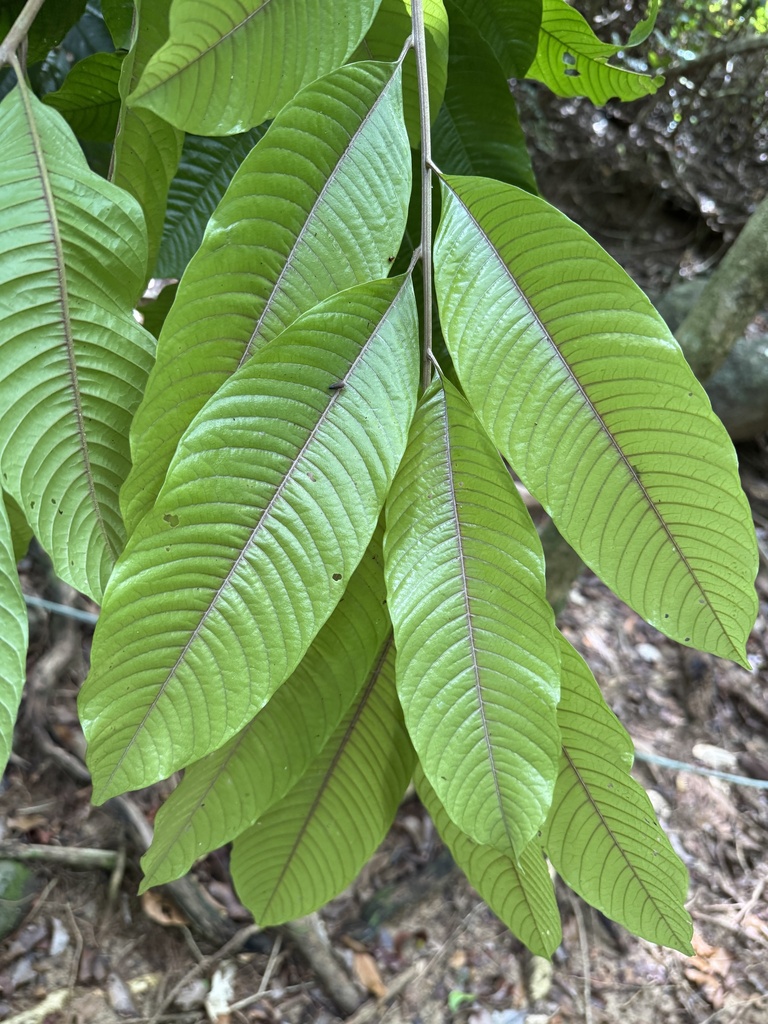
Diploglottis smithii
Diploglottis smithii, commonly known as Smith's tamarind or wild tamarind, is a plant in the maple family Sapindaceae found only in the Wet Tropics bioregion of Queensland, Australia.
From the article Diploglottis smithii on Wikipedia (CC BY-SA), quoted section by section
Description
It is a tree up to 18 m tall and 60 cm trunk diameter, and it may produce buttress roots. The large compound leaves can reach 47 cm in length (including the petiole), with between 4 and 6 pairs of leaflets. The leaflets have 24–34 lateral veins set about 7 mm apart, which are depressed in the upper surface (i.e. they are bullate). The inflorescence is a thyrse with numerous small flowers about 5 mm diameter. The fruits are yellowy-green, 2- or 3-valved capsules about 1.8 cm long and 3 cm wide, each valve containing a single brown seed entirely enclosed in an orange aril.
Range & habitat
Smith's tamarind is restricted to coastal rainforest in northeast Queensland from about Cooktown to just south of Innisfail, at altitudes from sea level to 450 m.
Wikipedia: “Distribution and habitat”
In human culture
The genus name Diploglottis comes from the Neo-Latin words diplo- meaning double, and glottis meaning tongue, which is a reference to the two tongue-like scales on the petals. The species epithet smithii was chosen to honour the botanist Lindsay Stuart Smith who collected the type specimen in 1948, and was an authority on Sapindaceae in Australia.
Wikipedia: “Etymology”
Where it lives
Recorded sightings
—
geo-referenced records in GBIF, from museums, herbaria and field observers.
Drag the globe to turn it. Dots are where records exist, not a range map; darker means more records.
In the stacks
Searching the stacks…
Every page naming Diploglottis smithii in the Biodiversity Heritage Library →
This page is assembled live from iNaturalist, GBIF, Wikipedia, the Source Library and the Internet Archive. It is not yet part of the hand-edited codex. iNaturalist taxon 319394.