- Animals
- ›Chordates
- ›Vertebrates
- ›Reptiles
- ›Snakes and Lizards
- ›Lizards
- ›Wall lizards, amphisbaenians, and allies
- ›Whiptails and Tegus
- ›Tupinambinae
- ›Salvator
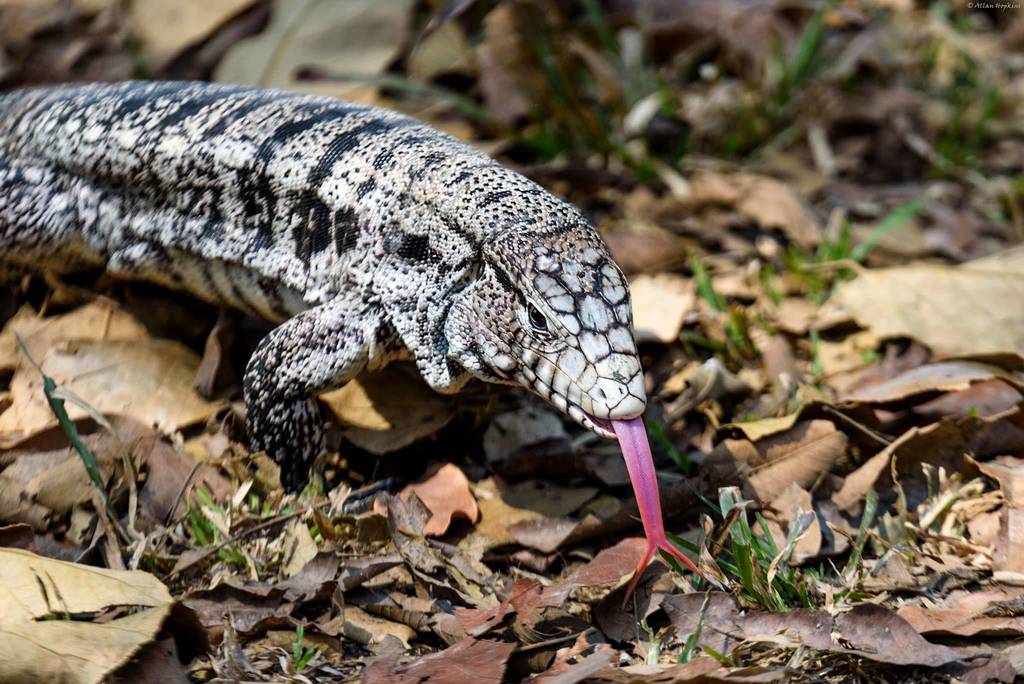
Argentine Black-and-white Tegu
Salvator merianae
The Argentine black and white tegu (Salvator merianae), also commonly known as the Argentine giant tegu, the black and white tegu, the blue tegu, and the huge tegu, is a species of lizard in the family Teiidae. The species is the largest of the "tegu" lizards. It is an omnivorous species, which inhabits the tropical rain forests, savannas, and semideserts of eastern and central South America. It is native to south and southeastern Brazil, Uruguay, eastern Paraguay, Bolivia, and Argentina.
Tegu lizards are sometimes kept as pets, being notable for their unusually high intelligence and their relatively gentle nature. Like some reptiles, tegus enter brumation in autumn when ambient temperature drops. They exhibit a high level of activity during their wakeful period of the year. They are the only known nonavian reptiles to be partly endothermic during breeding season.
From the article Argentine black and white tegu on Wikipedia (CC BY-SA), quoted section by section
Description
As a hatchling, Salvator merianae has an emerald-green color from the tip of its snout to midway down its neck, with black markings. The emerald green becomes black several months after shedding. As a young tegu, the tail is banded yellow and black; as it ages, the solid yellow bands nearest to the body change to areas of weak speckling. Fewer solid bands indicate an older animal. A tegu can drop a section of its tail as a distraction if attacked. The tail is also used as a weapon to swipe at an aggressor or potential predator. Capable of living 12 to 15 years in the wild, tegus could survive more than 20 years in captivity with excellent care. The skull is heavily built with a large facial process of the maxilla, a single premaxilla, paired nasals, a single frontal bone, and two parietal bones separated by the sagittal suture. Biomechanical analyses suggest the posterior processes of the parietal might be important for dealing with torsional loads due to posterior biting on one side. In the large adults, the posterior teeth are larger and more rounded than the anterior teeth.
Sexual dimorphism. Adult males, much larger than the females, can exceed 120 cm (4 ft) in total length (tail included) at maturity. They may continue to grow to total lengths of 120–140 cm (4–4.5 ft). The females are smaller, but may grow up to 100 cm (3 ft) in length from nose to tail tip. …
Range & habitat
As one of its common names would suggest, Salvator merianae is native to Argentina, but also to Brazil, Paraguay, Bolivia, and Uruguay. Significant populations of Argentine black and white tegus occur in the southern United States and the Brazilian coast. They are a consistently problematic invasive species in Florida and Georgia, along with sightings in South Carolina, most likely as a result of escaped or released specimens from the early-2000s pet trade. Previous studies have found that the differing weather and climate patterns far outside of their natural habitat range do not prevent adult Argentine black and white tegus from surviving in diverse areas across the United States, furthering concerns about their invasive status. In the wild, tegus inhabit both forested and open-plain environments, widening their potential invasive range. The first evidence of a reproducing population of these tegus into southeastern Florida occurred when a female was tracked to her nest mound. One clutch of 21 eggs from the current year was found and one clutch of 22 hatched eggshells and 13 unhatched eggs was found from a past year. Established communities were identified in Hillsborough and Polk Counties in Florida. Tegus have also been found in scrub and wet habitats such as flooded savannas, canals, ponds, and streams. …
Wikipedia: “Distribution and habitat”
What it does
Tegus are omnivorous; juveniles in the wild have been observed to eat a wide range of vertebrates, invertebrates, fruits, and seeds. A non-exhaustive list includes insects, annelids, crustaceans, spiders, snails, small birds, fish, frogs, other lizards, snakes rodents, armadillos, bananas, grapes, mangoes, and papayas. Tegus are notorious egg predators, seeking out eggs from the nests of birds and other reptiles. This makes them a concerning predator of sea turtles, alligators, and crocodiles as their invasive populations spread across the United States. As adults, their plant consumption increases, but their diet varies by season, with small vertebrate prey being more common in the spring, while plants and invertebrates are more commonly consumed in the summer. In captivity, tegus commonly are fed high-protein diets that include raw or cooked flesh, such as ground turkey, canned or dry dog food, commercial crocodile diet, chicken, eggs, insects, and small rodents. They are also fed various feeder insects, such as mealworms, superworms, earthworms, silkworms, crickets, and cockroaches. Some evidence indicates that cooking most of the egg in the diet is a good practice, so as to denature the protein avidin that occurs in the albumen. …
Wikipedia: “Diet”
At the table
S. merianae – like other animals used for bushmeat – is a common food source for humans in its native range. It could be an economically and dietarily beneficial meat source if used more widely.
Wikipedia: “As food”
In human culture
The Argentine black and white tegu is a member of the family Teiidae, which also includes racerunners and whiptails. The term "tegu" refers to 9 genera within Teiidae (though new taxonomic classifications change), with the Argentine black and white tegu being assigned to the genus Salvator. In 1839, this species of tegu was originally described as Salvator merianae. However, beginning in 1845 and continuing for 154 years, it was confused with Tupinambis teguixin and was considered a synonym of that species. In 1995, it was again given species status, as Tupinambis merianae because subsequent studies had shown that the gold tegu (Tupinambis teguixin) was distinct from it. In 2012, the Argentine black and white tegu was reassigned to the resurrected genus Salvator as Salvator merianae. The genus Salvator can be distinguished from Tupinambis by the presence of two loreal scales between the eye and the nostril, as opposed to only one.
Etymology. The specific name, merianae, is in honor of German-born naturalist Maria Sibylla Merian, a naturalist and artist who studied insects, plants, and reptiles from the 17th to the 18th centuries. S. merianae is called the "Argentine black and white tegu" to distinguish it from the "Colombian black and white tegu", which is another name for the gold tegu. …
Wikipedia: “Taxonomy and etymology”
Where it lives
Recorded sightings
—
geo-referenced records in GBIF, from museums, herbaria and field observers.
Drag the globe to turn it. Dots are where records exist, not a range map; darker means more records.
In the stacks
Searching the stacks…
Every page naming Salvator merianae in the Biodiversity Heritage Library →
This page is assembled live from iNaturalist, GBIF, Wikipedia, the Source Library and the Internet Archive. It is not yet part of the hand-edited codex. iNaturalist taxon 318758.