On eBird ↗
New Caledonian Imperial-Pigeon
Live sightings near you, the range map, bar charts of when it is seen, and Macaulay Library photos and recordings.
Goliath Imperial Pigeon
Ducula goliath
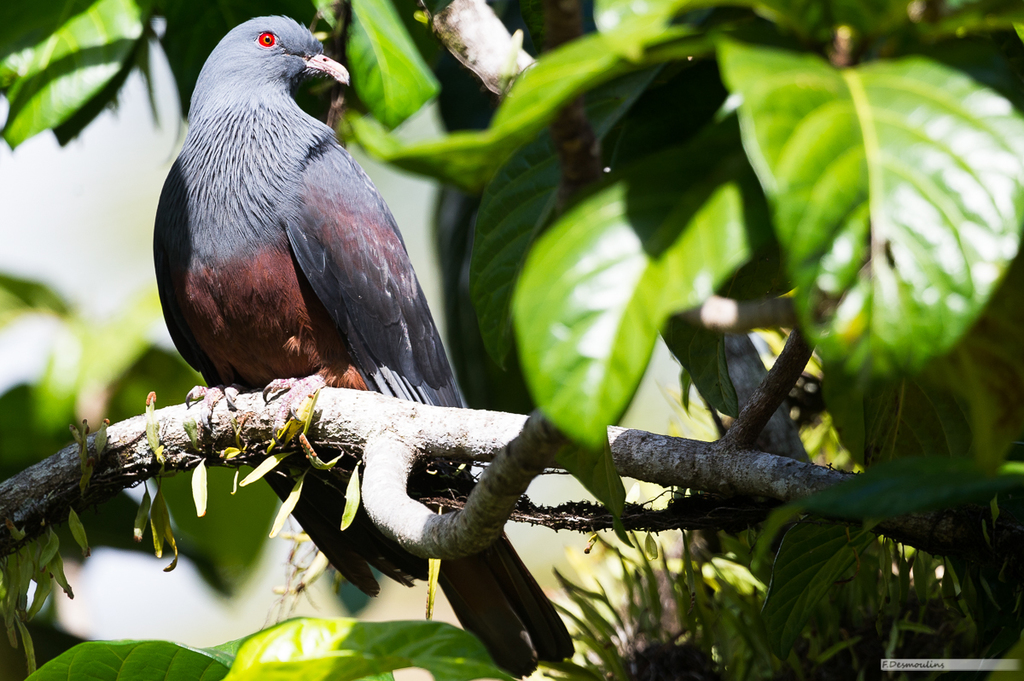
The goliath imperial pigeon (Ducula goliath), also known as the New Caledonian imperial pigeon and the notou, is a species of bird in the family Columbidae. It is endemic to New Caledonia. Its natural habitat is humid forests. The International Union for Conservation of Nature (IUCN) has assessed it as a near-threatened species.
From the article Goliath imperial pigeon on Wikipedia (CC BY-SA), quoted section by section
Description
The goliath imperial pigeon is about 51 cm (20 in) long, making it one of the largest species of arboreal pigeon. It is a slender bird with a long tail, weighing 600–716 g (21.2–25.3 oz). The head and neck are blue-grey. The upperparts and wings are sooty-grey, with a grey panel on the primaries' bases. The tail is black and has a dark chestnut band. The neck and upper breast have bifurcated feathers, so they appear shaggy or furrowed. The lower breast is sooty-grey, the belly and flanks are purplish-chestnut, and the vent is buffy-yellow. The eye is bright red, and the beak and feet are pinkish or vinous-red. The juvenile bird has a duller plumage, with no bifurcations.
Range & habitat
This pigeon is endemic to New Caledonia, on Grande Terre and the Isle of Pines. Its habitat is mostly humid primary forest, up to 1,500 m (4,900 ft) in elevation.
Wikipedia: “Distribution and habitat”
What it does
The goliath imperial pigeon is found singly or in pairs. It feeds on fruits, leaves and flowers, and it moves locally to eat fruits. Early in the morning, it warms itself on a branch. Its call is a low oom, and it also gives a gkrarr at dusk. It breeds from June to December. The nest, 30–40 cm (12–16 in) in diameter, is woven from twigs and built on a branch. One white egg is laid and incubated by both parents.
Wikipedia: “Behaviour”
Listen
Looking for field recordings…
Where it lives
Recorded sightings
—
geo-referenced records in GBIF, from museums, herbaria and field observers.
Drag the globe to turn it. Dots are where records exist, not a range map; darker means more records.
In the stacks
Searching the stacks…
Every page naming Ducula goliath in the Biodiversity Heritage Library →
This page is assembled live from iNaturalist, GBIF, Wikipedia, the Source Library and the Internet Archive. It is not yet part of the hand-edited codex. iNaturalist taxon 3178.