- Animals
- ›Chordates
- ›Vertebrates
- ›Ray-finned Fishes
- ›Spiny-rayed fishes
- ›Pipefishes and Allies
- ›Syngnathoidei
- ›Pipefishes, Seahorses, and Seadragons
- ›Tail-brooding Pipefishes
- ›Syngnathus
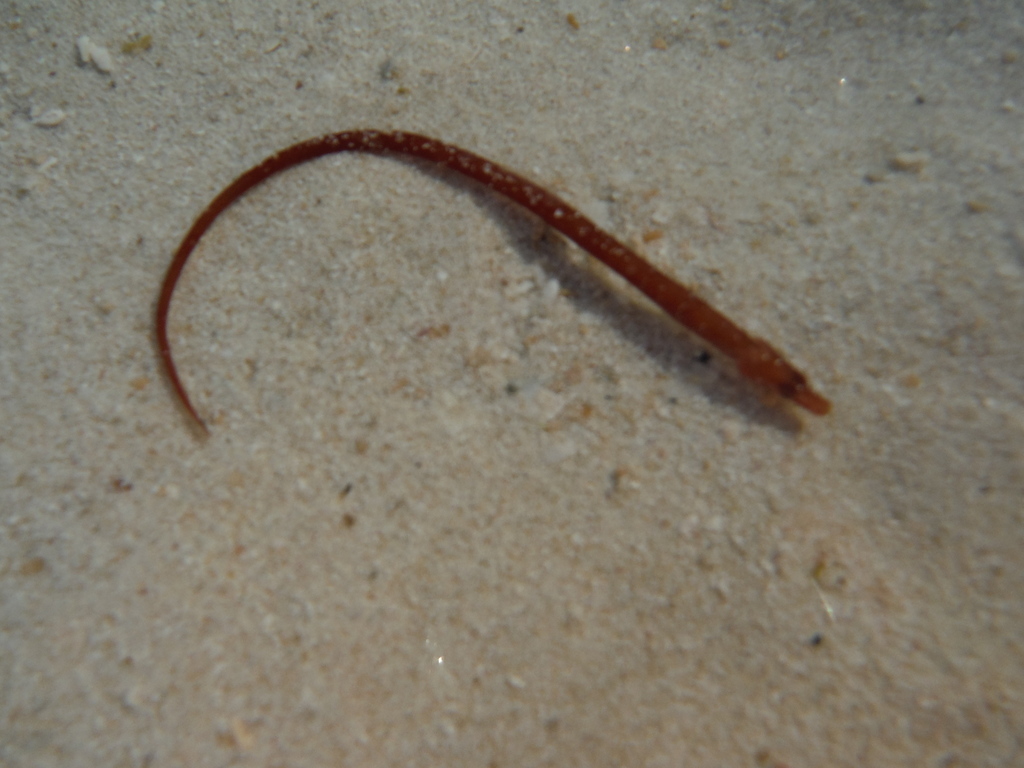
Yucatan Pipefish
Syngnathus makaxi
Yucatán pipefish, Syngnathus makaxi, is a pipefish species, inhabits the Western and Central Atlantic, in Mexico. Marine tropical demersal fish.
From the article Yucatan pipefish on Wikipedia (CC BY-SA), quoted section by section
Range & habitat
The Yucatan Pipe fish, Syngnathus makaxi, is indigenous to the Caribbean coast of Mexico near the Isla Majeures in the Laguna Makax (Herald and Dawson 1972). This island is approximately 13 kilometers from the northern coast of the Yucatan peninsula. Syngnathidae specimens, including fossils, are found in most areas of the world with heavy distributions along coast lines and freshwater rivers (Herald and Dawson 1972). Syngnathus makaxi is a subspecies of Syngnathus scovelli also known as the gulf pipefish. The gulf pipefish can be found in waters ranging from Florida to the Gulf of Mexico and Yucatan. The widespread area of geographic range allowed the subspecies S. makaxi over time to isolate and evolve with new defining characteristics.
Wikipedia: “Geographic range”
What it does
Sex roles in pipefishes are reversed in that the males are responsible for carrying the offspring to term. Due to the sex-role reversal, females often compete with one another for a male mate (Wilson, Ahnesjo, Vincent and Meyer 2002). Sexes are dimorphic, meaning that the females are often larger are more vibrant in color. Females that are larger and tend to be sexually selected more than the smaller females (Wilson, Ahnesjo, Vincent and Meyer 2002). The females within the species have demonstrated polygamous mating patterns, and the males have a longer-term parental investment (Svensson 1998). The cost of brooding in males is a lower risk of survival throughout winter because fat deposition was lowered as a result of parental commitment (Svensson 1998). S. makaxi belongs is a sub species of Syngnathus scovelli, and they are one of the two noted species that can breed in fresh and marine waters (Herald and Dawson 1972). It may be assumed that in males’ paternal investment per offspring is greater than the female’s investment in producing eggs than the males may limit the reproductive success for females within a population (Svensson 1998).
Wikipedia: “Reproduction”
At the table
S. Makaxi, along with other members of the pipefish family are commonly identified by an elongated snout that is used to with suction to devour small prey. Due to the size and confirmation of their mouths, members of the genus are limited by the size of their prey (Ryer and Orth 1987). S. Makaxi is considered carnivorous and consumes amphipods and copepods (Huh, Knitting 1985). Many pipefishes utilize their habitat and while camouflaged in tall sea grasses, use a “sit and wait” technique when hunting for food (Tipton and Bell 1988).
Wikipedia: “Food habits”
Where it lives
Recorded sightings
—
geo-referenced records in GBIF, from museums, herbaria and field observers.
Drag the globe to turn it. Dots are where records exist, not a range map; darker means more records.
In the stacks
Searching the stacks…
Every page naming Syngnathus makaxi in the Biodiversity Heritage Library →
This page is assembled live from iNaturalist, GBIF, Wikipedia, the Source Library and the Internet Archive. It is not yet part of the hand-edited codex. iNaturalist taxon 317417.