- Animals
- ›Chordates
- ›Vertebrates
- ›Ray-finned Fishes
- ›Spiny-rayed fishes
- ›Rivulines, Killifishes, and Livebearers
- ›Cyprinodontoidei
- ›Live-bearers and Topminnows
- ›Typical Livebearers
- ›Poecilia
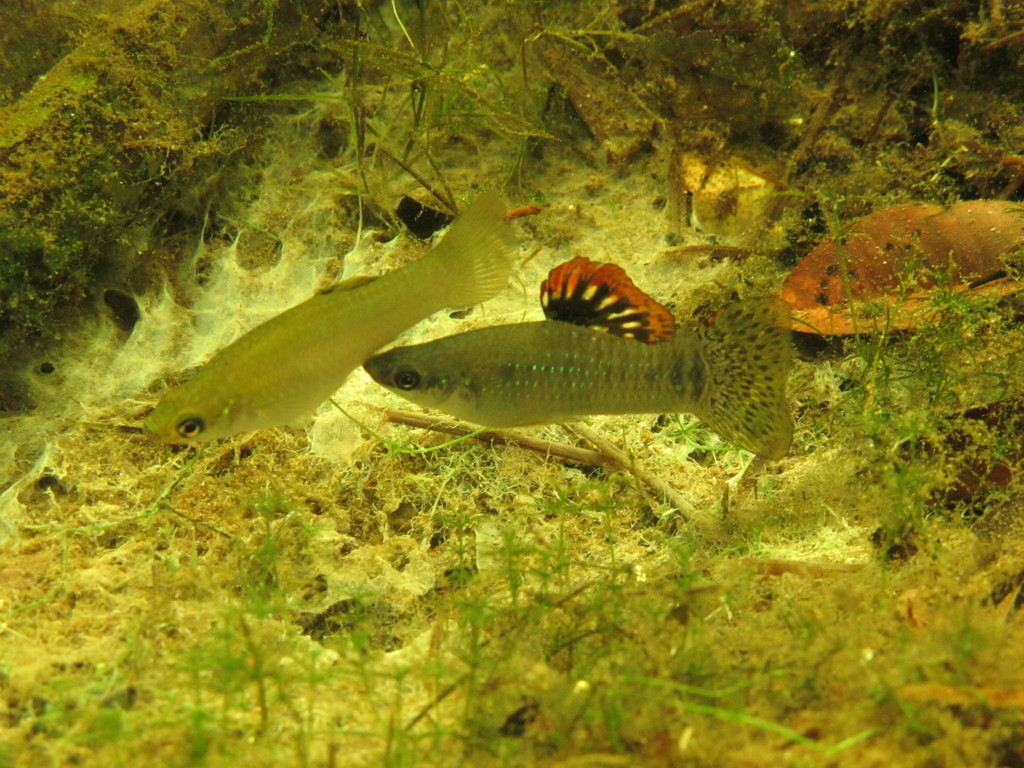
Mangrove Molly
Poecilia orri
Poecilia orri, the mangrove molly, is a brackish-water livebearer fish from Central America. Two morphs exist, differing in size, body shape, and coloring.
From the article Poecilia orri on Wikipedia (CC BY-SA), quoted section by section
Description
Two morphs of the mangrove molly exist: P. orri "orri" and P. orri "vetiprovidentiae". The former is smaller, has no visible markings on its body, and only has a little black spot on its dorsal fin. The medium-size P. orri "vetiprovidentiae" is a larger and deeper-bodied morph with a spotted dorsal fin. Alpha males of the latter morph normally have a humeral spot and a red or yellow dorsal fin. Both sexes differ between the morphs. Intermediate forms have not been reported.
Range & habitat
P. orri is distributed from the eastern side of the Yucatán Peninsula in the Mexican states of Yucatan and Quintana Roo through Belize to northern Honduras, including Bay Islands and Hog Island, as well as Colombia's Old Providence Island. The preferred habitats of P. orri are coastal lagoons, coral reefs, ponds, and river mouths. In creeks close to Belize City it occurs with the closely related P. mexicana. Although essentially a brackish water species, it can live and reproduce in both freshwater and saltwater habitats. The two morphs, P. orri "orri" and P. orri "vetiprovidentiae", occur in the same range but occupy different microhabitats.
Wikipedia: “Distribution and habitat”
What it does
Gut analyses have shown mangrove mollies to be herbivorous. The fish feed on cyanobacteria. They form shoals near the substrate, where they browse, and stay close to shelter such as mangrove or floating algae. In the cenotes along the Riviera Maya the species is found alongside the livebearer Gambusia yucatana, catfish Rhamdia quelen, and a Rocio cichlid. Males do not court females but rely exclusively on "sneaky" forced copulations.
Wikipedia: “Behavior”
Where it lives
Recorded sightings
—
geo-referenced records in GBIF, from museums, herbaria and field observers.
Drag the globe to turn it. Dots are where records exist, not a range map; darker means more records.
In the stacks
Searching the stacks…
Every page naming Poecilia orri in the Biodiversity Heritage Library →
This page is assembled live from iNaturalist, GBIF, Wikipedia, the Source Library and the Internet Archive. It is not yet part of the hand-edited codex. iNaturalist taxon 317294.