- Animals
- ›Chordates
- ›Vertebrates
- ›Ray-finned Fishes
- ›Spiny-rayed fishes
- ›Butterflyfishes, Angelfishes, and Allies
- ›Seabreams and Porgies
- ›Calamus
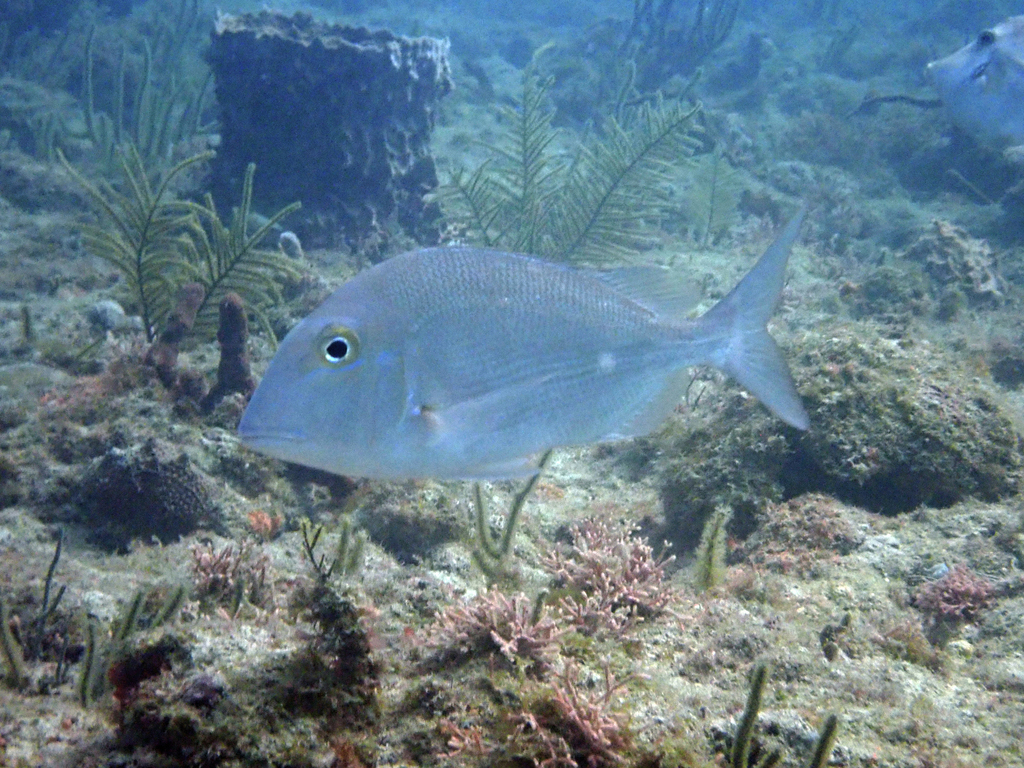
Pluma Porgy
Calamus pennatula
The Pluma porgy (Calamus pennatula) is an ocean-going fish of the family Sparidae. In many parts of the Caribbean, it is simply known as the Pluma, while in Jamaica can be called the Pimento grunt, and is sometimes called the West Indian porgy in the United States. The Pluma porgy was described by Alphone Guichenot, a French zoologist who taught, researched, and participated in specimen collecting trips on behalf of the National Natural History Museum in...
From the article Pluma porgy on Wikipedia (CC BY-SA), quoted section by section
Description
The pluma porgy is similar to its relative, the Jolthead porgy (C. bajonado). However, it has fewer rays on its Pectoral fins than the Jolthead. The pluma porgy has both 12 spines and 12 soft rays on its dorsal fin, while it has only 3 spines and 10 rays on its anal fin. Their heads are somewhat steep when viewed in profile, and have poorly developed prefrontal tubercles. The puma porgy's overall color is silvery with purple, or lavender iridescence, individual scales have brown-yellow edges with iridescent, blue-green spots. This species has a maximum published total length of 37 cm (15 in), although 30 cm (12 in) is more typical.
Range & habitat
Pluma porgies inhabit are found only in the western Atlantic, in a region from the Bahamas to Brazil; this includes much of the southern Caribbean and the Gulf of Mexico. Adults live at depths of up to 85 metres (279 ft), but usually between 5 and 30 metres (16 and 98 ft). They inhabit rocky areas, reefs, and also flat bottoms, where they feed on crabs, mollusks, sea worms, brittle stars and hermit crabs. The young are found in somewhat shallower water.
Wikipedia: “Distribution and habitat”
In human culture
The pluma porgy has the specific name pennatula which is a diminutive of penna, meaning "quill". Guichenot did not explain this but it may be an allusion to this species similarity to C. penna or to the shorter, more elongated body of this species compared to C. penna. In many parts of the Caribbean, this species is simply known as the pluma, while in Jamaica it is sometimes called the pimento grunt, and is sometimes known as the West Indian porgy in the United States.
Wikipedia: “Etymology and common names”
Where it lives
Recorded sightings
—
geo-referenced records in GBIF, from museums, herbaria and field observers.
Drag the globe to turn it. Dots are where records exist, not a range map; darker means more records.
In the stacks
Searching the stacks…
Every page naming Calamus pennatula in the Biodiversity Heritage Library →
This page is assembled live from iNaturalist, GBIF, Wikipedia, the Source Library and the Internet Archive. It is not yet part of the hand-edited codex. iNaturalist taxon 317017.