- Animals
- ›Chordates
- ›Vertebrates
- ›Reptiles
- ›Snakes and Lizards
- ›Lizards
- ›Iguanas and Allies
- ›Dragons and Chameleons
- ›Dragons
- ›Bearded Dragons, Water Dragons, and Allies
- ›Tympanocryptis
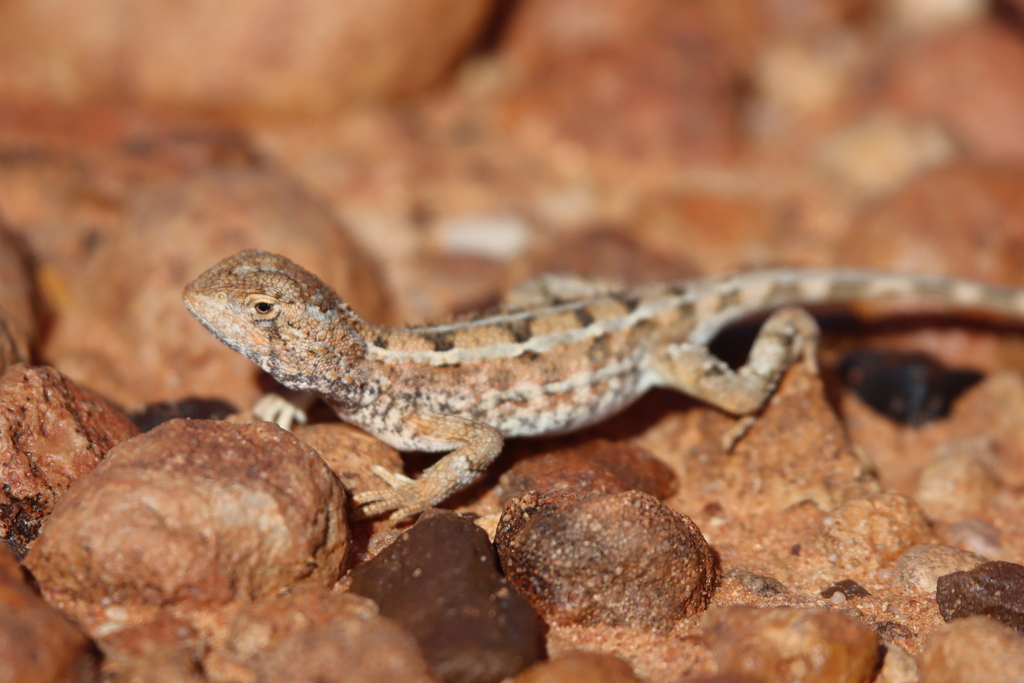
Eyrean Earless Dragon
Tympanocryptis tetraporophora
Tympanocryptis tetraporophora, also known as Eyrean earless dragon or long-tailed earless dragon, is one of a documented species of a relatively small dragon belonging to the genus Tympanocryptis. Tympanocryptis is differentiated from other genera within the family Agamidae by a tympanum covered with scales and a missing phalange in the fifth toe of the rear foot.
T. tetraporophora is a ground dwelling dragon inhabiting semi arid regions of central New South Wales, arid regions of South Australia, Northern Territory, Queensland and tropical grasslands of Northern Queensland.
From the article Tympanocryptis tetraporophora on Wikipedia (CC BY-SA), quoted section by section
Description
T tetraporophora has been described as a slender medium-sized Tympanocryptis with a distinct neck and a blunt roundly shaped snout with the nostril been closer to the eyes then to the end of the snout. The limbs are slender and somewhat moderately long and the tail tapers into a rounded tip. They have four pores, two are preanal pores; and two femoral pores, one on each side. Its colour and pattern can be variable with a red-brown to brown base colour with four to six broken dark cross bands on body and a pale ventral stripe that may not be very visible. Typically have dark brown bands on legs and tail. However, in mature females there can be next to no patterning.
Range & habitat
T tetraporopho distribution covers a large area, some of which is disjunct and or continuous which includes four states South Australia, the Northern Territory, New South Wales and Queensland. T tetraporophora distribution overlaps with other Tympanocryptis including T cephalus, T lineata, T intima and T pentalineata. T tetraporophora can be identified from the former three species by the presence of four pores and by the latter T pentalineata sp. nov with the absence of five longitudinal body stripes. T tetraporophora habitat is indicative of its wide and varied distribution, from the semi-arid to arid regions encompassing gibber plains, grassland and shrub land associated with stoney plains and hills, hiding in cracks of dried out river floodplains and overflows. Its extensive range also includes tropical savannah grasslands in the Gulf region of northern Queensland.
Wikipedia: “Distribution and habitat”
What it does
T tetraporophora are oviparous meaning they lay eggs. Breeding occurs between early spring and mid autumn. Females become sexually mature at a Mean Snout Vent Length(SVL) around 46mm and males are sexually active at about 42mm SVL. Mature females can range from 46 to 72mm SVL the average been around 58mm. Clutch sizes can vary from between 1 and 14 eggs, there is a positive association with the size of the female and how many eggs are laid. As a female matures they tend to lose the stripes and dark blotches and become totally without any pattern at around 55mm SVL. Mature Males on the other hand do not lose their stripes or blotches.
== References ==
Wikipedia: “Sexual Reproduction and Dimorphism”
Where it lives
Recorded sightings
—
geo-referenced records in GBIF, from museums, herbaria and field observers.
Drag the globe to turn it. Dots are where records exist, not a range map; darker means more records.
In the stacks
This page is assembled live from iNaturalist, GBIF, Wikipedia, the Source Library and the Internet Archive. It is not yet part of the hand-edited codex. iNaturalist taxon 31341.