- Animals
- ›Chordates
- ›Vertebrates
- ›Reptiles
- ›Snakes and Lizards
- ›Lizards
- ›Iguanas and Allies
- ›Dragons and Chameleons
- ›Dragons
- ›Flying Dragons and Allies
- ›Bronchocela
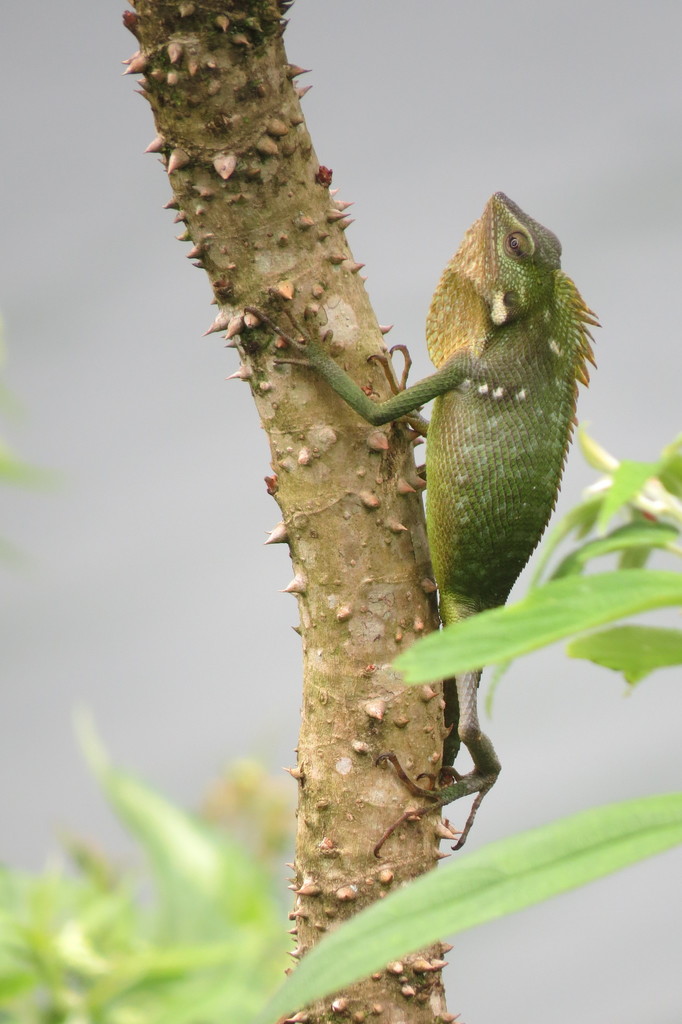
Maned Forest Lizard
Bronchocela jubata
Bronchocela jubata, commonly known as the maned forest lizard, is a species of agamid lizard found mainly in Indonesia on the islands of Singkep, Java, Bali, parts of Malaysia Sulawesi, Karakelang, Salibabu; Nias Island, Singkap Island, Borneo (Kalimantan) also in Thailand, Cambodia and Philippines. Although in the past it was thought the species may be found in India, either on the mainland or in the Nicobars, this is not the case according to herpetologist Das. It is also known by the common name of "bloodsucker", although this is a misnomer.
From the article Bronchocela jubata on Wikipedia (CC BY-SA), quoted section by section
Description
Bronchocela jubata is 550 mm (22 in) in total length, with a long hanging tail making up four fifths of its total length. It has a jagged crest on its neck which more closely resemble hairs, as opposed to the crest of its close relative, B. cristatella, which more closely resembles the points on a crown. The crest consists of elongated scales, although it is flabby like skin. The head is square in shape, and there is a soft sack under the chin. It has large, flexible eyelids made of fine speckled scales. The dorsal area is coloured from light green to dark green, and the lizard can change to brown or black if feeling threatened. A rusty-coloured stain appears under the throat. More spots, often blurring to form a stripe, appear on the shoulder and the front lateral side. Towards the back of the lizard, the colour becomes duller. The underside of the lizard is yellowish to white under the chin, neck, stomach and the back of the legs. The bottom of the hands and feet are a yellowish brown. The tail is coloured green at its base, with bluish stains. Towards the end of the tail, the colour becomes a dull brown with whitish spots on the tip. The scales of Bronchocela jubata are hard, course and strong. The tail has an angular feel.
Taxonomic diagnosis. …
What it does
Bronchocela jubata lays its eggs in loose earth, sand or humus. Like most members of the Agamidae, the mother lizard excavates the earth to form a hollow for the eggs with her snout. The eggs are white, waxy, and leathery in texture. A study carried out in the Situgede jungle, near Bogor, noted that the eggs of Bronchocela jubata were buried in sandy soil beneath a layer of humus, directly beneath bushes in a fairly open part of the forest. The two eggs were elongated, approximately 7 x 40mm in length, placed side by side, and covered by a thin layer of soil. In Walat Mountain, Sukabumi, there were eggs covered by a thin layer of humus in the middle of a jungle path.
Wikipedia: “Reproduction”
Where it lives
Recorded sightings
—
geo-referenced records in GBIF, from museums, herbaria and field observers.
Drag the globe to turn it. Dots are where records exist, not a range map; darker means more records.
In the stacks
Searching the stacks…
Every page naming Bronchocela jubata in the Biodiversity Heritage Library →
This page is assembled live from iNaturalist, GBIF, Wikipedia, the Source Library and the Internet Archive. It is not yet part of the hand-edited codex. iNaturalist taxon 31299.