- Animals
- ›Chordates
- ›Vertebrates
- ›Reptiles
- ›Snakes and Lizards
- ›Lizards
- ›Iguanas and Allies
- ›Dragons and Chameleons
- ›Dragons
- ›Flying Dragons and Allies
- ›Calotes
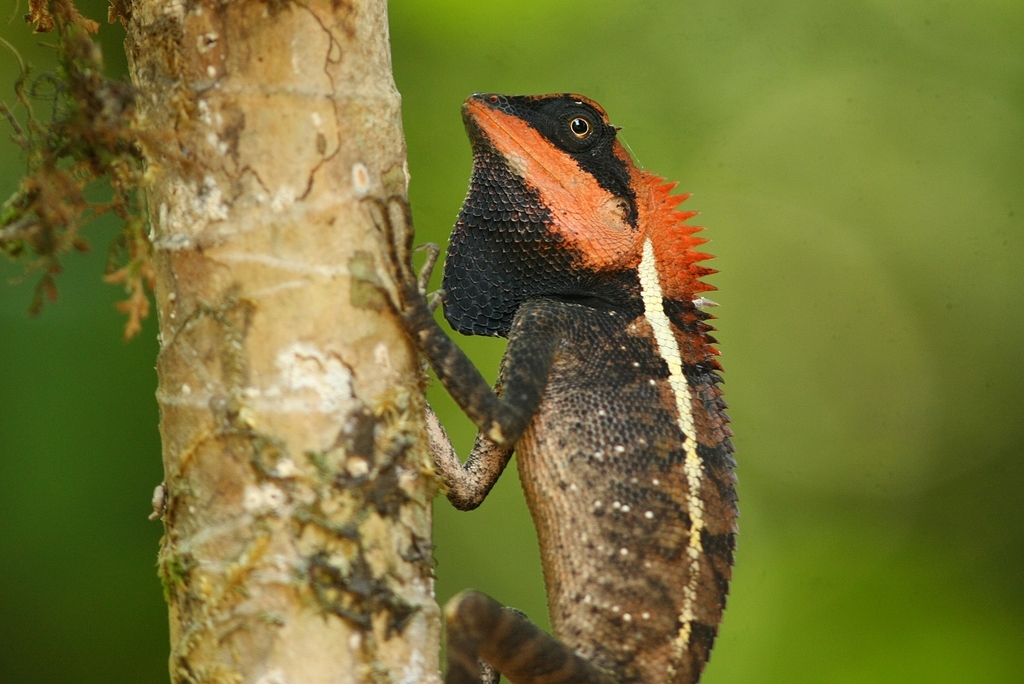
Forest Garden Lizard
Calotes emma
Calotes emma, commonly known as the forest garden lizard or Emma Gray's forest lizard, is a species of lizard in the family Agamidae. The species is native to China, South Asia, and Southeast Asia. There are two recognized subspecies.
From the article Calotes emma on Wikipedia (CC BY-SA), quoted section by section
Description
C. emma has the following morphology. Physical Structure: There are three small groups of spines, completely separate from each other, on each side of the head, one behind the superciliary margin and two above each tympanum. The dorsal crest is well developed on the neck and on the anterior part of the trunk, gradually disappearing behind. There is a transverse fold in front of each shoulder, and the gular sac is but little developed. The tail is laterally compressed. There are about 51 series of scales round the middle of the trunk. Color pattern: The dorsum is brownish olive, with brown bands across the back, which are lighter in the middle and interrupted by a white band running along each side of the back. The eyelids have short, radiating brown streaks. There is a brown band from behind the eye to above the tympanum. The fold before the shoulder is black, with an irregular white margin. The legs and tail have indistinct dark crossbands. The maximum total length (including tail) is 40 cm (16 in). The usual total length is 28 cm (11 in), and the usual snout-to-vent length (SVL) a 7.5 cm (3.0 in).
Range & habitat
C. emma is found in Bangladesh (Satchari National Park, Bandarban Hill District), Cambodia, China (Guangdong, Yunnan), India (Assam), Laos, Malaysia (Peninsular), Myanmar, Thailand (including Phuket) & Vietnam (including Pulo Condore Islands) and Possibly in Bhutan. "An inhabitant of Mergui, whence we have received it from Professor Oldham, ranging northwards perhaps to the Khasya Hills; extremely doubtful as an inhabitant of Afghanistan. Mr. Blyth mentions it amongst a collection made by Captain Bedmore at Schwe Gyen on the Sitang River in Pegu".
Wikipedia: “Geographic range”
What it does
C. emma is terrestrial, arboreal, and diurnal. It inhabits various forest habitats including dry deciduous, coastal, and moist evergreen.
Wikipedia: “Behavior and habitat”
At the table
C. emma is used in the pet trade. It plays a role in the ecosystem by eating various types of insects and otherwise.
Wikipedia: “Human uses”
In human culture
The specific name, emma, is in honor of English conchologist Maria Emma Gray, the wife of John Edward Gray, the describer of this species.
Wikipedia: “Etymology”
Where it lives
Recorded sightings
—
geo-referenced records in GBIF, from museums, herbaria and field observers.
Drag the globe to turn it. Dots are where records exist, not a range map; darker means more records.
In the stacks
Searching the stacks…
Every page naming Calotes emma in the Biodiversity Heritage Library →
This page is assembled live from iNaturalist, GBIF, Wikipedia, the Source Library and the Internet Archive. It is not yet part of the hand-edited codex. iNaturalist taxon 31271.