- Animals
- ›Chordates
- ›Vertebrates
- ›Reptiles
- ›Snakes and Lizards
- ›Lizards
- ›Iguanas and Allies
- ›Dragons and Chameleons
- ›Dragons
- ›Bearded Dragons, Water Dragons, and Allies
- ›Ctenophorus
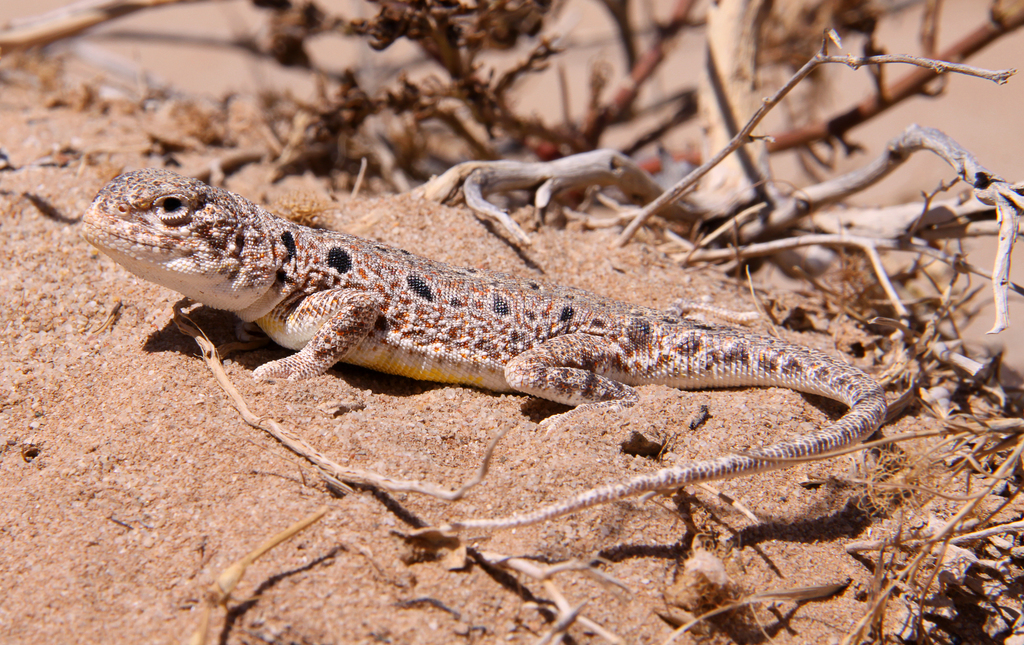
Lake Eyre Dragon
Ctenophorus maculosus
Ctenophorus maculosus, commonly known as the Lake Eyre dragon or salt-lake ground-dragon, is a species of agamid lizard endemic to South Australia. C. maculosus mainly inhabits the edges of salt lakes in South Australia, from which its common names are derived. It survives in this harsh habitat through adaptive mechanisms to tolerate high temperatures and lack of free water. The female C. maculosus possesses unique male rejection techniques which are currently the focus of further research.
From the article Ctenophorus maculosus on Wikipedia (CC BY-SA), quoted section by section
Description
C. maculosus can be identified by a white to pale grey dorsal surface with black blotches and a white ventral surface with a dark longitudinal dark streak. Black and brown spots are observed throughout its body. This cryptic coloration allows the species to blend into the salt surface it inhabits, and color variations are found depending on the specific population's environment. The adult male is about 11.5 cm (4.5 in) long (including tail), and the adult female is slightly shorter at 10.0 cm (3.9 in). C. maculosus possesses small, sunken eyes protected by serrated eyelids and eye linings. Its nostrils are connected to its nasal cavity by only a narrow downward slit. This nasal structure is adaptive for preventing nasal blockage from burrowing in sand. Other sand-burrowing American lizards have also developed similar nasal structures via convergent evolution, including species in the genera Uracentron, Holbrookia, and Phrynosoma.
Range & habitat
C. maculosus is endemic to the three largest dry salt lakes of inner South Australia (Lake Eyre, Lake Callabonna, and Lake Torrens), with the densest population found in Lake Eyre. Three habitat characteristics characterize its distribution: a surface crust, a thick layer of dry sand or clay under the crust, and a constant source of humidity. This dragon lizard inhabits the edges of the lakes where it burrows in the damp sediments under the salt crust.
Wikipedia: “Distribution and habitat”
What it does
The main food source for C. maculosus is the harvest ant Melophorus. The nest-mounds of these ants provide an additional benefit to the dragon lizard as lookout points, basking sites, and sources of shade. C. maculosus is an opportunistic feeder, also feeding on other insects trapped on the salt surface.
Wikipedia: “Diet”
Where it lives
Recorded sightings
—
geo-referenced records in GBIF, from museums, herbaria and field observers.
Drag the globe to turn it. Dots are where records exist, not a range map; darker means more records.
In the stacks
Searching the stacks…
Every page naming Ctenophorus maculosus in the Biodiversity Heritage Library →
This page is assembled live from iNaturalist, GBIF, Wikipedia, the Source Library and the Internet Archive. It is not yet part of the hand-edited codex. iNaturalist taxon 31228.